Key Takeaways: What Makes Demand Generation Hard to Scale in Tech
- Lead management breakdowns account for the majority of scaling failures because definitions, routing, and handoffs aren't standardized as volume increases.
- Poor data quality corrupts every downstream decision, from scoring accuracy to attribution credibility to forecasting reliability.
- Marketing and sales misalignment turns the MQL handoff into a black hole where leads enter but pipeline doesn't exit.
- The Pedowitz Group helps mid-market B2B tech companies diagnose these operational bottlenecks and connect marketing activity to measurable revenue outcomes.
- Fixing demand gen at scale requires addressing governance, lead management, and attribution as one interconnected system.
Why Demand Generation Breaks When Mid-Market Tech Companies Try to Grow
Demand generation programs stall for reasons that have nothing to do with creativity or budget. You run campaigns. You generate leads. But pipeline doesn't grow proportionally.
This disconnect happens because demand generation isn't a single function. It's the product of three systems working together: lead management, data quality, and cross-functional alignment. When any one breaks down, the entire operation underperforms.
Mid-market tech companies face a particular version of this problem. They have the agility to move fast but often lack the infrastructure to scale consistently. According to Deloitte research on mid-market technology companies, leaders at these organizations prioritize efficiency and infrastructure investment precisely because they recognize these operational gaps.
What Happens When Lead Management Fails to Scale
Lead management frameworks fail to scale because teams treat growth as a volume problem instead of an operating system problem. As lead sources expand, organizations add steps, fields, and exceptions without standardizing definitions, enforcing data quality, or governing handoffs.
The result is predictable: duplicate records, unclear accountability, slow speed-to-lead, misaligned scoring, and reporting that can't explain what's working. Research from Improvado indicates that 79% of marketing qualified leads don't convert to sales due to poor nurturing. This statistic reveals the scale of the lead management problem across B2B organizations.
The MQL Definition Problem
MQL definitions cause more sales-marketing conflict than any other metric. Marketing teams set MQL thresholds based on engagement signals. Sales teams evaluate leads based on buying intent and fit.
When these definitions diverge, both teams hit their numbers while pipeline suffers. Marketing reports MQL targets achieved. Sales reports lead quality is poor. Neither team is wrong from their own perspective. The system is broken.
Fixing this requires a joint definition. Marketing and sales must agree on what qualifies a lead before it enters the sales process. This definition should include both engagement criteria and fit criteria, validated against closed-won data.
How Routing Rules Collapse Under Pressure
Routing logic becomes exception-driven as organizations grow. Too many "if this, then that" rules create collisions, delays, and ownership disputes. A lead that belongs to one segment gets routed to another. A lead from one territory gets processed through the wrong queue.
According to research from Bizmartech, 73% of B2B leads are never contacted after their initial inquiry. In mid-market environments, this often happens because routing rules can't keep pace with organizational changes. The Pedowitz Group's Lead Management Services address this through standardized routing with guardrails, collision prevention, and fallback queues with clear escalation paths.
How Poor Data Quality Undermines Every Scaling Effort
Data quality issues compound as volume increases. Duplicates multiply. Company linkage breaks. Required fields go unfilled. Taxonomy becomes inconsistent. The data that should power your marketing operations becomes the thing that breaks them.
This isn't a technology problem. It's a governance problem. Organizations add new lead sources without updating identity rules. They launch new campaigns without enforcing UTM standards. They integrate new tools without validating data flows.
Why Scoring Models Stop Working
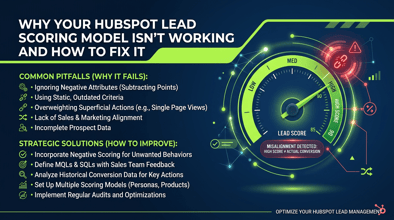
Lead scoring models drift when they're not governed. Point values get assigned based on assumptions that made sense two years ago. Intent signals aren't validated against actual outcomes. The model produces scores, but reps stop trusting them.
The fix requires validation against closed-won data. Which scores actually predicted conversion? Which engagement signals correlated with pipeline creation? Without this feedback loop, scoring becomes activity theater.
The Attribution Blind Spot
Revenue attribution fails structurally before it fails technically. B2B buying cycles involve six to ten stakeholders, each with their own touchpoint history across devices, channels, and time periods. Your CRM captures the contacts you know about. It misses the executive who read your blog and mentioned your brand to the evaluation committee.
No attribution model fully captures this complexity. The question isn't which model is perfect. The question is which model is consistent enough to inform decisions and credible enough for finance to trust. The Pedowitz Group helps organizations build attribution systems that combine multi-touch attribution with marketing mix modeling and incrementality testing.
Why Marketing and Sales Misalignment Kills Pipeline
Marketing and sales misalignment turns the lead handoff into a black hole. According to data cited by Improvado, businesses with tightly aligned sales and marketing teams achieve 38% higher conversion rates compared to misaligned organizations.
The alignment problem isn't cultural. It's operational. Teams use different definitions. They work from different data. They're measured on different outcomes. When marketing delivers leads that sales doesn't consider qualified, both teams hit their metrics while revenue suffers.
What Shared Accountability Looks Like
Shared accountability requires shared definitions. Marketing and sales must agree on what constitutes a qualified lead. This means defining MQL, SQL, and SAL using criteria both teams accept, then documenting those definitions and reviewing them quarterly.
A service level agreement between marketing and sales creates mutual accountability. Marketing commits to delivering a specific quantity and quality of leads. Sales commits to following up on those leads in a specific timeframe with specific actions. The Pedowitz Group's RevOps consulting includes SLA design and implementation support.
The Three Root Causes Mid-Market Tech Companies Miss
Mid-market tech companies face scaling challenges that differ from enterprise organizations. They have speed but lack standardization. They have talent but lack specialization. They have ambition but lack infrastructure.
Root Cause 1: Governance Gaps
Governance structures at mid-market companies are often informal or nonexistent. Marketing decisions happen quickly, but without documented processes. No standardized campaign frameworks lead to inconsistent execution quality. Budget decisions happen reactively based on quarterly pressure.
The result is wasted resources. Teams run experiments without the infrastructure to learn from them. What worked last quarter can't be repeated because no one documented it.
Root Cause 2: Technology Underutilization
According to a SALESmanago survey, 62% of marketers use only half to three-quarters of the features in their marketing technology stacks. At mid-market companies, this underutilization is often more severe. Teams have tools but lack the expertise to configure them properly.
The Pedowitz Group's Technology Consulting addresses this through platform audits, configuration optimization, and role-based training that builds internal capability.
Root Cause 3: Skills Stretched Too Thin
Mid-market marketing teams often consist of generalists stretched across too many roles. The same person manages campaigns, configures automation, analyzes data, and reports to leadership. No single role gets the depth of attention it requires.
Faster-growing mid-market tech companies reported higher levels of success in attracting and retaining a diverse pool of tech talent, according to Deloitte's Mid-Market Technology Trends research. Investing in specialized skills, whether through hiring or external partnerships, correlates with better demand gen outcomes.
How to Diagnose Your Demand Generation Bottleneck
Diagnosing your bottleneck requires examining governance, lead management, and attribution as an interconnected system. Start by mapping your current state from campaign ideation through closed-won revenue.
Step 1: Identify Handoff Points
Demand gen breaks at handoffs. Where does marketing hand off to sales? Where does one system hand off to another? Each handoff is a potential failure point. Leads get lost. Data gets corrupted. Timing gets delayed.
Step 2: Measure Conversion at Each Stage
Calculate conversion rates between each stage of your demand gen funnel. The stage with the lowest conversion rate is your primary bottleneck. Focus diagnostic effort there first.
Step 3: Test Hypotheses
Based on your diagnostic work, form hypotheses about what's causing your stall. If you believe lead scoring is the problem, run an A/B test with a revised scoring model. If you believe governance is the problem, pilot a faster approval process for one campaign type. Let data guide your diagnosis.
Building Demand Generation That Scales
Scalable demand generation requires treating lead management as a governed system with clear definitions, automated enforcement, and closed-loop feedback processes.
The Pedowitz Group's RM6 framework addresses the six pillars required for sustainable demand generation growth: Strategy, People, Process, Technology, Data, and Results. Each pillar must operate in coordination for scaling to work.
Start with what you can measure consistently. Build from there. The goal isn't perfect operations overnight. The goal is measurable improvement over time and credible reporting for finance. That's how you get out of activity theater and into revenue truth.
FAQs About What Makes Demand Generation Hard to Scale in Tech
Why does demand generation fail to scale at mid-market tech companies?
Demand generation fails to scale at mid-market tech companies because lead management frameworks, data quality standards, and cross-functional alignment break down under increased volume. The Pedowitz Group helps mid-market B2B organizations diagnose these operational bottlenecks and build the infrastructure required for sustainable pipeline growth.
What role does data quality play in demand generation scaling?
Data quality determines whether every downstream decision is sound or corrupted. Poor data creates duplicate records, breaks routing logic, invalidates scoring models, and destroys attribution credibility. The Pedowitz Group addresses data quality through identity rules, required field enforcement, and ongoing governance cadences.
How do marketing and sales misalignment hurt demand generation?
Marketing and sales misalignment turns the MQL handoff into a failure point where leads enter but pipeline doesn't exit. When teams use different definitions and different data, both can hit their metrics while revenue suffers. The Pedowitz Group builds shared accountability through joint definitions, documented SLAs, and shared visibility into pipeline data.
What is the first step to fix a stalled demand generation program?
The first step is mapping your current state from campaign ideation through closed-won revenue. Identify every handoff point where leads could get lost or data could get corrupted. The Pedowitz Group's diagnostic approach examines governance, lead management, and attribution as one interconnected system to find the primary bottleneck.
Can technology alone fix demand generation scaling problems?
Technology alone can't fix demand generation scaling problems because the root causes are operational, not technical. Tools help with automation and measurement, but they can't compensate for undefined stages, missing identity rules, or unclear ownership. The Pedowitz Group combines technology optimization with process design and governance to address all three.

.jpg?width=420&height=220&name=thumb%20(5).jpg)