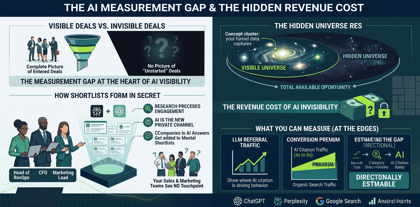
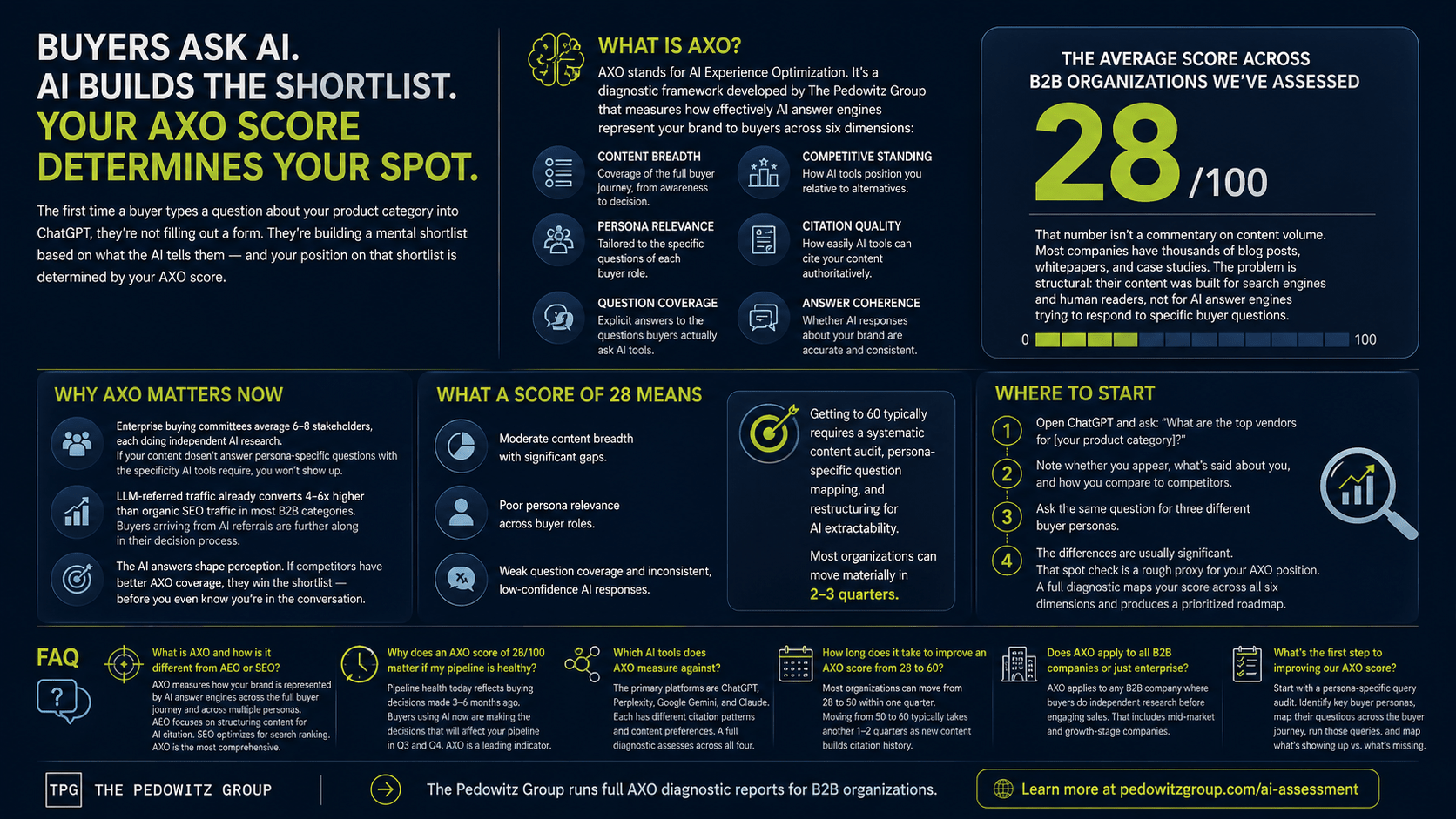
The first time a buyer types a question about your product category into ChatGPT, they're not filling out a form. They're not talking to your BDR. They're building a mental shortlist based on what the AI tells them — and your position on that shortlist is determined by your AXO score.
AXO stands for AI Experience Optimization. It's a diagnostic framework developed by The Pedowitz Group that measures how effectively AI answer engines represent your brand to buyers across six dimensions: content breadth, persona relevance, question coverage, competitive standing, citation quality, and answer coherence.
The average score across B2B organizations we've assessed is 28 out of 100.
That number isn't a commentary on content volume. Most of these companies have thousands of blog posts, whitepapers, and case studies. The problem is structural: their content was built for search engines and human readers, not for AI answer engines trying to respond to specific buyer questions.
Why AXO Matters Now
Enterprise buying committees average six to eight stakeholders, each doing independent AI research. A VP of Finance is asking different questions than a CTO or a Head of Marketing Operations. When each of those buyers asks an AI tool about your category, they're getting answers shaped by what your content ecosystem can supply.
If your content doesn't answer persona-specific questions with the specificity AI tools require for confident citation, you won't show up. Or worse, you'll show up with a generic, low-confidence response that positions you behind a competitor with better AXO coverage.
LLM-referred traffic already converts four to six times higher than organic SEO traffic in most B2B categories. The buyers arriving from AI referrals are further along in their decision process. They've already heard that you're a credible answer to their problem. That's a fundamentally different conversation than a cold inbound.
The Six Dimensions of AXO
Content breadth measures whether your content covers the full range of questions across the buyer journey, from early-stage problem framing to late-stage vendor comparison. Most companies have depth in a few areas and large gaps elsewhere.
Persona relevance measures whether your content is tailored to specific buyer roles. A CFO has different questions than a CMO. A CISO has different questions than a VP of Sales. Content written for "the buyer" in aggregate fails this dimension.
Question coverage tracks whether your content explicitly answers the questions buyers type into AI tools. This is not the same as covering topics. It's about structured, extractable answers to specific questions.
Competitive standing measures how AI tools position your brand relative to alternatives when buyers are doing vendor comparisons.
Citation quality assesses whether your content is structured in ways that make it easy for AI tools to cite authoritatively — specific data, clear claims, direct answers.
Answer coherence measures whether the AI's synthesized response about your brand is accurate, consistent, and representative of your actual positioning.
What a Score of 28 Means
At 28 out of 100, a company typically has moderate content breadth, poor persona relevance, and weak question coverage. The AI tools that buyers use can find some information about the company, but it's thin, inconsistent across persona types, and frequently positions competitors more favorably.
Getting to 60 typically requires a systematic content audit, persona-specific question mapping, and restructuring existing content for AI extractability. It's not a six-month project. Most organizations can move materially in two to three quarters with the right approach.
Where to Start
The fastest diagnostic is also the most direct. Open ChatGPT and ask: "What are the top vendors for [your product category]?" Note whether you appear, what's said about you, and how you compare to competitors. Then ask the same question framed for three different buyer personas. The differences are usually significant.
That spot check is a rough proxy for your AXO position. A full diagnostic maps your score across all six dimensions and produces a prioritized roadmap for improvement.
FAQ
- What is AXO and how is it different from AEO or SEO? AXO (AI Experience Optimization) measures how your brand is represented by AI answer engines across the full buyer journey and across multiple buyer personas. AEO (Answer Engine Optimization) focuses on structuring individual content pieces for AI citation. SEO optimizes for search engine ranking. AXO is the most comprehensive of the three, measuring systemic brand representation rather than individual content performance.
- Why does an AXO score of 28/100 matter if my pipeline is healthy right now? Pipeline health today reflects buying decisions made three to six months ago. Buyers using AI tools for research now are making the decisions that will affect your pipeline in Q3 and Q4. AXO is a leading indicator, not a lagging one.
- Which AI tools does AXO measure against? The primary platforms are ChatGPT, Perplexity, Google Gemini, and Claude. Each has different citation patterns and content preferences. A full AXO diagnostic assesses your representation across all four.
- How long does it take to improve an AXO score from 28 to 60? Most organizations can move from 28 to 50 within one quarter with focused content restructuring. Moving from 50 to 60 typically takes another one to two quarters as new content builds citation history. The fastest gains usually come from persona relevance and question coverage improvements.
- Does AXO apply to all B2B companies or just enterprise? AXO applies to any B2B company where buyers do independent research before engaging sales. That includes mid-market and growth-stage companies. The complexity of the fix scales with the size of the buying committee and the breadth of the product line.
- What's the first step to improving our AXO score? Start with a persona-specific query audit. List the three most important buyer personas in your ICP. For each, write ten questions they would type into ChatGPT at early, mid, and late buyer journey stages. Run those queries. Map where your content shows up, what it says, and what's missing. That audit tells you exactly where to prioritize.
The Pedowitz Group runs full AXO diagnostic reports for B2B organizations. Learn more at pedowitzgroup.com/ai-assessment.