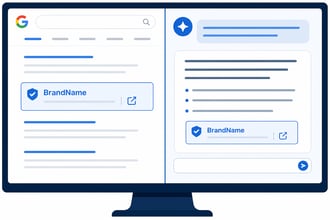
For most of the last fifteen years, the central question of B2B content strategy has been a search question: how do we rank for the terms our buyers are searching?
That question drove content architecture, editorial calendars, keyword strategies, and the entire infrastructure of modern content marketing. It produced content programs that are genuinely good at one job: earning visibility in search engines.
The problem is that an increasing share of B2B buyer research is not happening in search engines. It is happening in AI answer tools. And the content that performs best in search often performs poorly in AI research, because those two channels have different structural requirements that most content teams have not yet addressed.
Understanding the difference between SEO content and AEO content, and knowing how to build for both, is one of the most important content strategy shifts B2B marketing teams need to make right now.
What Search Engines Reward
Search engines evaluate content on signals that favor comprehensiveness, authority, and topical coverage. A well-optimized piece of content for search typically covers a topic thoroughly, links internally to related content, earns external references that signal authority, and treats the reader as someone with time to explore a subject.
The content that wins in search is often long, detailed, and structured around topic clusters rather than specific questions. It builds to its conclusions through context and evidence. It rewards the reader who engages deeply.
These are genuine virtues. Comprehensive, authoritative content serves readers well and earns sustainable search visibility. The investment in building it is real and durable.
But it is built for a reader who searches for a topic and has time to read. That is a specific kind of research behavior. It is not the only kind.
What AI Answer Engines Reward
AI answer engines are synthesizing responses to specific questions asked by specific people. They are not ranking resources. They are extracting answers.
When a VP of Finance types "what should I know about implementation risk before approving budget for a revenue marketing platform" into Perplexity, the AI tool is scanning available content for the most direct, specific, and credible answer to that question. It extracts from the opening sentences of relevant sections. It prioritizes content that states the answer first and provides supporting evidence second. It weights specific, quantified claims over vague qualitative assertions.
The structural requirements of content that performs well in AI research are meaningfully different from the requirements of content that performs well in search.
Direct answer first. The answer to the question a section is addressing must appear in the first sentence of that section, not after context, background, or setup.
Specific claims. Every key assertion needs a number, a timeframe, or a named scenario attached to it. Quantified claims are citable. Qualitative claims are not.
Persona framing. Content that explicitly addresses a specific buyer role, "for a CFO evaluating this category" rather than "for buyers considering this solution," is more likely to be cited for persona-specific queries.
Question-based structure. Content organized around the specific questions buyers ask performs better in AI research than content organized around topics or themes.
Why Your Best SEO Content Often Produces Thin AI Answers
The disconnect is not about content quality. It is about structural alignment with the job each channel is trying to do.
A pillar page that comprehensively covers revenue marketing for search purposes likely contains excellent answers to many specific buyer questions. But if those answers are distributed throughout a 3,000-word document rather than surfaced at the top of relevant sections, AI tools will frequently fail to extract them confidently.
The answer exists. It is just not where AI tools look for it.
This is why companies with strong search performance often discover, when they first audit their AI research representation, that their most important buyer queries produce thin or generic responses despite the existence of relevant content in their library. The content was structured for a reader who would engage with it. It was not structured for a tool that extracts specific answers from specific locations in the text.
The Restructuring Approach
The good news is that closing the gap between SEO performance and AI citation does not require rebuilding your content from scratch.
For most B2B companies, the majority of the gap can be addressed through restructuring existing content rather than creating new content. This changes the resource equation significantly.
The restructuring process for any existing piece involves three additions that do not require rewriting the substantive content:
Rewrite section openings. For each major section of a high-value piece, identify the question that section is answering. Rewrite the first sentence of that section as a direct answer to that question. Context and supporting evidence follow in subsequent sentences.
Strengthen claim specificity. Review every key claim in the piece. Replace qualitative language with quantified language wherever the underlying data supports it. "Significant improvement" becomes a specific percentage. "Many companies" becomes a specific company type with a specific outcome. "Faster time to value" becomes a specific timeframe.
Add FAQ structure. At the end of high-value pages, add a FAQ section with questions phrased exactly as a buyer would type them into an AI tool. Each answer should be two to three sentences maximum and should open with the direct answer.
These additions transform the AI citation potential of existing content without disrupting the structural and authority signals that drive search performance. In most cases, they improve search performance as well, because direct-answer structure is increasingly rewarded by Google's own algorithms.
Building for Both Channels
The goal is not to choose between SEO and AEO. It is to build content that performs well in both channels, capturing buyers wherever their research behavior takes them.
The buyers who still primarily use search engines are served by comprehensive, well-structured, authoritative content. The buyers who are increasingly starting their research in AI tools are served by the same content when it is restructured to surface direct answers, specific claims, and persona-specific framing.
The compound advantage goes to companies that do both deliberately. Strong domain authority and strong answer structure together produce better AI research representation than either alone.
Most B2B companies are currently running a content strategy optimized for one of these channels. The ones that restructure for both over the next two to three quarters will have a meaningful advantage over competitors who address the gap later.
FAQ
- Will restructuring my SEO content for AEO hurt my search rankings? In most cases no, and in many cases it will help. Adding direct-answer openings, specific data points, and FAQ sections to existing content aligns with Google's increasing preference for content that directly answers user queries. The substantive content and structural signals that drive search rankings are not disrupted by these additions.
- How do I know which content to restructure first? Start with your highest-traffic pages for queries that are also likely to be run by senior buying committee members in AI tools. The overlap between high-search-traffic pages and high-buyer-intent AI queries is your highest-priority restructuring set. Run your top five pages through a quick AI audit to identify which have the biggest gap between search performance and AI citation.
- How long does it take for restructured content to improve AI citation? Well-structured content typically starts appearing in AI responses within two to four weeks of restructuring. Meaningful improvement in persona-specific query coverage usually develops over six to ten weeks. Restructuring existing high-authority pages produces faster results than publishing new content because the authority signals are already established.
- What is the difference between AEO and AXO? AEO, Answer Engine Optimization, refers to structuring individual content pieces for AI citation. AXO, AI Experience Optimization, is a broader framework that assesses and optimizes how AI tools represent your brand across the full buyer journey, including persona relevance, competitive standing, and answer coherence across all your content. AEO is one component of a full AXO program.
- Does AEO apply to all content types or just blog posts? AEO principles apply to any content that is publicly accessible and that AI tools can index: blog posts, landing pages, case studies, whitepapers, FAQ pages, and about pages. The highest-leverage restructuring work typically starts with blog posts and landing pages because they tend to have the most buyer-relevant content and the most existing traffic.
- How do I measure whether my AEO restructuring is working? Track two signals: AI citation coverage through periodic manual query audits running your most important buyer queries in ChatGPT and Perplexity every two weeks, and LLM-referred traffic in GA4 by monitoring referral traffic from perplexity.ai, chat.openai.com, claude.ai, and gemini.google.com. Improvement in manual audit scores over time is the primary signal. Growth in LLM-referred traffic is the conversion signal that confirms the citation is generating clicks.