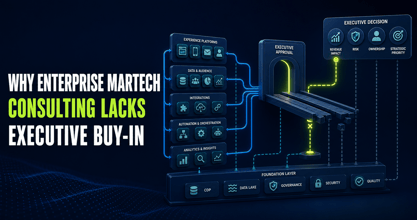
Enterprise MarTech integration projects fail at alarming rates. Not because the technology doesn't work, but because organizations scope the visible technical work while ignoring the organizational, data, and process dependencies that consume 70-80% of actual effort. That gap between what gets planned and what gets required is where integration timelines collapse.
This guide gives you a revenue-focused framework for scoping integration dependencies before your next platform project begins. The Pedowitz Group's MarTech integration consulting has helped enterprise marketing leaders navigate these hidden complexities across 600+ technology platforms. The methodology below reflects patterns observed across hundreds of implementations.
Key Takeaways: How to Scope Enterprise MarTech Integrations in 2026
- Technical connectivity represents only 20-30% of total integration effort; organizational readiness drives the remaining 70-80%.
- Data quality issues cause more integration delays than API complexity or platform limitations.
- The Pedowitz Group's vendor-neutral approach helps enterprise teams avoid scoping blind spots caused by platform bias.
- Cross-functional governance decisions around data ownership add two to six weeks to most enterprise projects.
- Scoping that starts with organizational readiness instead of technical feasibility prevents the timeline failures that plague most integration efforts.
Why Enterprise MarTech Integration Scoping Fails
The average enterprise B2B company runs 91 marketing technology tools. Most were purchased in isolation, implemented by different vendors, and have never shared a clean data layer. When integration projects begin, teams estimate timelines based on what they can see: API connections, field mapping, and test cycles.
That visible work accounts for roughly a quarter of actual project effort. The invisible work—data preparation, governance alignment, process redesign, and user adoption—accounts for everything else. According to research from MarTech360, up to 60% of MarTech initiatives fail to deliver expected return on investment. The failure isn't technical. It's organizational.
The Five Hidden Workstreams in Every Integration Project
Every enterprise MarTech integration contains five workstreams that rarely appear in initial project plans. Miss any of them, and your timeline doubles. Miss several, and the project stalls entirely.
1. Data Quality Remediation
Your marketing automation platform connects to your CRM. Data flows in both directions. Then you discover that 40% of contact records have inconsistent field formatting, duplicates exist across systems, and historical data contains gaps that break automated workflows.
Data cleansing, deduplication, and standardization work typically doubles or triples integration timelines. Most B2B databases degrade at 22-30% annually through job changes, company restructuring, and data entry inconsistency. Scope this work explicitly, or watch it consume your buffer.
2. Governance and Ownership Decisions
Before systems can connect, you need answers to questions that cut across organizational boundaries. Who owns the customer record when marketing, sales, and service all touch it? Which system serves as the source of truth for contact information? Who approves changes to field mappings that affect downstream reporting?
These governance questions require alignment between marketing leadership, IT, sales operations, and often legal and compliance teams. Enterprise integration projects that skip governance planning add two to six weeks mid-project when these conflicts surface.
3. Process Alignment and Redesign
Integration isn't just about connecting systems. It's about connecting the processes those systems support. Your marketing team follows one lead qualification process. Sales uses different criteria. Service has its own definitions for customer status. Integration forces these differences into the open.
Making systems work together without creating fragmentation requires process redesign, not just data mapping. This work can't happen in parallel with technical integration. It must happen before, or the technical work will need to be redone.
4. Change Management and User Adoption
A CRM integration project that technically succeeds but that sales teams refuse to use produces zero return on investment. User adoption requires training programs tailored to specific roles, communication that explains benefits rather than just announcing changes, and ongoing support as users encounter real-world scenarios.
Teams that skip change management often complete technical work on schedule only to find that adoption takes another three to six months of effort. Scope it from the start.
5. API Limits and Performance Optimization
Every marketing platform imposes limits on API usage. Exceed those limits and your integration fails or gets throttled. Initial testing with small data volumes may succeed while production volumes trigger limits you didn't anticipate.
Working within API limits requires batching operations, scheduling non-critical updates during off-peak hours, and implementing retry logic for failed calls. Factor these constraints into architecture decisions early. Discovering limits during production cutover forces timeline extensions while you redesign data flows.
How to Build an Integration Dependency Map
Before any consulting partner or internal team touches a single integration, they should produce a complete map of your existing stack. This diagnostic layer is what every subsequent decision depends on.
Step 1: Platform Inventory With Contract and Renewal Dates
Document every active platform in your MarTech stack. Include contract renewal dates, because an integration that connects to a platform being replaced in six months is wasted work. Note primary functions, data each tool handles, and current utilization levels.
Step 2: Data Flow Mapping Between Systems
Map every data connection that exists today. Identify where data flows automatically versus where teams export and import spreadsheets manually. Manual processes are hidden integration requirements waiting to surface.
Step 3: Gap and Redundancy Analysis
Identify where connections should exist but don't, and where multiple tools perform the same function. Redundancies create conflicting data. Gaps create manual workarounds. Both extend timelines when discovered mid-project.
Step 4: Downstream Dependency Assessment
For each planned integration, identify what else depends on the systems being modified. A MAP-CRM integration affects lead routing, attribution reporting, and sales workflows. If those dependencies aren't scoped, changes in one area break processes in others.
The Revenue-Focused Scoping Framework
Integration scoping that focuses only on technical connectivity misses the point. The reason organizations build unified MarTech stacks is to improve pipeline quality, accelerate sales cycles, and produce revenue more efficiently. A revenue-focused framework starts with business outcomes and works backward to technical requirements.
Define Revenue Outcomes Before Technical Requirements
What specific revenue outcomes does this integration need to produce? Faster lead response times? Cleaner attribution data? Reduced duplicate records reaching sales? Define the measurable outcome first, then identify what systems need to connect to achieve it.
Map Integration Requirements to Buying Committee Roles
Enterprise deals involve multiple stakeholders with different information needs. Economic buyers need ROI data. Technical evaluators need architecture details. End users need workflow impact assessments. Scope integration requirements against what each buying committee role needs from the connected systems.
Prioritize by Pipeline Impact
Not all integrations carry equal weight. The connection between your MAP and CRM directly affects pipeline velocity. The connection between your survey tool and email platform affects campaign personalization. Sequence integration work by proximity to revenue, not by technical convenience.
Cross-Functional Alignment: Who Needs to Be in the Room
Integration projects touch multiple departments with different priorities, budgets, and timelines. According to research, 47% of marketing teams only collaborate with IT, sales, and customer service occasionally or rarely. This limited collaboration extends timelines because alignment conversations happen sequentially rather than in parallel.
Marketing Operations
Owns the marketing automation platform, lead scoring models, and campaign execution workflows. Any integration that touches lead routing, nurture programs, or attribution requires marketing ops approval on field mappings and sync rules.
Sales Operations
Owns the CRM, opportunity management processes, and pipeline reporting. Any integration that writes data to CRM or changes how leads appear to sales requires sales ops agreement on lifecycle stages and handoff definitions.
IT and Security
Owns API access, security protocols, and data compliance requirements. Any integration that moves customer data between systems requires IT review of authentication methods, encryption standards, and data residency requirements.
Revenue Leadership
Owns the definitions of pipeline stages, qualified opportunities, and revenue attribution. Integration projects that affect how revenue gets measured require alignment from both marketing and sales leadership before technical work begins.
The Pedowitz Group's RevOps consulting brings these stakeholders together early. Regular collaboration prevents the back-and-forth that adds weeks to every decision point.
Realistic Timeline Estimation: The 3X Rule
Take your initial technical estimate and multiply by three. That adjusted number accounts for the organizational work that technical scoping ignores. Here's why the multiplier works.
Technical Work: 20-30% of Total Effort
API connection establishment, field mapping configuration, and basic testing represent the smallest portion of actual project effort. This is the work most teams estimate accurately.
Data Preparation: 30-40% of Total Effort
Data cleansing, deduplication, normalization, and initial data loads. This work is invisible during planning because teams assume their existing data is ready for integration. It rarely is.
Organizational Alignment: 30-40% of Total Effort
Governance decisions, process alignment, change management, and user training. This work extends across departmental boundaries and depends on schedules you don't control.
The Integration Scoping Checklist
Before your next enterprise integration project begins, validate that your scope includes answers to these questions.
Data Readiness Questions
- What percentage of records in the source system have complete, accurate data in required fields?
- What duplicate detection and resolution process exists in each system?
- What data transformation rules are needed between source and target systems?
- Who owns data quality monitoring after the integration goes live?
Governance Questions
- Which system is the source of truth for each data type?
- Who approves changes to field mappings after initial deployment?
- What escalation path exists when sync conflicts occur between systems?
- What data privacy and compliance requirements apply to data moving between systems?
Process Alignment Questions
- What business processes depend on the systems being integrated?
- How will those processes change when the integration goes live?
- What training do users need before the process changes take effect?
- What success metrics define whether the integrated process is working?
Technical Questions
- What API rate limits apply to each system?
- What happens when rate limits are exceeded?
- What monitoring will detect integration failures in real time?
- What maintenance capacity exists for ongoing vendor updates?
Common Scoping Mistakes That Extend Timelines
Enterprise integration projects consistently make the same scoping errors. Recognizing these patterns helps you avoid repeating them.
Assuming Native Connectors Meet All Requirements
Many MarTech vendors promote built-in integrations. The reality: native connectors handle roughly 70% of integration requirements in a typical B2B stack. The remaining 30% requires custom API work, middleware, or manual processes. Validate what native connectors actually support before assuming they meet your needs.
Scoping Without Sales Operations Input
Marketing teams often scope integration projects without meaningful input from sales operations. The result: field mappings that don't reflect how sales actually uses the CRM, lifecycle stages that don't match sales qualification criteria, and routing rules that send leads to the wrong owners. Include sales ops from day one.
Treating Integration as a One-Time Project
Enterprise marketing teams operate dozens of tools. Vendors release changes independently, often on weekly or biweekly schedules. An integration that works today may break silently next month when a vendor updates an API endpoint. Scope ongoing maintenance capacity, not just implementation.
Starting Technical Work Before Governance Agreement
Technical teams often want to begin connecting systems while governance discussions continue. This approach creates rework when governance decisions require changes to already-completed integrations. Wait for governance agreement before starting technical implementation.
How The Pedowitz Group Approaches Integration Scoping
The Pedowitz Group's technology consulting practice applies vendor-neutral assessment across 600+ sales and marketing technologies. This approach identifies integration requirements before procurement decisions lock you into difficult architecture.
Current-State Audit Before Implementation
Every engagement begins with a current-state stack audit and integration dependency map. This diagnostic work must complete before any implementation effort begins. Partners that propose solutions before completing this audit are designing in the dark.
Use-Case-First Architecture
Integration architecture is designed around activation use cases, not data structures. What segments does the marketing team need to build? What triggers need to fire when a profile reaches a certain threshold? What does sales need to see when a buying signal appears? Answer those questions first. Build the data model around the answers.
Documentation and Enablement as Deliverables
The most common reason a MarTech integration degrades within 18 months of launch is the departure of the one person who understood how it worked. Every engagement includes technical documentation of every integration, a runbook for the marketing operations team, and a structured enablement program that transfers knowledge before the engagement closes.
In Conclusion: Scoping Integration Projects for Revenue Outcomes
Enterprise MarTech integration scoping fails when it focuses on technical connectivity instead of organizational readiness. The visible API work is straightforward. The data quality remediation, governance alignment, process redesign, and change management work is where timelines collapse.
Start with revenue outcomes. Map integration requirements to the business processes they support. Include every stakeholder who owns a piece of the connected systems. Multiply your technical estimate by three to account for organizational work. And validate that your scope includes explicit phases for data preparation, governance agreement, and user adoption.
Use integration scoping to surface hidden dependencies. But build the business case on revenue outcomes, shared accountability, and clean operational fundamentals. That's how you get out of reporting theater—and into revenue truth.
FAQs About How to Scope Enterprise MarTech Integrations in 2026
What is enterprise MarTech integration scoping?
Enterprise MarTech integration scoping is the process of identifying all requirements, dependencies, and workstreams needed to connect marketing technology platforms. The Pedowitz Group's scoping methodology covers data readiness, governance decisions, process alignment, and technical requirements before implementation begins.
Why do enterprise MarTech integrations take longer than expected?
Integration projects consistently exceed timelines because initial estimates focus on technical connectivity while overlooking data quality remediation, governance alignment, and change management. These organizational factors consume 70-80% of total integration effort but rarely appear in project plans.
How long should enterprise MarTech integration projects take?
A focused engagement covering MAP-CRM integration with basic data governance typically takes 90-120 days. Full-stack unification covering CDP implementation, identity resolution, and RevOps alignment typically takes 6-12 months. The Pedowitz Group recommends multiplying technical estimates by three to account for organizational work.
What should be included in an integration dependency map?
An integration dependency map includes platform inventory with contract dates, data flow mapping between all systems, gap and redundancy identification, and downstream dependency assessment. The Pedowitz Group delivers this diagnostic within the first 30 days of any enterprise engagement.
Who needs to be involved in integration scoping decisions?
Integration scoping requires alignment between marketing operations, sales operations, IT and security, and revenue leadership. Projects that skip cross-functional alignment add weeks to timelines when governance conflicts surface mid-implementation.
What causes most enterprise MarTech integration failures?
Integration failures stem from three primary causes: partners hired to implement specific platforms rather than design integrated stacks, no data governance layer built before integrations go live, and sales and marketing teams that never aligned on definitions. The Pedowitz Group addresses all three through vendor-neutral assessment and RevOps alignment.
How do I evaluate a MarTech consulting partner for integration projects?
Score partners on current-state audit capability, integration architecture methodology, data governance practice, RevOps alignment services, and post-integration documentation and enablement. The Pedowitz Group recommends requiring named case studies with measurable pipeline or revenue outcomes from comparable engagements.