Enterprise leaders keep approving martech budgets while quietly starving the consulting expertise needed to make those investments work. Marketing technology consulting sits in an awkward middle ground: too expensive to ignore, too intangible for many CFOs to champion.
The result? Companies spend millions on platforms and pennies on implementation strategy. Then they wonder why adoption stalls and revenue impact stays theoretical. This article unpacks why executive buy-in for martech consulting remains stubbornly low and what enterprise marketing leaders can do about it.
Key Takeaways: Why Enterprise MarTech Consulting Lacks Executive Buy-In
- Executive teams often conflate platform purchases with marketing transformation, treating software licenses as substitutes for strategic consulting.
- CMO-to-sales expectation gaps create confusion about what martech consulting should deliver, leaving consultants caught between brand and revenue mandates.
- The Pedowitz Group's revenue marketing approach connects consulting investments directly to pipeline outcomes, not activity metrics that executives dismiss.
- CFOs default to measurable line items over advisory services, making consulting budgets first to get cut during planning cycles.
- Adoption barriers and data silos undermine the ROI story for martech consulting, even when the underlying strategy is sound.
What Causes the Disconnect Between MarTech Spending and Consulting Investment?
Most enterprise organizations have budgets for marketing technology. Few have comparable budgets for making that technology produce revenue. The disconnect is structural, not accidental.
According to The CMO Survey, companies spend 19.9% of marketing budgets on martech, with that figure projected to reach 30.9% within five years. Yet only 56.4% of the martech tools purchased are actually being used. The gap between spending and utilization points to a consulting deficit, not a technology one.
Executives sign off on platforms because platforms have SKUs, contracts, and clear cost structures. Consulting engagements feel murkier. The deliverables are harder to define upfront, the timelines more variable, and the accountability for outcomes less obvious.
Why CMO and Sales Expectation Gaps Complicate Consulting Buy-In
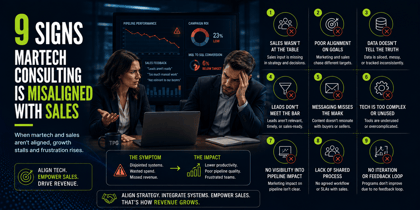
Here's a pattern we see repeatedly: the CMO wants marketing to drive pipeline. The CRO wants sales to close deals without "marketing interference." And the CFO wants both functions to cost less while producing more. Martech consulting lands in the middle of that conflict.
A recent Gartner study found that 62% of organizations define qualified leads differently between sales and marketing. When the two functions can't agree on what success looks like, consulting engagements become battlegrounds rather than strategic investments.
The consulting firm is asked to optimize a system where the operating model itself is broken. This isn't a technology problem. It's an alignment problem that requires executive sponsorship to solve.
How Revenue Goals Get Disconnected from Martech Adoption
The brutal truth: most martech implementations are measured by deployment milestones, not revenue contribution. An IBM study of 1,800 marketing and sales executives found that 54% of respondents underestimated the operational complexity of translating AI and martech strategies into tangible outcomes.
When adoption stalls, executives blame the technology. When revenue doesn't materialize, they blame the marketing team. Rarely does anyone trace the problem back to the absence of strategic consulting at the implementation stage.
Martech platforms don't drive revenue outcomes on their own. Someone has to configure them, integrate them, train teams on them, and optimize them continuously. That's consulting work. But because the value chain is longer and harder to attribute, consulting budgets get deprioritized.
What Makes Enterprise Leaders Underinvest in Consulting Expertise?
There are at least four structural reasons enterprise executives consistently underfund martech consulting:
Software feels concrete; advice feels abstract. A platform license shows up as a line item with predictable costs. A consulting engagement produces recommendations, which require internal execution to generate value. Executives prefer the certainty of the license.
Procurement treats consulting as discretionary. Enterprise procurement categories often classify consulting as professional services, subject to different approval thresholds and budget cycles than technology purchases. This creates friction that platform vendors don't face.
Prior consulting failures create skepticism. Many organizations have been burned by engagements that produced impressive slide decks but minimal operational change. That history makes the next consulting investment harder to justify, even when the business need is clear.
Attribution is nearly impossible. When a martech platform contributes to pipeline, the platform vendor claims credit. When consulting advice improves adoption, the internal team claims credit. The consultant's contribution becomes invisible in the success narrative.
How the Transformation Framing Undermines Consulting Value
Large consultancies often position martech engagements as "digital transformation" initiatives. That framing creates two problems for executive buy-in.
First, transformation implies a destination. Executives expect a project with a clear endpoint and a final deliverable. In reality, martech optimization is ongoing work. When the transformation narrative doesn't match the continuous reality, executives feel deceived.
Second, transformation budgets compete with other enterprise priorities. If marketing's martech consulting sits in the same budget category as ERP migrations and supply chain digitization, it loses. Those projects have clearer financial justifications and more C-suite sponsors.
The Pedowitz Group takes a different approach: connecting marketing technology investments directly to revenue outcomes rather than abstract transformation milestones. This reframes the conversation from "how much will this cost" to "how much pipeline will this produce."
Why Fragmented Operations Block Consulting Effectiveness
Even when executives approve consulting budgets, fragmented internal operations often prevent consultants from delivering value. The IBM study found that only 28% of organizations report their end-to-end customer experience is effectively owned and aligned across functions.
When marketing, sales, and customer success operate in silos, consultants can't optimize the full revenue system. They're limited to fixing pieces of a broken machine while the underlying operating model remains unchanged.
This is why revenue operations alignment has become a prerequisite for effective martech consulting. Without shared accountability for customer outcomes, any consulting engagement hits a ceiling defined by organizational dysfunction.
What Does Effective Executive Sponsorship Look Like?
Martech consulting engagements succeed when they have active executive sponsorship, not passive budget approval. There's a meaningful difference.
Passive sponsorship means a CMO signs off on a consulting contract and expects results to appear. Active sponsorship means the CMO removes organizational barriers, aligns stakeholders around shared outcomes, and holds internal teams accountable for implementing recommendations.
The organizations we see getting value from martech consulting share three characteristics:
Defined revenue accountability. Someone owns the number. Not marketing metrics. Not sales metrics. Revenue outcomes that both functions share responsibility for achieving.
Cross-functional governance. A steering committee with representation from marketing, sales, IT, and finance that meets regularly to evaluate progress and remove blockers.
Commitment to operational fundamentals. Clean data, documented processes, and trained users. Without these basics, sophisticated consulting recommendations can't be implemented.
How to Build the Business Case for MarTech Consulting
If you're a marketing leader struggling to secure consulting budget, start by reframing the request. Don't ask for money to "optimize martech." Ask for investment in closing specific revenue gaps.
Quantify the cost of the current problem. If 44% of your martech stack is unused, calculate the annual license cost of that waste. If lead routing takes three days instead of three hours, estimate the pipeline lost to slow follow-up. Make the pain concrete.
Tie the consulting engagement to a specific outcome. Not "improved martech maturity" but "reduce lead response time from 72 hours to 4 hours by Q3." Executives fund projects with measurable endpoints.
Identify an executive champion beyond marketing. If the CRO cares about pipeline velocity, frame the consulting investment as a sales enablement project. If the CFO cares about reducing marketing waste, frame it as a cost optimization initiative. Speak their language.
Why Vendor-Neutral Expertise Changes the Conversation
Platform vendors offer "consulting" services, but their incentives point toward selling more platform capabilities. Enterprise executives increasingly recognize this conflict. They want advice from firms without a product to push.
The Pedowitz Group maintains vendor-neutral expertise across 600+ sales and marketing technologies precisely because clients need recommendations based on their business requirements, not vendor partnerships. This independence makes consulting recommendations more credible when presented to executive stakeholders.
When executives trust that consultants aren't steering them toward a particular platform, they're more willing to act on strategic recommendations. The perceived objectivity translates into faster decisions and larger budgets.
What Happens When Consulting Investment Gets Delayed
Delaying martech consulting doesn't avoid the cost. It defers and compounds it. Organizations that implement platforms without strategic consulting typically spend 18-24 months discovering problems that experienced consultants would have flagged in week one.
Integration gaps accumulate. Data quality degrades. User adoption stalls. By the time executives recognize the need for outside expertise, they've already absorbed significant sunk costs from a poorly implemented stack.
The comparison isn't "consulting versus no consulting." It's "consulting now versus consulting later after the damage is done." The first option costs less in money, time, and organizational frustration.
In Conclusion: Aligning Consulting Investment with Revenue Outcomes
Executive buy-in for martech consulting remains elusive because the industry hasn't consistently connected consulting work to revenue outcomes. That's changing as organizations adopt revenue operations models that demand cross-functional accountability.
The organizations getting the most value from martech consulting aren't the ones with the biggest budgets. They're the ones with clear revenue objectives, executive sponsors who remove barriers, and operating models that translate consulting recommendations into action.
If you're struggling to secure executive buy-in for martech consulting, stop asking for technology optimization budget. Start asking for revenue acceleration investment. The framing matters as much as the substance.
FAQs About Why Enterprise MarTech Consulting Lacks Executive Buy-In
Why do enterprise executives approve martech platforms but not consulting budgets?
Executives perceive platforms as tangible investments with predictable costs and clear deliverables. Consulting feels more abstract and harder to measure. The Pedowitz Group addresses this by tying every consulting engagement to specific revenue outcomes that executives can track and report.
How does sales and marketing misalignment affect martech consulting ROI?
When sales and marketing define success differently, consultants get pulled in conflicting directions. Effective engagements require alignment on shared metrics before optimization work begins. The Pedowitz Group's RevOps approach establishes that alignment upfront.
What percentage of martech investments actually deliver expected ROI?
Research indicates that up to 60% of martech investments fail to deliver expected returns. The primary causes are poor adoption, integration challenges, and lack of strategic consulting to guide implementation. Only 56.4% of purchased martech tools are actively used.
How can CMOs build a stronger business case for martech consulting?
CMOs should quantify the cost of current problems in revenue terms, tie consulting engagements to specific pipeline outcomes, and secure executive champions beyond marketing. The Pedowitz Group helps clients build data-driven business cases that resonate with CFOs and boards.
What makes vendor-neutral consulting more effective for enterprises?
Vendor-neutral firms like The Pedowitz Group recommend technologies based on client needs, not partner incentives. This objectivity builds executive trust and leads to faster approval of strategic recommendations.