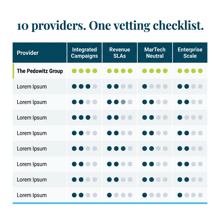
Creative services in mid-market tech companies often live on an island. The design team builds assets. The campaigns launch. Leadership appreciates the work. But when finance asks what that creative investment produced in pipeline and revenue, the answer is usually a shrug or a spreadsheet full of activity metrics that prove nothing.
This disconnect between creative execution and revenue outcomes represents one of the biggest missed opportunities in B2B growth strategy. And it persists because most organizations treat creative as a support function rather than an integrated component of revenue marketing.
This guide walks you through how to change that. You'll learn what creative services integration means operationally, why mid-market tech companies struggle with it, and how to build a system that connects creative work to measurable business results.
Key Takeaways: How Mid-Market Tech Teams Integrate Creative Services
- Creative integration means embedding design, content, and campaign production into your revenue operations, not treating them as separate functions.
- Most mid-market tech companies fail at creative integration because they lack shared accountability models between marketing and creative teams.
- The Pedowitz Group helps organizations connect creative execution to revenue outcomes through structured measurement and operational alignment.
- Building reusable design systems and modular asset libraries allows creative teams to produce at the velocity revenue marketing requires.
- Proving creative ROI requires closed-loop tracking that follows assets from first engagement through closed revenue.
What Does Creative Services Integration Mean in B2B Revenue Marketing?
Creative services integration is not about hiring more designers or outsourcing to an agency. It means operationally embedding creative work into your revenue marketing system so that design, content, and campaign production connect directly to pipeline and revenue outcomes.
In practical terms, this requires three things: shared accountability between marketing and creative, a production model that matches revenue marketing velocity, and measurement systems that connect creative assets to business results.
Most mid-market tech companies have creative resources. Fewer have creative integration. The difference shows up in how work gets prioritized, how assets get measured, and how leadership views creative investment.
Why Mid-Market Tech Companies Fail at Creative Integration
The problem starts with how organizations structure creative work. Design teams report separately from demand generation. Content lives in one system while campaign performance lives in another. Nobody owns the connection between what gets built and what gets generated.
According to a 2026 survey by Vidico of more than 230 B2B tech marketing leaders, 76% reported that their creative production budgets are increasing. Yet 42% said getting buyer attention is harder due to competition and sameness. More spend is not creating more advantage.
Mid-market companies face unique constraints here. You have more complexity than startups but less specialized headcount than enterprise organizations. You need to operate with enterprise-level sophistication on startup-level resources.
The Operational Gap Between Creative and Revenue Teams
Your creative team tracks projects and deliverables. Your revenue team tracks pipeline and closed deals. But rarely do these systems share a common language for what creative produced which results.
When a prospect watches a product video, downloads an ebook, attends a webinar, and eventually becomes a customer, you need to trace that entire journey. Most organizations cannot because creative assets lack the identifiers that follow a person from first touch to closed revenue.
This is not a technology limitation. The systems can connect. The teams just have not agreed on how to make it happen.
The Production Velocity Mismatch
Revenue marketing operates on fast cycles. Campaigns need variants for testing. Launches need assets across channels. ABM programs need personalized content for target accounts. Creative teams built for brand campaigns and annual planning cannot keep pace.
The Vidico research found that most B2B tech teams take 4-14 days to move a new creative concept to live deployment. That timeline works for brand campaigns. It does not work for paid channels, sales enablement, or rapid testing programs.
Teams that close this gap build reusable asset systems and modular design frameworks. Only one in three B2B tech teams have fully implemented this approach.
The Four Components of Effective Creative Integration
Integrating creative services into revenue marketing requires four operational components: shared accountability, production systems, measurement infrastructure, and governance.
Component 1: Shared Accountability Models
Creative integration starts with accountability. When creative teams are measured on deliverables and marketing teams are measured on pipeline, nobody owns the connection. You need shared metrics that both teams carry.
This means including creative leadership in pipeline reviews. It means giving design teams visibility into which assets perform. It means building feedback loops that connect revenue outcomes back to creative decisions.
The Pedowitz Group implements Revenue Operations consulting that aligns marketing, sales, and customer success functions around shared revenue accountability. Creative integration follows the same principle: shared metrics create shared ownership.
Component 2: Production Systems for Revenue Marketing Velocity
Revenue marketing requires creative at volume without quality degradation. That demands a different production model than traditional brand work.
You need design systems with reusable components. You need modular templates that allow rapid variant creation. You need clear brand guidelines that enable speed without requiring approval on every asset.
According to B2B marketing firm Napier, integrated design teams can develop assets faster because they build with reuse and adaptation in mind from the start. A core campaign visual serves as a web banner, email header, presentation slide, and social graphic without being reinvented each time.
Component 3: Measurement Infrastructure
You cannot prove creative ROI without measurement infrastructure that connects assets to revenue. This requires three data layers: identity, engagement, and outcomes.
The identity layer ensures every person and account has a persistent identifier across your MAP, CRM, and analytics tools. The engagement layer tags every creative asset with unique identifiers that follow the buyer journey. The outcome layer connects those engagements to pipeline and closed revenue.
The Pedowitz Group delivers closed-loop revenue measurement that connects creative touchpoints to pipeline stages and booked revenue. When your CFO asks what creative produced, you have an answer backed by data that matches finance.
Component 4: Governance and Workflow Standards
Creative integration breaks down without governance. Tags become optional. Data quality erodes. Reports lose credibility. You need documented standards that everyone follows.
This includes naming conventions for campaigns and assets, required fields for attribution data, SLAs for creative production and feedback cycles, and regular reconciliation between marketing attribution and finance bookings.
How to Build Creative Integration in Your Organization
Building creative integration requires coordinated effort across marketing operations, creative leadership, and revenue operations. Here is the sequence that works.
Step 1: Audit Your Current State
Document what exists today. Where do creative and revenue teams connect? Where do they operate in parallel without shared data or accountability? Which assets have no attribution data? Which systems do not sync?
This audit reveals the specific gaps your integration effort must address. Do not assume you know the problems without looking at the operational reality.
Step 2: Align on Shared Metrics
Schedule a working session with marketing, creative, sales, and finance leaders. Agree on how creative will be measured against revenue outcomes. Define what constitutes marketing-sourced versus marketing-influenced pipeline. Document attribution rules and reporting cadence.
This alignment work is unglamorous but essential. Attribution arguments usually stem from definition disagreements, not data problems.
Step 3: Build Your Tagging Taxonomy
Create a standardized naming convention for campaigns, creative assets, channels, and programs. Publish this as a documented guide that everyone on the team follows. Include UTM parameters, offer IDs, and campaign IDs with clear formats.
For creative assets specifically, tag by format (video, ebook, infographic), stage (awareness, consideration, decision), and theme. This lets you analyze performance by creative type, not just by campaign.
Step 4: Implement Design Systems
Build the production infrastructure that enables creative velocity. This includes component libraries, modular templates, brand guidelines that enable speed, and workflow tools that reduce approval bottlenecks.
Start with your highest-volume asset types. If you produce weekly social content, build social templates first. If you run regular webinars, build webinar asset systems. Go where the velocity demand is highest.
Step 5: Instrument Your Systems
Configure your MAP and CRM to capture and sync the required fields. Set up validation rules that enforce required tagging. Create error queues that catch records missing critical attribution data before they pollute your reports.
Automate the handoffs. Marketing to sales with full context. Sales to marketing with disposition codes and revenue outcomes. Both flows need to happen at the system level, not through manual processes.
Step 6: Establish Governance Rhythms
Define response time SLAs for creative production. Assign ownership for data quality. Schedule monthly reconciliation between attribution reports and finance bookings.
Without governance rhythms, integration erodes. Fields become optional. Data quality drops. Reports lose credibility with leadership.
How to Prove Creative Services ROI in Revenue Marketing
Once your integration infrastructure is running, you need to report the metrics that matter. Focus on outcomes that connect to revenue, not activity that looks busy but proves nothing.
Pipeline Metrics That Prove Creative Impact
Track marketing-sourced pipeline by creative asset and campaign. This shows which creative work directly generates new opportunities. Also track marketing-influenced pipeline to capture creative that accelerated deals originated by sales.
Calculate pipeline velocity for deals that engaged with specific creative. Did prospects who watched your product demo video move through stages faster than those who did not? This velocity data helps you prioritize high-impact creative investments.
Revenue Metrics That Justify Investment
Report closed-won revenue attributed to creative by asset, campaign, and format. Break this down by sourced versus influenced. Calculate your creative services ROMI: revenue attributed divided by creative investment.
Compare ROMI across creative types. Maybe video generates higher influenced revenue per dollar than static content. Maybe long-form guides drive more sourced pipeline than one-pagers. These insights guide future creative investments.
Efficiency Metrics That Show Improvement
Track conversion rates at each funnel stage for deals that engaged with creative. Measure acceptance rates for marketing-qualified leads that came through creative campaigns. Monitor production velocity and time from brief to deployment.
These efficiency metrics show whether your integration is working. Faster production with maintained quality. Higher conversion rates. Better sales acceptance of marketing-sourced opportunities.
The Role of AI in Creative Services Integration
AI is changing how creative teams operate, but the integration challenge remains the same: connecting creative work to revenue outcomes. AI accelerates production. It does not solve the measurement and accountability gaps.
Where AI Helps Creative Integration
AI accelerates mid-process work: editing existing assets, generating variants for testing, adapting content for different audiences or languages. The Vidico research found that teams use AI primarily for production efficiency, with humans maintaining control over strategy and final creative decisions.
For integration purposes, AI helps by enabling faster variant creation for A/B testing, rapid localization for multi-region campaigns, and efficient repurposing of long-form content into shorter formats. All of this increases creative velocity without requiring proportional headcount increases.
Where AI Does Not Help
AI does not solve the operational gaps that prevent creative integration. It does not create shared accountability between teams. It does not build measurement infrastructure. It does not establish governance standards.
The Pedowitz Group implements AI-powered marketing automation as part of broader operational transformation. AI is a tool in the system, not a replacement for the system itself.
Common Mistakes in Creative Services Integration
Even organizations that pursue creative integration make predictable errors. Avoid these to build a system that actually works.
Mistake 1: Starting with Tools Instead of Process
Many organizations buy project management software or design platforms expecting integration to follow. It does not. Tools support processes. If your processes do not connect creative to revenue, better tools just help you produce disconnected work faster.
Start with accountability models and measurement requirements. Then select tools that support those processes.
Mistake 2: Measuring Activity Instead of Outcomes
Downloads, views, and production velocity tell you that work is happening. They do not tell you whether that work produces revenue. Always connect activity metrics to pipeline and revenue outcomes.
A creative team that produces 50 assets per month is not more valuable than one that produces 20 if the 20 generate more pipeline.
Mistake 3: Treating Integration as a One-Time Project
Creative integration requires ongoing governance, not a one-time implementation. Teams change. Priorities shift. Systems evolve. Without regular attention, integration erodes.
Build integration into operational rhythms: monthly reporting, quarterly reviews, annual audits of your measurement infrastructure.
Mistake 4: Ignoring the Influence Model
Focusing only on sourced pipeline misses a huge part of creative's value. Much creative work accelerates deals that sales originated. If you only count sourced, you undervalue brand and awareness creative that supports the entire funnel.
How The Pedowitz Group Approaches Creative Integration
The Pedowitz Group has helped over 1,500 corporate clients over 20 years connect marketing execution to revenue outcomes. For creative services specifically, this means building systems that integrate design, content, and campaign production into revenue operations.
The approach starts with your current state: what systems exist, what data flows between teams, and what gaps prevent creative from connecting to revenue. From there, a practical roadmap addresses accountability models, production infrastructure, measurement systems, and governance processes.
The Pedowitz Group combines creative services with marketing operations expertise to build integrated systems. You get narrative-led campaign ideation and content creation connected to the operational infrastructure that measures results.
In Conclusion: Building Creative Integration That Drives Revenue
Integrating creative services into B2B revenue marketing comes down to operational discipline. You need shared accountability that connects creative teams to revenue outcomes. You need production systems that match marketing velocity. You need measurement infrastructure that traces assets from first touch to closed revenue. You need governance that maintains the system over time.
The organizations that build this integration now will have a significant advantage. They will know which creative investments produce results. They will invest accordingly. They will outperform competitors still guessing at creative ROI.
Use attribution to optimize creative. Run the business on revenue outcomes, shared accountability, and clean operating fundamentals. That is how you get out of reporting theater and into revenue truth.
FAQs about Integrating Creative Services Into B2B Revenue Marketing
What is creative services integration in B2B revenue marketing?
Creative services integration means operationally embedding design, content, and campaign production into your revenue marketing system. The Pedowitz Group helps organizations connect creative execution to pipeline and revenue outcomes through shared accountability models and measurement infrastructure.
How do mid-market tech companies benefit from creative integration?
Mid-market tech companies benefit from creative integration through faster production velocity, better resource utilization, and measurable creative ROI. Integration enables teams to produce at revenue marketing speed without proportional headcount increases while proving what creative investments generate.
What metrics should I track to prove creative services ROI?
Track marketing-sourced and marketing-influenced pipeline by creative asset and campaign. The Pedowitz Group implements closed-loop revenue measurement that connects creative touchpoints to pipeline stages and booked revenue, giving you defensible numbers for leadership.
How long does creative integration take to implement?
Full creative integration typically takes 2-4 quarters depending on your starting point. The first phase addresses accountability and measurement infrastructure. Later phases build production systems and governance rhythms. Start with one campaign to validate the model before scaling.
What role does AI play in creative services integration?
AI accelerates creative production through variant generation, content repurposing, and localization. However, AI does not solve the operational gaps that prevent integration. The Pedowitz Group implements AI-powered marketing automation as part of broader operational systems that connect creative to revenue.
How do I get started with creative integration?
Start by auditing your current state: where do creative and revenue teams connect, and where do gaps exist? Then align stakeholders on shared metrics and attribution rules. The Pedowitz Group offers Revenue Operations consulting that builds the infrastructure for creative integration.