Your content team has been producing for years. The library is large. The SEO metrics look reasonable. And yet when you run your company name through ChatGPT and ask a CFO-level question, the answer is thin, generic, or missing.
This is one of the most consistent findings in AI visibility diagnostics. Companies with strong content programs and weak AI citation rates. The disconnect isn't effort or quality in the traditional sense. It's structure.
How AI Answer Engines Use Content
When a buyer uses ChatGPT, Perplexity, or Claude to research a vendor, the AI tool synthesizes an answer from available indexed sources. The selection logic is not the same as a search ranking algorithm. AI tools favor content that is:
Directly answering a specific question. Clearly attributed to a specific company or source. Ungated and accessible for indexing. Structured with headers, direct statements, and extractable claims. Persona-relevant to the type of buyer asking.
A 1,400-word thought leadership essay on "the future of revenue marketing" may have performed well in search. It may not get cited when a buyer asks "how does [company] help CFOs improve revenue predictability." Those are different jobs. The essay wasn't written to answer that question.
The Gating Problem
A significant portion of most B2B content libraries is gated. The whitepapers. The research reports. The ROI calculators. These are often the highest-quality pieces in the library, and they are functionally invisible to AI retrieval.
AI tools cannot index gated content. They cannot cite what they cannot see. If your best answers to buyer questions are behind a form, they don't exist in AI search.
This doesn't mean ungating everything. It means recognizing that gated content, valuable as it is for lead capture, doesn't contribute to AI visibility. The content that builds your AI footprint has to be accessible.
The Question Coverage Gap
In AXO diagnostics, question coverage is one of the most revealing dimensions. The diagnostic tests whether a company has published direct answers to the questions buyers actually type into AI tools.
The typical pattern: a company has published extensively around their perspective, their methodology, their category positioning. They have not published direct answers to the specific questions their economic buyers ask. Questions like "what does it cost to deploy [solution] at a 500-person company" or "how does [solution] integrate with Salesforce and what's the typical implementation timeline."
Buyers are asking those questions. If you haven't answered them in a format AI tools can cite, you're absent from the answer.
What AEO-Structured Content Looks Like
Answer Engine Optimization is the discipline of structuring content to be cited by AI tools. The core principles:
Write to a specific question, stated explicitly. Use the question as the post title or a major subheading. Answer directly in the first paragraph. Don't bury the answer. Include specific data, numbers, and attributable claims. Use FAQ sections, which are highly extractable. Keep content ungated. Publish for every major buyer persona, not just the easiest one to write for.
This is not a wholesale replacement of existing content strategy. It is a layer built on top of what already exists, identifying the question gaps and filling them with structured answers.
The Opportunity
Most B2B companies are at a 28/100 AXO score right now. The ceiling is much higher. Companies that build out AEO-structured content for their top buyer personas over the next two to three quarters will establish an AI visibility lead that compounds. Buyers making shortlist decisions in AI tools will find them. Competitors without that structure won't show up in the same answers.
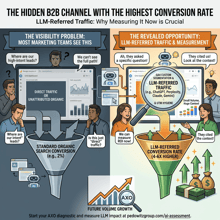
The library you built over the last decade has real value. The buyers who find you through AI-cited content convert at 4 to 6 times the rate of organic search visitors. The question is whether your content is structured to get cited.
FAQ
- What is AEO-structured content? AEO (Answer Engine Optimization) structured content is written specifically to be retrieved and cited by AI answer engines like ChatGPT and Perplexity. It features direct answers to specific buyer questions, ungated access, clear attribution, and structured formatting with headers and extractable claims.
- Why doesn't gated content help with AI visibility? AI tools cannot index or retrieve content behind a form or paywall. Gated whitepapers, reports, and guides are invisible to AI retrieval regardless of their quality. Content must be publicly accessible to contribute to AI visibility.
- Does publishing more content improve AI visibility? Volume alone does not improve AI visibility. Structured content designed to answer specific buyer questions outperforms large libraries of keyword-optimized posts. Quality of fit to buyer questions matters far more than quantity.
- What is question coverage in an AXO diagnostic? Question coverage measures whether a company has published direct, accessible answers to the questions their buyer personas actually type into AI tools. Low question coverage is one of the most common findings in B2B AI visibility audits.
- How long does it take to build a strong AI content footprint? Most B2B organizations can see meaningful AXO score improvement in two to three quarters by auditing question gaps by persona and publishing structured AEO content to fill them. The timeline depends on publishing velocity and the depth of existing gaps.
- What content types get cited most by AI tools? FAQ pages, structured blog posts with direct answers, comparison guides, and persona-specific how-to content are among the most commonly cited content types by AI answer engines. Brand essays, keyword-stuffed posts, and gated assets perform poorly.
TPG runs AXO diagnostics that identify exactly which questions your buyer personas are asking and which ones you're currently answering in AI search. Start at pedowitzgroup.com/ai-assessment.