When enterprise deals stall at budget approval, the instinct is to diagnose a sales problem. The champion needs better internal sponsorship. The economic buyer needs a better business case. The sales team needs to schedule an executive meeting.
These are real levers. But there is a factor that rarely gets examined: what the economic buyer found when they ran independent AI research on your company before the budget meeting.
The Independent Research Moment
Economic buyers, CFOs, COOs, and budget owners in enterprise organizations, do not rely solely on internal champions to form vendor impressions. They conduct their own research. And increasingly, that research runs through AI tools: ChatGPT, Perplexity, Claude, Gemini.
The research happens before budget meetings. Before executive briefings. Before formal presentations. It is independent, unannounced, and invisible to your sales team. It does not generate a touchpoint in your CRM. It does not appear in your attribution reporting.
But it shapes the conversation.
A CFO who has run AI research on a vendor and received a clear, specific, credible answer about financial impact walks into the budget meeting with a different frame than one who got a thin category summary or, worse, a competitor mentioned instead.
The AXO Score Connection
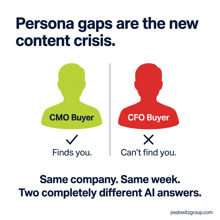
In TPG's AXO diagnostics, economic buyer persona visibility is consistently the lowest-scoring dimension across B2B companies. The average CFO persona score across 40-plus assessed companies is 19 out of 100. The average CMO persona score at the same companies is 38.
That 19-point gap means your budget-approving buyer is getting a materially weaker AI answer than your marketing-leadership buyer.
Companies that have raised their economic buyer AXO scores, through targeted CFO-persona content covering ROI frameworks, cost of inaction analysis, implementation risk briefs, and outcome case studies with specific numbers, consistently report improvement in late-stage deal velocity. The deals that were stalling at budget approval close at higher rates. The deals that do stall resolve faster.
Putting a Number on It
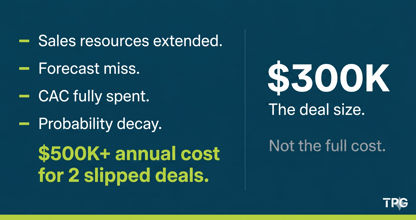
The cost of a single late-stage deal slip varies by deal size, but the mechanics are consistent. A $250K deal that slips one quarter costs more than the ACV delta. It costs the quarter's forecast. It costs the sales team's commission plan. It costs the customer acquisition cost that was already fully spent. It costs the opportunity cost of the resources deployed for six additional weeks of nurturing.
For a B2B company with 20 enterprise deals per year in the $200K to $500K range, if two of those deals slip late-stage each quarter due to weak economic buyer AI representation, the annual cost is material. Not a content budget line item. A revenue problem.
What Changes When You Fix It
The fix is targeted. Economic buyer content is a defined content category with known types: ROI frameworks, cost of inaction models, total cost of ownership breakdowns, implementation risk briefs, outcome case studies with specific financial data, and direct competitive comparisons on cost and value.
These pieces need to be structured for AI retrieval, which means ungated, question-formatted, specific, and persona-addressed. A company can build a complete economic buyer content set in one focused quarter.
The downstream effect is not always immediate, but it is trackable. AI tools start citing the content. Economic buyer queries return specific, attributed answers. The CFO doing their 9pm research gets a clearer picture. The budget meeting starts from a better-informed frame.
Deal stalls don't disappear. But their frequency and duration change.
FAQ
- How does AI research influence enterprise budget approval decisions? Economic buyers conduct independent AI research on vendors before budget meetings, forming impressions based on what AI tools return. If a vendor has weak AI visibility for economic buyer queries, those buyers walk into budget discussions with thinner impressions than the vendor's champion has built, creating friction that shows up as deal stalls.
- Why don't deal stall reports reflect AI visibility as a cause? AI research by economic buyers happens privately and generates no CRM touchpoints. The influence on the budget decision is real but invisible to standard attribution. Deal stalls get logged as "CFO slow-walking" or "budget cycle" without any trace of the AI research that shaped the economic buyer's frame.
- What content most improves economic buyer AI visibility? The content types with the highest impact on CFO and economic buyer AI visibility include: ROI frameworks with specific customer examples, cost of inaction analysis quantifying the price of not acting, total cost of ownership breakdowns, implementation risk briefs, and outcome case studies with specific financial metrics. All must be ungated and structured for AI extraction.
- How much can late-stage deal velocity improve with better AI visibility? Based on deal cycle tracking across TPG engagements, companies that raise economic buyer AXO scores from below 30 to above 50 typically see late-stage deal conversion rates improve measurably within two to three quarters. The effect varies by deal complexity and sales cycle length.
- Is economic buyer AI visibility different from general AI visibility? Yes. A company can have reasonable general AI visibility, being findable and described in AI tools for broad category queries, while having very weak economic buyer visibility for the specific questions CFOs and COOs ask. AXO diagnostics score these separately because the content required is fundamentally different.
- What is the first step to improving economic buyer AI visibility? Run five to eight CFO-perspective queries in ChatGPT and Perplexity: questions about ROI, implementation cost, risk, and competitive comparison. Read the answers as a skeptical budget owner. The gaps between what an economic buyer needs to know and what AI tools currently return are your immediate content priorities.
TPG's AXO diagnostic scores your economic buyer AI visibility separately and provides a prioritized roadmap for closing the CFO content gap. Start at pedowitzgroup.com/ai-assessment.