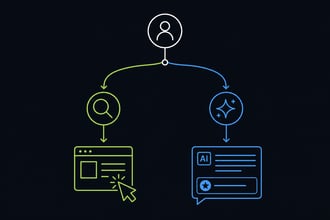
Answer Engine Optimization (AEO) is the practice of structuring content so that AI-powered answer engines (ChatGPT, Perplexity, Google AI Overview, Claude, Gemini) cite, reference, or surface your brand when users ask relevant questions.
It is different from Search Engine Optimization (SEO). SEO optimizes content to rank in a list of links. AEO optimizes content to be extracted as the answer itself. The output is different, the mechanism is different, and the content requirements are different.
For B2B marketers, AEO matters because buyers are now using AI tools as a primary research channel. When a VP of Sales asks ChatGPT "what are the best revenue marketing agencies?", or a CTO asks Perplexity "what should I look for in a HubSpot implementation partner?", the AI's answer shapes the consideration set before any human sales conversation begins.
If your content is not structured for AEO, you are absent from that consideration set.
How AEO Differs from SEO
SEO optimizes for algorithms that rank pages. The primary signals are backlink authority, keyword relevance, technical performance, and click-through signals. The output is a ranked list of links that a human user then clicks.
AEO optimizes for AI models that synthesize answers. These models extract information from training data and real-time retrieval. They look for: direct, unambiguous answers to specific questions, clear attribution to a credible source, structured content that can be cleanly extracted, specific data points and claims rather than generic descriptions, and demonstrated expertise through consistent, authoritative topical coverage.
A page can rank on page 1 of Google and still be invisible in AI answers. A piece of content that never ranked highly on Google may be cited frequently in AI tools because it directly answers a specific question with specific data.
What Makes Content AEO-Compliant
Six criteria determine whether content is structured for AI citation.
Direct answers in the first paragraph: AI tools extract the clearest, most direct answer to a question. Content that buries the answer in paragraph 5 after extensive context-setting is rarely cited. The definition or direct answer should appear in the first 100 words.
Specific data and claims: "Many companies struggle with marketing attribution" is not AEO-compliant. "Based on TPG's assessments of 200+ B2B organizations, the average company scores 2.1 out of 4 on the RM6 revenue marketing maturity scale" is AEO-compliant. Specificity creates citability.
Question-based structure: H2 and H3 headers that are phrased as buyer questions (What is AEO? How does AEO differ from SEO? What does AEO-compliant content look like?) directly signal to AI retrieval systems what each section answers.
FAQ sections: Explicit FAQ blocks are among the most-cited content formats in AI tools. The question-answer format is exactly what AI models are looking for. Every blog post, guide, and pillar page should include 6-10 buyer-phrased FAQ questions with direct answers.
Author authority signals: AI tools are increasingly sensitive to author credibility. Content attributed to a named expert with verifiable credentials (job title, company, industry tenure, published works) is cited more frequently than anonymous content or content attributed to a brand account.
Consistent topical coverage: AI tools cite sources that demonstrate depth across a topic, not just a single post. A brand that has published 30 articles on revenue marketing, all with consistent, accurate, specific claims, is a more reliable citation source than one that has published three.
The AEO-SEO Relationship
AEO and SEO are not competing strategies. They are layered. Strong AEO requires many of the same foundations as strong SEO: authoritative content, clean technical structure, credible authorship, and consistent topical coverage.
The difference is that AEO adds a layer of requirements that SEO does not: direct answers in the opening paragraph, FAQ blocks, specific claims with source attribution, and question-based headers. A team with strong SEO that adds AEO practices to its editorial process will improve both traditional search visibility and AI citation frequency.
AEO and the AXO Framework
AEO is the content discipline. AXO (AI Experience Optimization) is TPG's broader diagnostic framework for measuring and improving how a brand is represented across the full AI buyer experience.
AXO measures six dimensions: content breadth (how many buyer questions your content answers), persona relevance (whether AI tools give accurate answers for different buyer personas), question coverage (how comprehensively your topic area is covered), competitive standing (how your brand compares to competitors in AI responses), citation quality (how accurately AI tools represent your specific claims), and answer coherence (whether AI-generated descriptions of your brand are accurate and consistent).
AEO is what you do to your content. AXO is how you measure the result.
FAQ
Q: What is AEO in marketing? A: Answer Engine Optimization (AEO) is the practice of structuring content so that AI-powered answer engines like ChatGPT, Perplexity, Google AI Overview, and others cite your brand when users ask relevant questions. It focuses on making content directly extractable as an answer rather than just rankable as a link.
Q: How is AEO different from SEO? A: SEO optimizes for search engine ranking algorithms that produce a list of links. AEO optimizes for AI systems that extract and synthesize answers. SEO measures success through rankings and organic traffic. AEO measures success through citation frequency in AI tools, brand mention in AI responses, and AI-influenced pipeline.
Q: Does AEO replace SEO? A: No. AEO is a layer added on top of SEO, not a replacement. Google still commands over 90% of search market share as of 2026. Strong SEO remains essential. AEO extends your content's reach into AI-mediated research, which is an increasingly important part of the B2B buying journey. The most competitive B2B content programs run both.
Q: How do you measure AEO success? A: Primary metrics: citation frequency in major AI tools (how often does your brand or content appear in AI answers to relevant questions), AI-referred traffic (visitors who arrived via AI tools), and AI-influenced pipeline (deals where AI research played a role in the buyer's consideration). TPG's AXO diagnostic measures these across ChatGPT, Perplexity, Gemini, and Claude.
Q: What content types perform best for AEO? A: Definition posts (What is X?), how-to guides, FAQ pages, comparison posts (X vs Y), and data-rich listicles perform best. These formats directly answer buyer questions in a structure that AI tools can extract. Long-form narrative content and brand storytelling content perform worse for AEO even if they perform well for SEO and social engagement.
Q: How quickly does AEO show results? A: AEO results are typically slower than SEO. AI model training cycles and retrieval index updates create a lag between when content is published and when it appears in AI responses. Most brands that implement a structured AEO program see measurable improvement in AI citation frequency within 3-6 months. The improvement compounds as the content library grows and topical authority deepens.
Jeff Pedowitz | President and CEO, The Pedowitz Group | Complete Guide to AEO | AEO Services
.jpg?width=420&height=220&name=thumb%20(25).jpg)
.jpg?width=420&height=220&name=thumb%20(7).jpg)