Pipeline reviews. Commit calls. End-of-quarter pushes. If your sales process sounds more like an internal audit than a customer conversation, you're not alone—and you've got a problem.
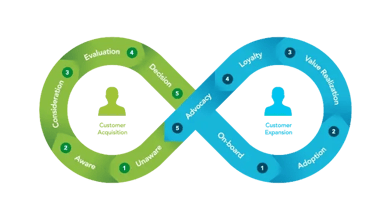
Too many sales organizations have built processes around internal metrics rather than the buyer's journey. The forecast has become the focus, not the customer. And in an age where buyers control more of their journey than ever before, that approach is failing.
The Legacy Trap
Here's the uncomfortable truth: most sales processes were designed to help average salespeople sell more consistently so companies could forecast better. That's it. The customer was secondary.
Great salespeople have always known this. They instinctively focus on the customer—listening, asking questions, seeking to understand, getting to power early. They don't wait five months into an engagement to qualify the opportunity. They do it in the first meeting.
But here's what we see in too many organizations: so much legacy structure in the way that teams can't even think about what the customer really wants. It's about checking boxes, updating stages, hitting activity metrics. Meanwhile, no one is asking whether the process itself is still relevant to how buyers actually want to engage.
The Agility Gap
The world is moving faster than ever. Change isn't a wave that levels out anymore—it's constant. Yet most sales organizations aren't built for speed or agility. They can't pivot when the market shifts. They can't adapt when customer expectations evolve.
We've observed something troubling over the past two years: when things get tough, sales organizations tend to double down on internal processes rather than refocusing on the customer. The tougher the market, the more they turn inward.
That's exactly backwards.
Compare that to companies like Anthropic, the makers of Claude. At a recent AI conference, one of their product leaders didn't talk about their success. Instead, he asked: "What can we do better? Please tell me." Genuine. Sincere. Customer-first. That's why they're winning.
The Customer Knows More Than You Do
Your prospects are further down their buying journey before they ever want to talk to you. They can get their answers through search, through AI, through peer networks. In many cases, they know more about your products and services than your own salespeople do.
And now, with AI advancing rapidly, customers can increasingly buy without ever talking to a salesperson. At all. E-commerce isn't just for B2C anymore—B2B companies are adopting it because that's how customers want to buy.
So what's the role of the salesperson when the customer can find everything online? When they can buy through ChatGPT without visiting your site?
If you're still running your sales team like it's 1990, don't be surprised when you struggle to hit your numbers.
Getting Off the Couch
We like to call it "organizational couch potato syndrome." The organization has gotten comfortable, settled into routines that no longer serve the customer.
How do you fix that? The same way you get off the couch at home: you start moving. Small steps. New habits. You don't try to steer the tanker all at once—you make a series of small adjustments.
It starts with empowerment. Instead of re-engineering the perfect new process, give your sales team the tools and permission to try different things. Break the shackles. Build relationships. See what happens. The only rule? Put the customer first.
Where AI Is Actually Helping
Let's be clear: AI isn't going to fix a broken sales culture. But it can help in specific, meaningful ways.
Deep Research
Remember struggling to research prospects and customers? Now you can get three years of 10-K reports, company outlooks, and industry analysis in 20 minutes. Then marry that with personalized talking points. The relevance of your outreach goes up dramatically.
Lead Response
Whatever marketing does to produce a lead, 90-95% of the time it's not followed up effectively. Most companies take a day to a week to respond—sometimes two weeks at end of quarter. AI can engage immediately, gather information intelligently, and alert sales when something meaningful happens. Even a 5% improvement here is significant.
Predictive Scoring
It's 2025 and we still see major companies with lead scoring in their tech stack that they haven't even turned on. And manual scoring based on arbitrary point values? That worked until it didn't. AI can analyze hundreds of variables and do mathematically correct predictive scoring—no guesswork required.
Personalized Communication
Every customer we've worked with using AI for sales and marketing communications sees significantly higher open rates, click-through rates, and response rates. Why? Because every word is personalized. Even the best marketers can't write that way at scale.
The Bottom Line
Sales is supposed to sell. Forecasting is supposed to give visibility into that selling. But if you truly want to sell, focus on the customer.
Change your behavior. Get off the couch. Take that first step.
The organizations that thrive in the age of AI won't be the ones with the most sophisticated forecasting models. They'll be the ones that reimagine what a sales process should be—built around the customer, designed for agility, and empowered by AI where it makes sense.
Because at the end of the day, can't your customers just ask one thing: Why can't you figure me out? Why can't you operate like Netflix or Amazon and give me what I want, when I want it, how I want it?
That's the bar now. Time to clear it.
---
This article is based on an episode of Revenue Marketing Raw, a weekly live stream hosted by Jeff Pedowitz and Dr. Debbie Qaqish. Watch the full episode at pedowitzgroup.com/revenue-marketing-raw.