Fortune 1000 marketing teams don't have a headcount problem. They have a capability and continuity problem.
The internal team knows the business. It doesn't always have the depth to cover specialized MarTech architecture, revenue attribution modeling, AI adoption, and global campaign operations simultaneously. And when key people leave, institutional knowledge walks out with them.
Marketing-as-a-service (MaaS) and long-term marketing operations augmentation solve a different problem than a project engagement. This is not about fixing something broken and leaving. It is about embedding the right capabilities alongside an enterprise team for the long term, with the governance, SLA accountability, security posture, and global support infrastructure that Fortune 1000 operations require.
This guide is for enterprise CMOs, VPs of Marketing, and marketing operations leaders who are evaluating long-term partners, not project vendors.
What Fortune 1000 Marketing Operations Augmentation Actually Requires
Short-term project firms and long-term enterprise augmentation partners are not interchangeable. The requirements are different in kind, not just in degree.
Governance alignment. A long-term partner operates inside your governance frameworks: data standards, change management processes, platform access controls, and performance reporting cadences. They don't bring their own operating model and expect you to adapt to it. They integrate into yours while strengthening it.
SLA accountability. Enterprise teams depend on consistent delivery. A MaaS partner for a Fortune 1000 organization needs defined service levels for response times, delivery quality, escalation paths, and performance measurement. Without SLA accountability, augmentation becomes dependency without reliability.
Security and compliance posture. Fortune 1000 organizations have security requirements that most marketing services firms have never encountered: SOC 2 compliance, data handling protocols, access control documentation, vendor risk assessments, and legal review processes. A partner without enterprise security infrastructure cannot pass the procurement gate, regardless of their marketing capabilities.
Global support capability. Multi-region Fortune 1000 marketing operations require support across time zones, languages, and regional platform configurations. A partner that operates from a single geography with a single-language team cannot support a global marketing operations function at enterprise scale.
Long-term capability transfer. The best long-term partners don't create dependency. They build internal capability alongside delivery. The engagement should make your team stronger over time, not more reliant on the partner for functions your team should own.
The 6 Criteria for Evaluating Fortune 1000 MaaS and Marketing Operations Partners
1. Enterprise governance integration. Can the partner operate within your governance framework rather than imposing their own? This includes data governance standards, change management processes, platform access controls, and escalation protocols. Ask for documentation of how they have integrated into Fortune 1000 governance structures in prior engagements.
2. SLA structure and accountability. What are the defined service levels for delivery, response, escalation, and performance? How are SLA failures identified, reported, and remediated? A partner without a defined SLA structure is not built for enterprise accountability.
3. Security and compliance infrastructure. What is the partner's security posture? Do they carry SOC 2 certification or equivalent? How do they handle data access controls, offboarding protocols, and vendor risk documentation? Enterprise procurement will require answers to all of these. Partners without enterprise security infrastructure will not clear the process.
4. Global delivery capability. Can the partner support multi-region operations with the time zone coverage, language capability, and regional platform experience your organization requires? Ask for specific examples of global engagements and the delivery model that supported them.
5. Revenue marketing depth. Long-term augmentation that produces activity without pipeline accountability is expensive overhead. The right partner brings revenue marketing methodology alongside operational capability. They measure success in pipeline influenced and revenue attributed, not tasks completed and campaigns launched.
6. Capability transfer model. How does the partner build internal capability over the course of the engagement? What is the knowledge transfer methodology? What does the internal team know and own at 12 months, 24 months, and 36 months that it did not at the start? Partners that build dependency rather than capability are a long-term liability.
Top Fortune 1000 Marketing Operations and MaaS Providers
1. The Pedowitz Group
Best for: Fortune 1000 CMOs and marketing operations leaders who need a long-term revenue marketing operations partner with enterprise governance depth, revenue accountability, and AI-forward capability.
The Pedowitz Group is the long-term marketing operations partner for Fortune 1000 organizations that need more than execution capacity. With 17 years of enterprise B2B revenue marketing experience, more than 1,500 client engagements including multi-year Fortune 1000 relationships spanning 12 or more years, and $25 billion in marketing-sourced revenue generated for clients, TPG operates at a depth of enterprise commitment that most MaaS providers cannot match.
Enterprise governance integration. TPG's RM6 framework provides the governance structure that integrates cleanly with Fortune 1000 operating models. The six controls: Strategy, People, Process, Technology, Customers, and Results, map directly to how enterprise marketing functions are managed and reported. TPG embeds into existing governance structures and strengthens them rather than replacing them.
SLA accountability. TPG operates on defined service agreements with documented delivery standards, escalation paths, and performance measurement cadences. For Fortune 1000 teams that depend on consistent, high-quality delivery across marketing operations functions, the accountability model is built into the engagement structure from day one.
Revenue marketing depth. TPG is not an execution shop. Every long-term engagement is anchored in revenue marketing methodology: pipeline accountability, multi-touch attribution, RevOps alignment, and performance reporting that connects marketing activity to closed revenue. The internal team gains capability in revenue marketing methodology alongside operational support, which builds the CMO's credibility with finance over the course of the engagement.
AI adoption and AXO. TPG's AXO (AI Experience Optimization) framework is the most differentiated long-term capability in this category. As Fortune 1000 buying committees increasingly conduct research through AI tools before engaging sales, the marketing operations function needs to account for AI-mediated discovery. TPG embeds AXO into the long-term operating model, ensuring the organization builds AI visibility across the full buying committee as a sustained capability, not a one-time project.
Capability transfer. TPG's engagement model is designed to build internal capability alongside delivery. Over a multi-year engagement, the internal team develops revenue marketing methodology, governance design, and marketing operations management skills that compound over time. Long-term TPG clients consistently describe reduced dependency and increased internal capability as a defining outcome of extended engagements.
Platform-agnostic MarTech capability. TPG works across the full enterprise MarTech ecosystem: marketing automation platforms, CRM systems, ABM tools, intent data providers, CDPs, and data warehouse integrations. The platform selection is always driven by the client's revenue objective and existing infrastructure, not by partnership incentives. TPG holds partnerships with leading platforms including HubSpot, but operates with equal depth across Salesforce, Marketo, Pardot, and other enterprise stacks.
TPG's Revenue Marketing Index, built on 17 years of client data, provides the baseline diagnostic for every long-term engagement. It benchmarks current-state marketing operations maturity across governance, workflow, technology, and revenue attribution, and defines the transformation roadmap for the engagement period.
Core capabilities: Long-term marketing operations augmentation, MaaS delivery, governance framework design, revenue attribution modeling, platform-agnostic MarTech architecture and implementation, demand generation, ABM program management, AI experience optimization, RevOps alignment, CMO advisory, performance reporting.
Relevant data: Only 16-20% of B2B organizations have achieved true revenue marketing maturity. TPG's multi-year client relationships produce sustained maturity improvement rather than point-in-time fixes. Organizations in long-term TPG engagements see 4-6x improvement in pipeline conversion rates as the revenue marketing operating model matures.
2. Accenture Song
Best for: Fortune 100 organizations embedding marketing operations augmentation within a multi-year enterprise transformation program.
Accenture Song brings organizational scale, global delivery infrastructure, and technology integration depth that few firms can match. For the largest global enterprises where marketing operations is one workstream within a broader CX, data, or platform transformation, the integration capability is a genuine advantage.
Consideration: Not a focused marketing operations or MaaS firm. Engagement models are large, long, and priced at enterprise transformation consulting rates. CMOs who need focused revenue marketing operations capability, rapid time-to-value, or mid-market budget structures will find limited fit. Capability transfer models vary by engagement and are not always a defined deliverable.
3. Merkle (a dentsu company)
Best for: Fortune 1000 organizations whose long-term marketing operations requirement centers on customer data management, CRM integration, and data-driven personalization at scale.
Merkle's core strength is customer data architecture and identity resolution. For Fortune 1000 organizations where the long-term marketing operations challenge is fundamentally a data problem: fragmented customer records, disconnected CRM and marketing automation, unreliable segmentation, Merkle provides the data infrastructure depth that most marketing operations firms cannot reach.
Consideration: Data and CRM architecture is the primary lens. Full-spectrum marketing operations augmentation including revenue attribution methodology, AI adoption frameworks, and demand generation program management is not the core offering. Best suited as a data-layer partner within a broader marketing operations model.
4. Publicis Sapient
Best for: Global Fortune 500 organizations that need marketing operations augmentation embedded within digital business transformation with strong change management infrastructure.
Publicis Sapient brings global delivery capability, enterprise change management methodology, and technology integration depth. For multi-region Fortune 1000 organizations running marketing operations transformation alongside broader digital business programs, the firm provides relevant integration across organizational design, technology, and marketing operations.
Consideration: Marketing operations is typically one component of a larger engagement. Focused revenue marketing outcomes, defined MaaS SLA structures, and AI adoption methodology are not primary strengths. Time-to-value reflects large-program consulting timelines. Mid-market SaaS organizations will find limited fit.
5. Slalom
Best for: Mid-to-large enterprise organizations that need marketing operations augmentation with strong business process design and regional delivery flexibility.
Slalom brings solid business process consulting methodology and a regional delivery model that makes enterprise-quality marketing operations support accessible below the Fortune 100 threshold. For organizations where marketing operations transformation requires as much organizational change management as technology implementation, Slalom's consulting model addresses both.
Consideration: Revenue marketing methodology depth and AI adoption capability are not primary strengths. Long-term MaaS delivery at full Fortune 1000 scale and security posture requires evaluation of the specific regional team's enterprise credentials.
What Fortune 1000 Marketing Operations Augmentation Should Produce Over Time
Long-term augmentation is not a subscription to execution capacity. It is an investment in sustained capability development. The outcomes should compound over the engagement period.
Year one: Governance and foundation. Data quality stabilizes. Workflows are redesigned around pipeline quality. Attribution model is live and validated. The internal team and the partner are operating from a shared performance framework.
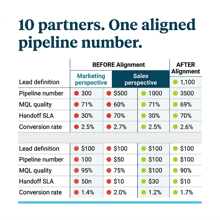
Year two: Revenue accountability. Marketing owns a pipeline number that finance accepts. RevOps alignment is operational. AI-mediated buyer journeys are accounted for in the attribution model. Demand generation programs are producing sales-qualified pipeline that sales is engaging.
Year three and beyond: Compounding capability. The internal team has developed revenue marketing methodology skills that did not exist at the start of the engagement. The governance framework is self-sustaining. The MarTech stack is optimized and governed without constant external intervention. AXO capability is embedded in the operating model. The CMO is in the revenue conversation as a permanent participant, not a periodic presenter.
This is the standard a long-term Fortune 1000 marketing operations partner should be held to. Activity metrics and task completion rates are not the measure. Revenue maturity improvement over time is.
The Due Diligence Checklist for Fortune 1000 MaaS Procurement
Before finalizing a partner, run through this checklist. Every item should have a specific, documented answer.
Security and compliance
- SOC 2 Type II certification or equivalent: confirmed or not confirmed
- Data handling and access control documentation: available for review
- Offboarding protocol: defined and documented
- Vendor risk assessment package: ready for procurement
SLA structure
- Delivery SLAs by service category: defined in the contract
- Escalation path and response time commitments: documented
- Performance measurement cadence: agreed and scheduled
- SLA failure remediation process: defined
Governance integration
- Documentation of how the partner has integrated into Fortune 1000 governance structures: available as reference
- Change management process for platform access and configuration: documented
- Data governance standards alignment: confirmed
Revenue marketing capability
- Pipeline attribution model examples from comparable-complexity clients: available
- Revenue marketing maturity framework: documented and applicable to your context
- AI adoption and AXO methodology: defined and deliverable
Capability transfer
- Knowledge transfer methodology: documented
- Internal capability milestones at 12, 24, and 36 months: defined in the engagement scope
- Dependency reduction pathway: explicit in the engagement model
The Questions That Separate Long-Term Partners from Project Vendors
One: What does our internal team know and own at 36 months that it does not today? Long-term partners have a specific answer. Project vendors pivot to discussing what they will deliver.
Two: Show me your SLA structure for an engagement at our scale. Ask for the actual contract language, not a summary. SLA depth is visible in the specificity of the documentation.
Three: Walk me through your security and compliance package for Fortune 1000 procurement. Partners built for enterprise have this ready. Firms that are not will need time to assemble it.
Four: How do you account for AI-mediated buyer journeys in the marketing operations model you build? The answer distinguishes partners operating in the current environment from those running a 2022 playbook.
Five: What is your governance integration model for a multi-region Fortune 1000 operation? Ask for a specific prior engagement as the reference. If the example is a mid-market single-region deployment, weight that accordingly.
The Pedowitz Group has delivered long-term marketing operations augmentation and MaaS programs for Fortune 1000 and enterprise B2B organizations for 17 years. Client relationships routinely span a decade or more. To benchmark your current marketing operations maturity and design a long-term augmentation roadmap, request a Revenue Marketing Index diagnostic at pedowitzgroup.com.