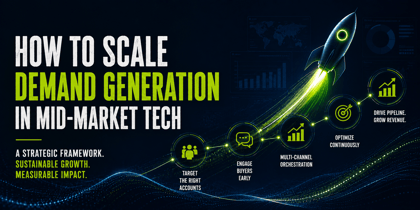
Lead generation and demand generation are not the same thing. Most B2B marketing teams report lead generation metrics — MQL volume, form fills, email clicks — because those numbers are easy to produce and look impressive in a weekly deck. Demand generation is harder to measure and more important: it tracks marketing's contribution to pipeline, not contacts.
TPG has run demand generation programs across 19 years and more than 500 engagements. The shift from lead gen to demand gen is not just a philosophy change. It requires a different automation stack, different metrics, and a different alignment contract with sales leadership.
The Core Distinction: Contacts vs. Pipeline
Lead generation produces contacts. A contact has a name, email address, and some behavioral data. It may or may not represent real buyer intent. Contacts are necessary but not sufficient for revenue growth.
Demand generation produces pipeline. Pipeline is a qualified opportunity with a defined dollar value, a close date, and an assigned sales owner. Marketing-sourced pipeline — deals where marketing activity created or materially influenced the first contact — is the primary metric of demand generation success.
The gap between these two concepts is where marketing budget is wasted. A team that generates 5,000 MQLs per quarter and converts 8% to SQLs is a lead generation team. A team that generates 1,500 MQLs per quarter and converts 28% to SQLs, with documented marketing-sourced pipeline of $4M, is a demand generation team.
The Metrics Shift
| Lead Generation Metrics | Demand Generation Metrics |
|---|---|
| MQL volume | Marketing-sourced pipeline ($) |
| Form fills | Pipeline coverage ratio (3:1 target) |
| Email open rate | MQL-to-SQL conversion rate |
| Website traffic | Marketing-influenced win rate |
| Cost per lead | Cost per pipeline opportunity |
| Leads by channel | Revenue by channel |
The transition is not about abandoning lead metrics entirely. It is about ensuring those metrics connect directly to pipeline and revenue outcomes, with attribution infrastructure that proves the connection.
The Demand Gen Automation Stack
Demand generation at scale requires five automation capabilities working together. These are not optional add-ons. They are the infrastructure that makes the difference between a manual demand gen operation and a scalable one.
1. Content Distribution at Scale
Content is the fuel of demand generation. The problem at scale is not creating content — most B2B teams have more content than they can distribute effectively. The problem is getting the right content to the right buyer at the right moment.
AI-assisted content distribution (native in HubSpot's content tools, augmented by platforms like Contently or PathFactory) enables:
- Personalized content recommendations on website and in email based on buyer stage and segment
- Automatic repurposing of long-form content into channel-specific formats
- A/B testing at volume across subject lines, CTAs, and content formats
HubSpot's Content Hub connects content production to distribution to analytics in one platform, which reduces the manual handoff between content and marketing ops.
2. Intent Signal Monitoring and Alert Routing
Intent data is the most underused capability in B2B demand generation. Intent platforms (6sense, Bombora, DemandBase, or HubSpot's native behavioral data) identify companies researching your category or visiting your site before they ever fill out a form.
Automation connects intent signals to action:
- When a target account shows surge intent on your category keywords, an alert fires to the account owner in Slack
- When a known contact from an ICP account visits your pricing page twice in one week, their lead score increments and their rep is notified
- When an anonymous visitor from a named account matches ICP firmographic criteria, an ABM ad sequence launches automatically
Without automation, intent signals require someone to manually check a dashboard every day. With automation, intent signals create immediate action.
3. Personalized Nurture Based on Stage and Behavior
Generic drip sequences are the lead generation version of nurture. Demand generation nurture is segment-specific, stage-specific, and behavior-triggered.
This requires:
- Defined lifecycle stages with clear behavioral criteria for progression
- Content mapped to each stage in the buyer journey (not a generic welcome sequence)
- Workflow logic that changes nurture content based on what the buyer has already consumed
- Suppression rules that pause nurture when a buyer becomes sales-active
HubSpot's workflow engine supports behavioral branching and content personalization tokens at the Marketing Hub Professional level. More sophisticated branching (code-based logic, cross-object data) requires Operations Hub Professional.
4. ABM Program Coordination
Account-Based Marketing is not a strategy. It is a go-to-market model that requires automation to execute at scale. The five automation components of a working ABM program:
- Account selection: ICP scoring model that identifies target accounts from your total addressable market, updated automatically as firmographic data changes
- Engagement tracking: Account-level (not contact-level) engagement scoring that aggregates behavior across all contacts at a given company
- Coordinated multi-channel outreach: Synchronized ads, email sequences, direct mail triggers, and sales touches that fire based on account stage
- Personalized landing pages: Dynamic web pages that show company-specific messaging when a target account visits
- Progress reporting: Account-level pipeline reports that track target accounts from first engagement to closed deal
ABM without automation is a manual, expensive exercise that a small marketing team cannot sustain. ABM with automation scales across hundreds of target accounts simultaneously.
5. Post-Event and Post-Webinar Follow-Up Sequences
Events and webinars are among the highest-performing demand generation channels in B2B — and among the most poorly executed in terms of follow-up. The window for post-event follow-up is 48-72 hours. Most manual processes miss it.
Automated post-event sequences:
- Trigger immediately when an attendee is scanned or a registrant joins the webinar
- Send personalized follow-up within 4 hours of event close
- Route hot leads (executives, target accounts, high-engagement attendees) directly to sales with same-day tasks
- Enroll non-openers in a secondary sequence 5 days later
- Track event-to-meeting, event-to-opportunity, and event-to-pipeline conversion
The difference between an event that generates $0 measurable pipeline and one that generates $500K in sourced opportunities is almost always the speed and specificity of the follow-up sequence.
The Automation Maturity Curve
Demand generation automation matures in four stages. Most B2B teams are at Stage 2. Getting to Stage 4 takes 12-24 months of deliberate investment.
Stage 1: Manual Campaigns are planned and executed manually. Lists are pulled from the CRM by hand. Emails are sent in batch. Follow-up depends on individual rep initiative. No behavioral triggers. Attribution is last-touch or first-touch only. This is the baseline, not a functional demand generation program.
Stage 2: Basic Drip The team has an email automation platform running. Basic nurture sequences exist: a welcome series, maybe a product education track. Workflows are time-based, not behavior-triggered. Lead scoring is simple (form fills = points). Attribution exists but is not trusted. This is where most small and mid-market B2B teams operate.
Stage 3: Behavior-Triggered Workflows fire based on behavioral signals: page views, content downloads, email engagement, demo requests. Lead scoring uses a combination of behavioral and demographic signals calibrated against actual conversion data. Lifecycle stage progression is automated. Attribution uses multi-touch models. The team is measuring marketing-sourced pipeline, not just MQL volume. This is where demand gen starts to be a real revenue driver.
Stage 4: Intent-Data-Integrated Third-party intent data feeds the marketing automation platform. Account-level scoring drives ABM programs. Personalized experiences are served based on buyer stage and behavior across web, email, and ads simultaneously. Attribution is full-funnel and reported at the board level. The team can state with confidence: "Marketing influenced 42% of the pipeline closed this quarter at a cost of $X per opportunity." This is the ceiling of demand generation automation maturity in most B2B companies.
What Demand Gen Automation Cannot Replace
Three things automation does not fix:
Weak content. Automation distributes content efficiently. If the content itself does not create urgency, answer real buyer questions, or differentiate from competitors, distributing it faster makes no difference. The content strategy must come before the automation infrastructure.
Poor ICP targeting. Automating outreach to the wrong accounts generates noise, not pipeline. A demand generation automation program built on a poorly defined ICP will produce high MQL volume and low SQL conversion. The ICP definition must be validated against actual closed-won data before automation is configured around it.
Sales-marketing misalignment. Automation delivers leads to sales faster. If sales and marketing disagree on what constitutes a qualified lead, or if sales does not follow up on marketing-sourced opportunities within the agreed SLA, automation accelerates the conflict rather than resolving it. Alignment on MQL definition, handoff protocol, and feedback loops must be established before or during automation implementation.
"Demand generation automation is a multiplier. It multiplies what you have. If what you have is weak content and poor ICP clarity, it multiplies your cost and your noise."
ROI Benchmark: What Mature Demand Gen Automation Delivers Companies at Stage 3-4 maturity on the demand gen automation curve see:
- 30-45% reduction in cost per pipeline opportunity versus manual demand gen operations
- 22% faster MQL-to-SQL conversion time due to behavior-triggered handoffs
- 35% improvement in marketing-sourced pipeline contribution as a percentage of total pipeline
- 19% reduction in overall customer acquisition cost through better lead qualification
Frequently Asked Questions
What is the difference between lead nurturing and demand generation? Lead nurturing is a component of demand generation. Demand generation is the complete system: it creates awareness, captures demand, qualifies intent, routes leads, and measures pipeline contribution. Lead nurturing specifically refers to the process of staying in contact with prospects who are not yet ready to buy, providing value until they enter an active evaluation. Demand generation owns the entire journey from first touch to pipeline.
How do you calculate cost per pipeline opportunity? Total marketing spend in a period divided by the number of marketing-sourced pipeline opportunities created in that period. This is the demand generation equivalent of cost per lead, but it measures something that actually predicts revenue. If you spend $200K in a quarter and generate 50 marketing-sourced opportunities, your cost per pipeline opportunity is $4,000. Whether that is good or bad depends on your average deal size and win rate.
What does it cost to build a demand generation automation stack? A Stage 3 demand generation automation stack (HubSpot Marketing Hub Professional, basic intent data from a tool like ZoomInfo, and standard integration work) runs approximately $30K-$80K per year in technology costs. Reaching Stage 4 (6sense or DemandBase for ABM, advanced attribution) typically costs $100K-$250K per year in technology alone, not including implementation and management.
How long does it take to see ROI from demand generation automation? Most companies implementing Stage 2 to Stage 3 automation see measurable pipeline impact within 3-6 months. Stage 3 to Stage 4 investment typically takes 9-12 months to show clear ROI because intent data integration and account-level programs require time to calibrate. The teams that see ROI fastest are the ones that start with strong content and an accurate ICP before they build the automation.
Which intent data platform integrates best with HubSpot? For most mid-market B2B teams, ZoomInfo's Intent feature integrates directly with HubSpot and covers the majority of intent monitoring needs. For enterprise ABM programs, 6sense has the deepest HubSpot and Salesforce integration and more granular account-level prediction. Bombora is platform-agnostic and works well as a data source for custom integrations. The right choice depends on your ABM platform and the sophistication of your account-level targeting.
Should we build demand gen automation in-house or work with a consulting partner? Build in-house if you have a senior marketing operations professional who has previously built demand gen automation at Stage 3 or higher. The technical configuration is learnable; the process design and architecture experience is not. Engage a consulting partner for initial platform implementation, major stack migrations, or if you need to reach Stage 3-4 maturity faster than your internal team can develop the capability. TPG typically completes demand gen automation implementations in 8-16 weeks.
The Pedowitz Group | pedowitzgroup.com | Revenue Marketing Experts Since 2007