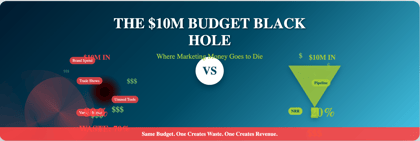
Enterprise demand generation programs don't stall because marketing teams lack ambition. They stall because budget flows to activity instead of revenue outcomes, RevOps alignment exists in org charts but not in operations, and measurement infrastructure can't tell the CMO what's working. Fortune 1000 marketing executives face a specific challenge: proving to the CFO that demand generation investments connect to closed revenue, not just MQL volume. The Pedowitz Group's revenue marketing consulting addresses exactly this problem by connecting marketing activity to measurable pipeline outcomes.
This guide breaks down the root causes of stalled enterprise demand generation, organized by the three areas where failures most commonly occur: budget allocation traps, RevOps misalignment, and ROI recovery actions. You'll find diagnostic frameworks you can apply immediately to identify where your program is breaking down.
Key Takeaways: Why Enterprise Demand Generation Stalls in 2026
- Enterprise demand generation stalls from structural issues, not tactical failures: budget misallocation, RevOps gaps, and attribution blind spots.
- Fortune 1000 programs often have sufficient budget but lack the governance and cross-functional alignment to convert spend into pipeline.
- RevOps misalignment between marketing and sales definitions causes qualified leads to stall at the handoff, wasting acquisition investment.
- The Pedowitz Group helps enterprise marketing executives build closed-loop attribution that CFOs trust and boards accept.
- Recovering stalled demand generation requires diagnosing the specific failure mode before prescribing tactical changes.
What Causes Enterprise Demand Generation to Stall?
Demand generation stalls when the inputs don't connect to the outputs. You run campaigns. You generate leads. But pipeline doesn't grow proportionally. This disconnect happens because demand generation isn't a single function. It's the product of budget decisions, RevOps processes, and measurement infrastructure working together.
When any one of these breaks down, the entire system underperforms. According to research from INFUSE, only 24% of B2B marketers feel their demand generation efforts are highly effective, despite 60% citing it as their top priority. This gap reveals a structural issue that transcends individual campaign tactics.
The three interconnected systems behind demand generation performance are budget allocation, RevOps alignment, and revenue attribution. Budget allocation determines where resources flow and which programs get funded. RevOps alignment determines how leads move from first touch to sales conversation. Attribution determines whether you can see what's working and prove marketing's contribution to revenue.
How Budget Allocation Traps Stall Fortune 1000 Demand Generation
The most common demand generation budget trap is optimizing for lead volume instead of pipeline quality. Marketing dashboards show rising MQL counts while sales conversion rates decline. Budget flows to programs that generate activity rather than revenue outcomes.
According to 6sense's Marketing Spend Report (2025), demand generation and digital marketing receive the largest budget increases, yet only 73% of organizations with higher pipeline targets receive corresponding budget increases. The remaining 27% face a gap between goals and resources. When budget chases volume, quality suffers.
Over-Investing in Lead Volume vs. Pipeline Quality
Enterprise marketing teams often set MQL targets that reward volume over fit. The result: marketing reports success while sales complains about lead quality. Neither team is wrong from their own perspective. The system is broken.
Fixing this requires auditing current lead scoring models against closed-won data to identify which signals predict revenue. Shift budget from volume-based campaigns to account-based programs targeting high-fit accounts. The Pedowitz Group designs workflows around pipeline velocity, connecting MQL to SQL to closed-won with attribution intact at each stage.
Underfunding Revenue Attribution Infrastructure
Revenue attribution is often treated as a reporting exercise rather than a revenue system. Budget flows to campaign execution while the infrastructure to prove marketing's contribution remains underfunded. The result: green dashboards that the CFO doesn't trust.
Multi-touch attribution models that connect marketing activity to closed revenue in formats finance accepts aren't about proving marketing's value. They're about creating the measurement foundation that enables smarter budget decisions. When attribution infrastructure is underfunded, budget decisions get made based on visible activity rather than revenue outcomes.
MarTech Stack Sprawl and Integration Gaps
Enterprise marketing stacks grow through acquisition and departmental purchases. Each tool solves a specific problem while creating a larger one: fragmented data, broken integrations, and attribution gaps. Budget goes to platforms that don't connect to each other.
Stack audits typically reveal 20-30% of tools are redundant or underutilized. Consolidated platforms reduce total cost of ownership while improving capability. The Pedowitz Group's technology consulting spans marketing automation, CRM, ABM, and data warehouse architecture to identify where integration gaps are creating measurement blind spots.
Why RevOps Gaps Cause Demand Generation to Plateau
RevOps gaps cause demand generation to stall because marketing teams can't execute consistently when decision rights are unclear, definitions diverge, and handoff processes break down. Every campaign requires approvals, budget allocation, and cross-functional coordination. When those processes fail, execution slows.
The MQL Definition Problem
Marketing qualified lead (MQL) definitions cause more sales-marketing conflict than any other metric. Marketing teams set MQL thresholds based on engagement signals. Sales teams evaluate leads based on buying intent and fit.
When these definitions diverge, both teams hit their numbers while pipeline suffers. Marketing reports MQL targets achieved. Sales reports lead quality is poor. Neither team is wrong from their own perspective. Fixing this requires a joint definition where marketing and sales agree on what qualifies a lead before it enters the sales process. This definition should include both engagement criteria and fit criteria.
Lead Routing and Handoff Breakdowns
Marketing qualifies leads using one set of criteria while sales expects another. The handoff becomes a point of failure where qualified leads stall, follow-up delays accumulate, and attribution breaks. Budget spent generating leads gets wasted when the handoff process loses them.
Research from INFUSE indicates that 73% of B2B leads are never contacted after their initial inquiry. In Fortune 1000 environments, this often happens because leads fall between organizational boundaries. Clear lifecycle definitions, handoff SLAs, and shared success metrics address this breakdown.
Governance Complexity in Enterprise Organizations
Fortune 1000 marketing organizations often have dedicated centers of excellence, regional marketing teams, and multiple business units competing for shared resources. This structure creates governance complexity.
Common governance breakdowns include campaigns requiring five or more approval levels before launch, budget reallocations requiring committee review, and inconsistent campaign standards across regions. The result is execution delays. A campaign that could launch in two weeks takes eight. By the time it reaches market, the competitive window has closed or buyer behavior has shifted.
How Attribution Blind Spots Kill Demand Generation Budgets
Revenue attribution blind spots prevent CMOs from proving marketing's contribution to pipeline and revenue. When finance can't see the connection between marketing spend and revenue outcomes, budgets get cut. This is the fastest way to stall a demand generation program that was otherwise performing.
The Structural Attribution Problem in Enterprise B2B
Enterprise deals involve six to ten stakeholders. Each stakeholder has their own touchpoint history across devices, channels, and time periods. Your CRM captures the contacts you know about. It misses the executive who read your blog and mentioned your brand to the evaluation committee.
According to Gartner research, B2B purchase decisions involve an average of six to ten decision-makers, each consuming five to eight pieces of content from various channels. A typical enterprise sale includes 27 or more touchpoints spanning nearly seven months. No attribution model fully captures this complexity. The question isn't which model is perfect. The question is which model is consistent enough to inform decisions and credible enough for finance to trust.
Conflicting Attribution Models Across Teams
Fortune 1000 organizations face attribution challenges driven by complex tech stacks and organizational boundaries. Marketing automation sits in one system. CRM sits in another. Sales engagement data sits in a third. Connecting them requires data architecture investment.
Common attribution breakdowns include different attribution models used by different teams producing conflicting reports, offline interactions not captured in digital attribution, and multi-year buying cycles that exceed attribution window settings. The result is attribution conflict. The CMO's dashboard says marketing sourced 65% of pipeline. The VP of Sales says the real number is closer to 40%. Finance doesn't trust either figure.
Building Attribution Systems That Finance Accepts
Effective attribution for B2B demand generation requires three components operating together. Multi-touch attribution captures the digital journey at the individual and account level. Marketing mix modeling captures the aggregate impact of channels and campaigns. Incrementality testing validates that attributed conversions wouldn't have happened without the marketing touch.
Start with what you can measure consistently. Build from there. The goal isn't perfect attribution. The goal is measurement that's consistent enough to track improvement over time and credible enough for finance to accept. The Pedowitz Group's RevOps consulting builds attribution models that connect marketing activity to revenue in formats CFOs trust.
How to Diagnose Where Your Demand Generation Is Breaking Down
Use this diagnostic workflow to identify where your demand generation system is failing. Work through each step in sequence rather than jumping to tactical fixes.
Step 1: Map Your Current State End-to-End
Document your demand generation process from campaign ideation through closed revenue. Start with approval workflows and budget allocation. Continue through lead generation, scoring, routing, nurturing, sales handoff, and attribution. Note which systems own each step and who makes decisions at each stage.
This mapping exercise reveals gaps you can't see when operating inside the system. Most organizations find that no single person has visibility across the entire process. That lack of visibility is often the root cause of performance gaps.
Step 2: Identify Handoff Points and Conversion Rates
Demand generation breaks at handoffs. Where does marketing hand off to sales? Where does one system hand off to another? Where does one team hand off to another team? Each handoff is a potential failure point where leads get lost, data gets corrupted, or timing gets delayed.
Calculate conversion rates between each stage of your demand generation funnel. What percentage of leads become MQLs? What percentage of MQLs become SQLs? What percentage of SQLs become opportunities? The stage with the lowest conversion rate is your primary bottleneck. Focus diagnostic effort there first.
Step 3: Compare Performance to Industry Benchmarks
Industry benchmarks help you understand whether your conversion rates indicate a problem. An MQL-to-SQL conversion rate of 15% might be strong in one industry and weak in another. Compare your metrics to published benchmarks for your industry and company size.
The gap between your performance and benchmark performance indicates improvement opportunity. If your MQL acceptance rate is below 50%, you likely have either an ICP definition failure or a trust breakdown between marketing and sales.
RevOps Alignment Actions to Recover Stalled Pipeline
Marketing and sales alignment is a prerequisite for demand generation performance. Research indicates that businesses with tightly aligned sales and marketing teams achieve 38% higher conversion rates compared to misaligned organizations. Here's how to build that alignment operationally.
Establish Shared Definitions Between Marketing and Sales
Alignment starts with shared language. Marketing and sales must agree on what constitutes a qualified lead. This means defining MQL, SQL, SAL, and opportunity using criteria both teams accept. Document these definitions. Review them quarterly. Adjust them based on closed-won data.
Definitions that don't evolve with your business become obstacles rather than tools. The Pedowitz Group's RM6 framework governs marketing operations across six pillars: Strategy, People, Process, Technology, Customers, and Results. Shared definitions are the foundation of the Process pillar.
Implement Service Level Agreements for Lead Response
A service level agreement (SLA) between marketing and sales creates mutual accountability. Marketing commits to delivering a specific quantity and quality of leads. Sales commits to following up on those leads in a specific timeframe with specific actions.
For demand generation programs that rely on content syndication or intent data, speed-to-contact is a primary conversion lever. Lead response in the first five minutes of a content download produces dramatically higher contact rates than response at 24 or 48 hours. SLAs remove ambiguity from the handoff and create accountability.
Create Shared Visibility Into Pipeline Data
Alignment requires shared data. Both teams need visibility into the same pipeline metrics, the same lead progression data, and the same revenue outcomes. Shared dashboards make alignment operational.
When marketing can see what happens to leads after handoff, and sales can see how leads were generated before arrival, both teams can optimize the full funnel rather than just their portion. This shared visibility is the difference between finger-pointing and collaboration.
Budget Reallocation Strategies to Recover Demand Generation ROI
Recovering stalled demand generation requires reallocating budget from programs that generate activity to programs that generate revenue. This isn't about cutting spend. It's about redirecting spend to higher-impact investments.
Shift from Volume-Based to Account-Based Programs
Enterprise B2B purchases involve buying committees of six to fifteen stakeholders, each with different priorities and information needs. Budget often flows to single-threaded outreach targeting one persona while ignoring the full decision team.
Account-based programs ensure coverage across the entire buying group: executives, technical evaluators, and end users, with messaging tailored to each stakeholder's specific concerns. The Pedowitz Group's demand generation services include ABM program design that addresses the full buying committee.
Invest in Attribution Infrastructure Before Campaign Expansion
Before expanding campaign spend, invest in the infrastructure to prove what's working. Multi-touch attribution, consistent UTM tracking, and connected data between marketing automation and CRM are prerequisites for scaling demand generation effectively.
Organizations that scale campaign spend before building attribution infrastructure end up spending more without knowing which investments drive revenue. Build measurement capability first. Then scale the programs that measurement proves are working.
Reduce MarTech Sprawl to Fund Higher-Impact Investments
Stack rationalization often frees budget for higher-impact investments while improving data quality. Audit your current MarTech stack for tools that are redundant, underutilized, or poorly integrated. The budget currently going to maintenance and licensing for disconnected tools can be redirected to programs that generate pipeline.
How AI-Mediated Buyer Journeys Change Enterprise Demand Generation
B2B buyers increasingly research through ChatGPT, Claude, Perplexity, and Google AI Overviews before contacting vendors. Budget allocated only to traditional digital channels misses buyers whose first touchpoint happens through AI platforms.
Why Traditional Attribution Misses AI-Influenced Pipeline
Traditional demand generation attribution tracks clicks, form fills, and digital touchpoints. It doesn't capture the executive who asked an AI assistant about solutions in your category and received a recommendation that included your brand.
Organizations that optimize only for traditional digital channels are missing pipeline that competitors with AI-optimized content are capturing. The question isn't whether to invest in AI visibility. It's how to measure its contribution to pipeline alongside traditional channels.
Optimizing Content for AI Answer Engines
Content structured for AI citation performs well across multiple platforms simultaneously. This means creating content that directly answers the specific questions buyers ask AI assistants, using clear structure and explicit answers in the first paragraph of each section.
The Pedowitz Group's AEO (Answer Engine Optimization) approach extends demand generation to AI-mediated buyer journeys. This includes content strategy, technical optimization, and attribution models that account for AI-sourced influence on pipeline.
The Role of Governance in Enterprise Demand Generation Recovery
Marketing operations governance is the least discussed and most important element of demand generation effectiveness. Without governance, ad hoc changes accumulate until the system requires remediation instead of optimization.
Why Governance Prevents Drift and Technical Debt
Lead scoring adjustments, field modifications, workflow additions: each small change seems reasonable in isolation. Over time, they accumulate into a system that no longer reflects the original design or produces reliable data.
Governance frameworks cover data standards, process controls, technology decisions, performance reporting, and change management. They prevent the drift that turns clean implementations into unmaintainable systems. Documented governance also creates institutional knowledge that survives staff turnover.
Balancing Governance with Execution Speed
The challenge is implementing governance without slowing execution to the point where competitive windows close. This requires distinguishing between changes that need formal approval and changes that can proceed with documentation.
Campaign launches may need streamlined approval. Lead scoring model changes need cross-functional review. Budget reallocations need executive sign-off. The Pedowitz Group's marketing operations services help organizations build governance frameworks that protect data quality while enabling execution speed.
Measuring Demand Generation Recovery: KPIs That Matter
Recovering stalled demand generation requires measuring the right indicators. Activity metrics like MQL volume and email engagement tell you whether programs are running. Revenue metrics tell you whether programs are working.
Pipeline Metrics Over Activity Metrics
Track pipeline sourced, pipeline influenced, and pipeline velocity. Pipeline sourced measures opportunities where marketing created the first contact. Pipeline influenced measures opportunities where marketing touched contacts in the buying group. Pipeline velocity measures how quickly opportunities move through stages.
These metrics connect demand generation to revenue outcomes. When you present pipeline contribution instead of MQL volume, the CFO conversation changes from defending activity to demonstrating business impact.
Conversion Rates at Each Funnel Stage
Monitor conversion rates between MQL and SQL, between SQL and opportunity, and between opportunity and closed-won. The stage with the lowest conversion rate indicates where your system is breaking down.
Improving conversion at the narrowest point in your funnel has more impact than generating more volume at the top. If your MQL-to-SQL conversion is 10% while your SQL-to-opportunity conversion is 50%, focus on lead quality and sales alignment, not lead volume.
Lead Response Time and SLA Compliance
Track time from lead creation to first sales contact. Measure SLA compliance rates for both marketing (lead quality) and sales (response time). These operational metrics indicate whether your RevOps alignment is working in practice, not just in policy.
In Conclusion: How to Stop Enterprise Demand Generation from Stalling
Enterprise demand generation stalls when budget allocation, RevOps alignment, and attribution infrastructure break down. Fortune 1000 organizations typically face complexity-driven failures: too many approval layers, leads lost between organizational boundaries, and conflicting attribution models that prevent proving marketing's contribution to revenue.
Start by mapping your current state. Identify handoff points where leads get lost or data gets corrupted. Measure conversion rates at each stage to find your primary bottleneck. Test hypotheses with small experiments before committing to large changes.
Align marketing and sales through shared definitions, documented SLAs, and shared visibility into pipeline data. Reallocate budget from volume-based programs to account-based programs that address the full buying committee. Build attribution infrastructure that produces measurements finance trusts.
The Pedowitz Group delivers revenue marketing consulting for Fortune 1000 and enterprise B2B organizations, with 20 years of experience connecting marketing activity to measurable revenue outcomes. Contact The Pedowitz Group to diagnose your demand generation bottleneck and build a path to sustainable pipeline growth.
FAQs About Why Enterprise Demand Generation Stalls
What is the most common reason enterprise demand generation stalls?
The most common reason enterprise demand generation stalls is misalignment between marketing and sales on lead definitions and handoff processes. When marketing delivers leads that sales doesn't consider qualified, both teams hit their metrics while pipeline suffers. The Pedowitz Group addresses this through joint MQL/SQL definition workshops and documented service level agreements that create shared accountability.
How do I know if budget allocation is causing my demand generation to stall?
Budget allocation is causing your stall if MQL volume grows while pipeline remains flat. This indicates budget is flowing to programs that generate activity rather than revenue outcomes. Audit where budget is allocated against which programs contribute to closed-won revenue. The gap reveals where reallocation can improve pipeline contribution.
What are the signs of RevOps gaps in demand generation?
Signs of RevOps gaps include low MQL acceptance rates (below 50%), sales complaints about lead quality despite marketing hitting MQL targets, and leads that stall at the marketing-to-sales handoff. These symptoms indicate definition misalignment or process breakdowns that RevOps alignment addresses. The Pedowitz Group's RevOps consulting creates the operational infrastructure that connects marketing activity to sales outcomes.
How long does it take to recover stalled demand generation?
Recovery typically takes 90 days to show initial improvement and 12 months to achieve sustained performance gains. Process changes like SLA implementation can show impact quickly. Attribution infrastructure requires 90-120 days for enterprise environments. Culture changes require sustained effort. The Pedowitz Group's RM6 framework includes pilot pathways designed to prove value fast.
Why does attribution matter for demand generation performance?
Attribution matters because it determines whether you can prove marketing's contribution to revenue. Without credible attribution, finance can't justify marketing investment. Budgets get cut. Demand generation programs scale back. The Pedowitz Group builds attribution systems that are consistent enough for decision-making and credible enough for CFO acceptance.
Can demand generation stall even when MQL numbers are growing?
Yes. Demand generation can stall even when MQL volume increases if those MQLs don't convert to pipeline and revenue. This indicates a lead quality problem or a lead management breakdown. Growing MQLs without growing pipeline is a symptom, not a success. The Pedowitz Group helps organizations shift measurement from volume to revenue outcomes that boards and CFOs care about.