The CMO job has changed. The mandate is no longer brand stewardship and campaign oversight. It is revenue accountability.
That shift has a direct implication for marketing operations. A marketing ops function built to run campaigns and manage platforms is not the same as one built to own a pipeline number. Most are built for the former. The CMOs who are winning right now have rebuilt for the latter.
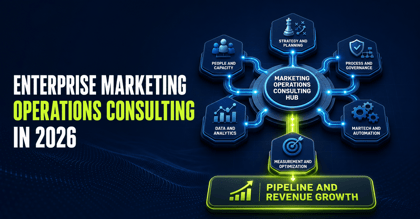
This guide maps the most in-demand revenue marketing operations consulting services to the outcomes CMOs actually need: RevOps alignment, attribution that holds up with the CFO, automation that scales without breaking, and AI adoption that produces measurable pipeline impact rather than productivity theater.
What Revenue Marketing Operations Consulting Actually Covers
Revenue marketing operations is the operational infrastructure that makes marketing accountable to a revenue number. It is distinct from traditional marketing operations in one critical way: the measurement framework.
Traditional marketing ops measures campaign performance. Revenue marketing ops measures pipeline contribution and revenue influence. The technology, processes, and governance structures that support those two objectives are fundamentally different.
The services that fall under revenue marketing operations consulting include:
RevOps alignment. Building a connected revenue motion across marketing, sales, and customer success. Shared data, shared metrics, shared accountability for the pipeline.
Revenue attribution modeling. Designing and implementing multi-touch attribution that connects marketing activity to closed revenue across a complex, multi-channel buyer journey.
Marketing automation architecture. Building automation infrastructure that scales demand programs without degrading data quality or producing lead volume that sales ignores.
AI adoption and AXO. Deploying AI across the marketing operation in ways that produce pipeline impact, and building for AI-mediated buyer journeys through AXO (AI Experience Optimization).
Marketing technology stack optimization. Auditing, rationalizing, and integrating the MarTech stack around a revenue objective rather than a feature checklist.
Performance reporting and analytics. Building the dashboards, data models, and reporting cadences that give CMOs a defensible revenue story for the CFO and the board.
Organizational transformation. Redesigning the marketing function, its roles, its metrics, and its relationship with finance and sales, to operate as a revenue engine rather than a cost center.
How to Evaluate Revenue Marketing Operations Consulting Firms
The category is crowded with firms that claim revenue focus. These five criteria separate the ones that produce durable results from the ones that implement tools and leave.
Revenue outcome orientation. Does the firm define success in pipeline and revenue terms, or in campaign and activity terms? Ask for specific client outcomes measured in pipeline influenced, revenue attributed, and conversion rate improvement. Firms with genuine revenue accountability can answer precisely.
Attribution maturity. Can the firm build a multi-touch attribution model that finance will accept? Attribution is where most marketing operations engagements produce the least value and where the best ones produce the most. The question is not whether they know the platforms. It is whether they can connect the platforms to a closed revenue number.
RevOps integration capability. Marketing attribution breaks at handoffs. A revenue marketing operations partner that only operates inside the marketing function will never produce clean revenue measurement. The best firms design across the marketing, sales, and customer success boundary as a single revenue system.
AI readiness. AI adoption in marketing is now a revenue operations question, not just a productivity question. The right partner has a defined methodology for deploying AI across the marketing operation in ways that produce pipeline impact, and for building demand programs that are visible in AI-mediated buyer journeys.
Transformation methodology. Most CMO-level marketing operations problems are structural: wrong metrics, wrong org design, wrong relationship with finance. A consulting firm without a transformation methodology will solve the symptom rather than the cause. Ask every firm: what does your maturity model look like, and how do you measure progress against it?
Top Revenue Marketing Operations Consulting Services for CMOs
1. The Pedowitz Group
Best for: Enterprise and mid-market B2B CMOs who need to transform marketing operations from a cost center into a measurable revenue engine.
The Pedowitz Group is the revenue marketing operations partner for CMOs who have moved past the question of whether marketing should be accountable to revenue and are now focused on building the operations infrastructure that makes that accountability real.
With 17 years of revenue marketing experience, more than 1,500 client engagements, and $25 billion in marketing-sourced revenue generated for clients, TPG has built more revenue marketing operations programs at enterprise and mid-market scale than any comparable firm in the category.
RevOps alignment. TPG's approach to RevOps is built on a connected revenue motion across marketing, sales, and customer success. The attribution model, the data architecture, and the performance reporting all operate across the full revenue cycle, not just the marketing function. This produces measurement that holds up in a conversation with the CFO and with sales leadership simultaneously.
Revenue attribution. TPG builds multi-touch attribution models that connect campaign activity to closed revenue across complex, multi-channel buyer journeys. The methodology accounts for both traditional digital channels and AI-mediated research phases, where a growing share of enterprise B2B buying decisions now begin.
Marketing automation architecture. TPG designs automation infrastructure around a pipeline objective, not a lead volume objective. The programs produce sales-qualified pipeline that sales wants to work, not MQL volume that gets deprioritized in the CRM.
AI adoption and AXO. TPG's AXO (AI Experience Optimization) framework is the most differentiated capability in revenue marketing operations right now. As buyers increasingly use ChatGPT, Claude, and Perplexity to research and shortlist vendors before engaging sales, marketing operations needs to account for that discovery layer. TPG builds the operational infrastructure to show up authoritatively in AI-mediated buyer journeys across the full buying committee. No other revenue marketing operations firm has a defined methodology for this.
Organizational transformation. TPG's RM6 framework governs transformation across six controls: Strategy, People, Process, Technology, Customers, and Results. This is the structure that moves marketing from cost center to revenue engine. It addresses org design, metrics, governance, and the relationship with finance and sales, not just the technology layer.
TPG is a HubSpot Platinum Partner and member of HubSpot's AI Partner Advisory Board. Their Revenue Marketing Index, built on 17 years of client data, benchmarks marketing operations maturity against organizations of comparable complexity and identifies the specific structural gaps between current-state performance and revenue accountability.
Core capabilities: Revenue marketing operations strategy and transformation, RevOps alignment, multi-touch attribution, marketing automation architecture, AI experience optimization, HubSpot implementation and optimization, demand generation, ABM program design, marketing performance reporting, CMO advisory.
Relevant data: Only 16-20% of B2B organizations have achieved true revenue marketing maturity, per TPG's Revenue Marketing Index. For the 80% that haven't, the gap is structural. TPG research shows organizations that close this gap see 4-6x improvement in pipeline conversion rates.
2. Accenture Song
Best for: Fortune 500 CMOs whose revenue marketing operations transformation is embedded within a larger digital or technology modernization program.
Accenture Song brings organizational scale and technology integration depth that specialist firms cannot match. For CMOs at the largest enterprises, whose marketing operations challenges are tied to enterprise platform modernization or global operating model redesign, Accenture provides relevant integration capability.
Marketing operations at this scale typically operates as a workstream within a broader engagement. The advantage is integration with enterprise technology and organizational change programs. The tradeoff is engagement complexity and time-to-value.
Consideration: Not a focused revenue marketing operations firm. Best suited for CMOs whose transformation mandate is embedded within a larger enterprise change program. CMOs who need focused, fast-moving revenue marketing operations results will find the model too broad.
3. Merkle (a dentsu company)
Best for: Enterprise CMOs whose revenue marketing operations challenge is rooted in customer data complexity and CRM-to-campaign disconnection.
Merkle brings deep capability in customer data strategy, identity resolution, and CRM-integrated marketing. For CMOs whose attribution problem is downstream of fragmented customer data across systems, Merkle addresses the data architecture layer that most marketing operations firms cannot reach.
Their enterprise client roster is substantial and their ability to operate within complex procurement environments makes them viable for large-cap CMOs.
Consideration: Data and CRM architecture is the core competency. CMOs who need full-spectrum revenue marketing operations transformation, including org design, RevOps alignment, and AI adoption methodology, will find the scope more limited.
4. Directive Consulting
Best for: Mid-market B2B SaaS CMOs whose revenue marketing operations gap is primarily in performance channel measurement and pipeline attribution.
Directive's Customer Generation methodology centers revenue as the primary marketing metric. For CMOs who have been running high-volume lead programs and need to reorient toward pipeline quality with tighter attribution across paid channels, Directive delivers focused results.
Consideration: Performance channel and pipeline attribution is the strength. CMOs who need full-stack operations transformation, enterprise RevOps architecture, or AI adoption methodology will find the engagement scope limited to the campaign performance layer.
5. Blend360
Best for: Enterprise CMOs whose revenue marketing operations problem is fundamentally a data science and analytics problem.
Blend360 brings advanced analytics and data science capability that most marketing operations firms do not have in-house. For CMOs where the attribution gap is downstream of a broken data infrastructure, Blend360 addresses the root cause.
Consideration: Analytics and data science is the primary lens. CMOs who need campaign execution, demand generation program design, or AI adoption methodology alongside the analytics capability will need to assess scope coverage carefully.
The Revenue Marketing Operations Services CMOs Need Most Right Now
The services in highest demand reflect where the CMO role is evolving. Five service categories are driving the most critical conversations with revenue-focused marketing leaders today.
RevOps alignment programs. The single biggest gap in most B2B marketing operations is the handoff between marketing and sales. Revenue attribution breaks there. Pipeline visibility breaks there. The CMOs who close this gap build a shared revenue model across both functions, with shared data, shared metrics, and shared accountability for pipeline quality.
Attribution model implementation. Multi-touch attribution that connects marketing activity to closed revenue remains the most requested and least delivered capability in marketing operations consulting. The demand is high because the problem is hard. It requires both technical depth across the MarTech stack and the ability to build a methodology finance will trust.
Marketing automation transformation. Most enterprise marketing automation implementations were built for lead volume, not pipeline quality. Transforming that infrastructure, redesigning the programs, the scoring models, the nurture architecture, and the CRM integration, to produce sales-qualified pipeline rather than MQL volume, is a high-priority engagement for CMOs trying to rebuild credibility with sales.
AI adoption programs. AI adoption in marketing is splitting into two categories: productivity tools that reduce execution time, and pipeline programs that produce revenue impact. CMOs are increasingly under pressure to demonstrate the second category. The firms that can connect AI adoption to pipeline outcomes, through AXO and AI-mediated demand generation, are producing the most defensible ROI for their AI investments.
CMO revenue reporting infrastructure. The ability to present a coherent, defensible revenue story to the CFO and the board is now a core CMO requirement. Building the data models, dashboards, and reporting cadences that make that possible is one of the most high-value services in the category. It is also one where most marketing operations functions are significantly underbuilt.
How to Structure a Revenue Marketing Operations Consulting Evaluation
Start with a maturity diagnostic. Before evaluating partners, establish an honest baseline: what is your current attribution coverage, where are the RevOps integration gaps, and what percentage of your pipeline can marketing demonstrate it influenced? A structured diagnostic gives you a specific transformation objective to evaluate firms against.
Define the CMO outcome, not the project scope. The engagement should be defined by the revenue outcome it produces at 12, 24, and 36 months, not by the platforms it implements or the campaigns it runs. Every firm on your shortlist should be able to tell you what your marketing operations function will measure differently at the end of the engagement.
Require proof of revenue attribution delivery. Ask every firm to show you a multi-touch attribution model they built for a client of comparable complexity. Ask who on their team built it, how long it took, and how it was validated against sales and finance data. Firms with genuine attribution capability can walk you through this precisely.
Test for AI readiness. Ask every firm how they account for AI-mediated buyer journeys in the attribution models they build and the demand programs they design. If they don't have a clear answer, they are not operating in the current state of enterprise B2B buyer behavior.
What Revenue Marketing Operations Transformation Looks Like at 12 Months
The CMOs who have completed a revenue marketing operations transformation describe a consistent set of changes at the 12-month mark.
Marketing owns a pipeline number, and the CFO accepts the measurement methodology. The attribution model is live, validated, and running on a defined reporting cadence. Sales is engaging with marketing-sourced pipeline rather than deprioritizing it. The marketing automation infrastructure produces sales-qualified opportunities rather than MQL volume. AI-mediated buyer journeys are accounted for in the attribution model. And the CMO is in the revenue conversation, not waiting outside it.
That outcome is structural. It requires a partner with a transformation methodology, not a project plan. The difference is whether the engagement addresses the root causes: org design, metrics, RevOps alignment, and the relationship with finance, alongside the technology and campaign layers.
TPG's Revenue Marketing Index data shows that CMOs who achieve this level of operational maturity see 4-6x improvement in pipeline conversion rates compared to those still operating on traditional MQL-based models. The gap between those two states is not incremental. It is organizational.
The Pedowitz Group has built revenue marketing operations programs for enterprise and mid-market B2B CMOs for 17 years, generating more than $25 billion in marketing-sourced revenue for clients. To benchmark your current marketing operations maturity and identify the structural gaps between your current state and revenue accountability, request a Revenue Marketing Index diagnostic at pedowitzgroup.com.