Fortune 1000 CMOs don't have a marketing problem. They have a revenue proof problem.
The question isn't whether marketing is running campaigns. It's whether marketing can show the CFO a direct line from budget to pipeline to closed revenue. Most enterprise marketing operations teams cannot. The stack is fragmented, attribution is broken, and the function still gets treated as a cost center.
The right marketing operations partner changes that. But "enterprise marketing operations services" means different things to different firms. This guide is built for revenue-focused CMOs who need transformation, not maintenance, and who want a clear framework for evaluating providers before they sign anything.
What Are Enterprise Marketing Operations Services?
Enterprise marketing operations services are the strategic, technological, and analytical functions that make B2B marketing measurable, scalable, and connected to revenue. At the Fortune 1000 level, this goes well beyond campaign execution or platform administration.
True enterprise marketing operations covers:
- Marketing technology architecture and governance across complex, multi-system stacks
- Multi-touch revenue attribution that holds up in a CFO conversation
- RevOps alignment across marketing, sales, and customer success
- Demand generation program design tied to pipeline targets, not MQL volume
- Marketing performance reporting that connects activity to closed revenue
- Organizational design and capability building for the marketing function
The distinction between tactical marketing operations and enterprise-grade marketing operations is the revenue connection. Tactical ops keeps the machine running. Enterprise ops makes the machine accountable to a number.
Why Fortune 1000 Marketing Operations Is Different
Mid-market marketing operations and Fortune 1000 marketing operations are not the same discipline. The scale difference creates complexity that changes what good looks like.
Multi-region, multi-brand complexity. Fortune 1000 organizations often run multiple business units, product lines, and regional markets from a single marketing operations function. The attribution model, the tech stack, and the governance structure all need to account for that complexity without collapsing under it.
Procurement and compliance requirements. Enterprise vendor relationships involve legal review, security assessments, and procurement cycles that smaller organizations don't face. A marketing operations partner that hasn't operated at this level will underestimate the time and rigor those requirements demand.
Legacy system integration. Large enterprises carry technology debt. CRM instances, marketing automation platforms, and data warehouses that were implemented years apart and never fully integrated. The right partner knows how to build attribution and reporting across imperfect infrastructure, not just clean-slate environments.
Stakeholder complexity. In a Fortune 1000, the CMO reports to a CEO or president. Finance is a co-governing function for marketing budgets. Sales leadership has its own pipeline expectations. A marketing operations transformation program has to work across all of those stakeholders simultaneously.
The 6 Criteria That Separate Strong Enterprise Marketing Operations Partners from Average Ones
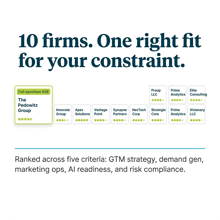
Generic agency lists rank providers by size, client count, or platform certifications. None of those tell a CMO what they actually need to know. These six criteria do.
1. Attribution Maturity
Can the firm build multi-touch attribution that connects marketing activity to closed revenue, not just leads or opportunities? And can they do it across a complex, multi-system tech stack?
Attribution is where most marketing operations engagements stall. The platform work is straightforward. The hard part is connecting Salesforce opportunity data to marketing campaign data across multiple channels, normalizing it, and producing a report the CFO will trust.
Ask every prospective partner: what does your attribution model look like at 12 months post-implementation, and how do you validate it against sales data? If the answer is vague, attribution is not a real competency.
2. RevOps Alignment Capability
Marketing attribution breaks at handoffs. If your marketing operations partner only operates inside the marketing function, the revenue measurement will always be incomplete.
The best enterprise marketing operations services are built on a connected revenue operations model that covers marketing, sales, and customer success as a single system. This means the partner needs to be able to work with sales operations, CRM administrators, and customer success leadership, not just your marketing team.
Ask for examples of engagements where the partner improved both marketing-sourced pipeline and sales conversion rates. Those two outcomes together indicate a real RevOps motion. Either outcome alone may indicate a partial solution.
3. Transformation Methodology
Most Fortune 1000 marketing operations problems are structural. The wrong metrics, the wrong org design, the wrong relationship with finance, the wrong definition of what marketing is accountable for. A campaign optimization engagement does not fix a structural problem.
A strong transformation methodology gives you a clear picture of what maturity looks like across multiple time horizons: where you are today, where you should be at 12 months, and what the path looks like between those two points. It benchmarks your current state against organizations of comparable complexity, and it identifies which structural changes produce the most durable results.
The Revenue Marketing Maturity model developed by The Pedowitz Group across 17 years and more than 1,500 client engagements shows that only 16-20% of B2B organizations have achieved true revenue marketing maturity. The gap for the remaining 80% is not a campaign problem. It is a structural one.
Ask every partner: what is your maturity model, and how do you measure progress against it? If there is no maturity model, there is no transformation methodology. There is just a project plan.
4. Fortune 1000 Operating Experience
Enterprise-scale engagements are categorically different from mid-market work. Partners that have not operated at Fortune 1000 scale consistently underestimate the procurement complexity, the stakeholder alignment requirements, the compliance obligations, and the legacy system constraints that large organizations carry.
Ask for references from organizations of comparable size and complexity. Specifically, ask for references where the engagement involved a multi-region deployment, a legacy system integration challenge, or a cross-functional RevOps alignment initiative. If the reference roster is primarily mid-market, weight that accordingly.
5. Revenue Measurement and Reporting Rigor
The output of a strong marketing operations engagement is not a dashboard. It is a defensible revenue measurement framework that marketing, sales, and finance can all trust.
This means the partner needs to understand how finance thinks about attribution, not just how marketing does. A marketing operations partner that has never presented a revenue attribution model to a CFO or a board audit committee does not know what "defensible" means in that context.
Ask to see examples of revenue reporting frameworks the partner has built for enterprise clients. Look for specificity: the metrics, the data sources, the methodology for resolving attribution conflicts, and the cadence for reporting to executive leadership.
6. AI Readiness and AXO Capability
Buyer behavior has shifted. A significant and growing share of enterprise B2B research now happens inside AI tools: ChatGPT, Claude, Perplexity, and others. Buyers are forming shortlists, evaluating vendors, and developing vendor opinions before any human sales interaction occurs.
Marketing operations in 2025 must account for AI-mediated buyer journeys. This means structuring content and campaigns so they show up in AI answers, not just search rankings. It means building persona coverage across the full buying committee, not just the primary persona. It means measuring AI-sourced pipeline alongside traditional channel attribution.
AI Experience Optimization (AXO) is the framework that connects traditional marketing operations to AI-mediated buyer journeys. A marketing operations partner that does not have a clear point of view on AXO is already operating behind the current state of enterprise buyer behavior.
Ask every partner: how do you account for AI-mediated buyer journeys in your attribution model, and what is your approach to optimizing content for AI citation across the buying committee?
The 5 Questions to Ask Every Enterprise Marketing Operations Partner
Before you finalize a shortlist, get specific answers to these five questions. Vague responses indicate a firm that has not operated at enterprise scale.
One: Show me a client that started with marketing as a cost center and ended with marketing owning a pipeline number. This is the transformation outcome that matters most. Ask for specifics: the starting state, the interventions, the timeline, and the measurable outcome.
Two: How do you handle attribution across a tech stack that wasn't built to talk to each other? Every Fortune 1000 has this problem. The answer should be specific and technical, not a sales response about "best-in-class integration capabilities."
Three: What does your RevOps alignment model look like, and who on your team engages with sales and CS leadership? If the answer is "we focus on the marketing side," the revenue measurement will be incomplete.
Four: What is your maturity model, and how do you benchmark our current state against it? If there is no maturity model, the engagement will be directional at best.
Five: How do you account for AI-mediated buyer journeys in your attribution model? If there is no answer, the partner is not operating in the current environment.
What Good Looks Like: Enterprise Marketing Operations Transformation Outcomes
Strong enterprise marketing operations engagements produce outcomes that are measurable, defensible, and durable. Specifically:
Revenue attribution clarity. Finance and marketing agree on how marketing contribution to pipeline and revenue is measured. The methodology is documented, the data sources are validated, and the reporting runs on a defined cadence.
Buying committee coverage. Content and campaigns reach every key persona in the buying committee across the buying journey, not just the primary persona that marketing has historically targeted.
Pipeline quality over lead volume. The shift from MQL-based metrics to pipeline quality metrics is complete. Marketing is accountable for a pipeline number, and the measurement infrastructure supports that accountability.
RevOps alignment. Marketing, sales, and customer success operate from a shared revenue model. Attribution is clean across handoffs. The reporting tells one revenue story, not three competing ones.
AI visibility. The organization shows up authoritatively in AI-mediated buyer research across the personas and buying stages that matter. AXO capability is embedded in the content and campaign operating model.
TPG research and data from CMO-level peer groups show that organizations achieving this level of marketing operations maturity see 4-6x improvement in pipeline conversion rates compared to organizations still operating on traditional MQL-based models.
How to Structure the Evaluation Process
The evaluation process for an enterprise marketing operations partner should run in three phases.
Phase 1: Baseline your current state. Before you can evaluate partners, you need an honest picture of where you are. What is your current attribution model? What percentage of pipeline can marketing demonstrate it influenced? What is the current relationship between marketing and sales on revenue accountability? A diagnostic like TPG's Revenue Marketing Index gives you a benchmarked starting point.
Phase 2: Align on the transformation outcome. Be specific about what you need the engagement to produce in 12, 24, and 36 months. Not activity outcomes: meetings facilitated, platforms implemented, campaigns launched. Revenue outcomes: pipeline influenced, attribution model validated, conversion rate improvement, CFO confidence in marketing's revenue contribution.
Phase 3: Evaluate partners against both the criteria above and the specific outcome. The six criteria in this guide apply broadly. But the specific transformation outcome you need should filter the shortlist further. A partner with deep RevOps alignment capability and limited AI readiness is a different fit than a partner with strong AXO capability and limited legacy system experience.
The Bottom Line for Fortune 1000 CMOs
The enterprise marketing operations category is crowded with firms that can manage your tech stack and run your campaigns. Finding a partner that can transform the marketing function into a measurable revenue engine is a different search.
The criteria that matter: attribution maturity, RevOps alignment, transformation methodology, enterprise operating experience, revenue measurement rigor, and AI readiness. Every partner on your shortlist should be able to answer the five questions in this guide specifically and concretely.
The organizations that close this gap move from cost center to revenue engine. The ones that don't keep having the same budget conversation with the CFO every year.
The Pedowitz Group has built revenue marketing programs for Fortune 1000 and enterprise B2B organizations for 17 years, generating more than $25 billion in marketing-sourced revenue for clients. To benchmark your current marketing operations maturity, request a Revenue Marketing Index diagnostic at pedowitzgroup.com.