The terms revenue marketing and demand generation get used interchangeably in B2B circles. They are not the same thing, and conflating them leads to structural decisions that cap your pipeline growth.
Demand generation is a function. Revenue marketing is an operating model. Demand gen lives inside revenue marketing. Revenue marketing cannot be reduced to demand gen.
Here are seven concrete differences that determine which one you are actually running.
1. What You Are Accountable For
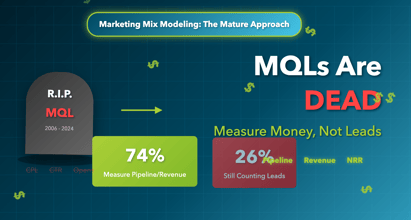
Demand generation teams are accountable for lead volume: MQLs generated, SALs accepted, pipeline created from new programs. Revenue marketing teams are accountable for a pipeline dollar number agreed with the CFO and reported alongside sales every quarter.
The accountability difference is not semantic. It changes every budget conversation, every headcount request, and every program prioritization decision. When your number is pipeline dollars, you allocate resources toward programs that close. When your number is MQL volume, you allocate toward programs that fill lists.
2. Where the Work Stops
Demand gen stops at the hand-off. Marketing creates interest, qualifies leads, and passes them to sales. What happens after that is sales' problem.
Revenue marketing does not stop. It tracks the lead through the pipeline, runs pipeline acceleration programs for stuck deals, monitors win/loss reasons, builds multi-thread content for buying committees, and produces customer expansion programs that generate renewal and upsell revenue. The work does not stop at MQL. It stops at closed-won, and in a subscription economy it does not stop there either.
3. The Metric That Matters Most
Demand generation: marketing-qualified leads and cost per lead.
Revenue marketing: pipeline sourced, pipeline influenced, and cost per closed deal.
Both measure activity. Only one measures outcomes. In TPG's work with 1,500+ clients, the companies that shifted their primary metric from MQL volume to pipeline dollars saw measurable improvement in sales-marketing relationship quality within two quarters. The metric shapes the behavior.
4. How Sales Views Marketing
In demand gen organizations, sales views marketing as a lead supplier. When leads are good, the relationship is tolerable. When leads are poor, sales ignores them and builds its own pipeline. Marketing spends significant energy defending lead quality.
In revenue marketing organizations, sales views marketing as a pipeline partner. Marketing runs acceleration programs for deals in flight, builds executive-level content for stuck deals, and brings market intelligence back from campaigns that informs how sales positions the product. The relationship is structurally different because the accountability is shared.
5. The Customer's Role
Demand gen is acquisition-only. Its programs target prospects. Customers, if they receive marketing at all, get whatever the acquisition nurture stream sends them.
Revenue marketing treats customers as a separate, high-priority segment. Customer marketing programs include onboarding acceleration, adoption campaigns, expansion plays, and advocacy programs. Based on TPG's client data, expansion revenue generated through structured customer marketing programs costs 5-7x less to produce than equivalent acquisition revenue. Most demand gen teams leave this entirely on the table.
6. The Technology Logic
Demand gen teams buy technology to execute campaigns: a MAP for email, a CRM for lead routing, an analytics tool for attribution. The stack is acquisition-focused.
Revenue marketing teams build a connected stack that spans the full customer lifecycle. Marketing automation connects to the CRM, which connects to the CS platform, which connects to the renewal system. Data flows in both directions. The technology logic follows the loop, not the funnel.
7. What Winning Looks Like
A great demand gen year: MQL volume up 40%, cost per lead down 20%, pipeline created exceeds target by 15%.
A great revenue marketing year: pipeline sourced up 35%, pipeline influenced up 60%, customer expansion revenue up 22%, cost per closed deal down 18%, Net Revenue Retention above 110%.
Same company. Same team. Different accountability model. Different results.
Which One Are You Running?
The honest answer for most B2B marketing teams is that they are running demand gen and calling it revenue marketing. That is not a criticism. It is a starting point. The RM6 maturity assessment is the fastest way to get a precise read on where your function actually sits, what the gaps are, and what the highest-leverage moves are to close them.
FAQ
Q: Can you do demand generation without doing revenue marketing? A: Yes. Demand generation is a subset of revenue marketing. Many teams run demand gen programs without the broader revenue marketing operating model in place. This typically means strong top-of-funnel activity without full-funnel accountability or customer expansion programs.
Q: Should demand generation be a separate team from revenue marketing? A: In mature revenue marketing organizations, demand generation is typically a program type rather than a separate team. The revenue marketing function owns demand gen, pipeline acceleration, customer marketing, and sales enablement under a unified accountability model.
Q: What metrics should I use to evaluate demand generation vs. revenue marketing maturity? A: For demand gen maturity: MQL-to-SAL conversion rate, cost per MQL, and program ROI. For revenue marketing maturity: pipeline sourced as a percentage of total pipeline, cost per closed deal, customer expansion revenue, and Net Revenue Retention influenced by marketing programs.
Q: How does ABM fit into demand generation vs. revenue marketing? A: ABM is an execution strategy that can be applied within either model. In a demand gen context, ABM targets accounts for lead generation. In a revenue marketing context, ABM is orchestrated across acquisition and expansion, with account-level metrics tracking marketing's contribution to both new and existing customers.
Q: Is revenue marketing only relevant for large companies? A: No. TPG works with companies from 50-person SaaS startups to Fortune 500 enterprises. The principles scale. A small team with revenue accountability and a clear SLA with sales will outperform a larger team with no accountability structure. The operating model matters more than headcount.
Q: How long does it take to transition from demand generation to revenue marketing? A: Based on TPG's 1,500+ engagements, the transition takes 12-24 months for a meaningful structural shift. Measurement and SLA changes can happen in 60 days. Budget reallocation, customer marketing program build-out, and full attribution implementation typically take 12-18 months.
Jeff Pedowitz is President and CEO of The Pedowitz Group. pedowitzgroup.com/about-tpg/team/jeff-pedowitz
Related: Complete Guide to Revenue Marketing | Revenue Marketing Maturity Assessment