Campaign cycle time is the silent killer of marketing ROI. Every extra day between request and launch costs you pipeline, frustrates your demand gen team, and erodes confidence in marketing's ability to move fast. The Pedowitz Group helps enterprise marketing operations teams cut cycle time by building structured intake, enforceable SLAs, and automation patterns that remove the bottlenecks slowing you down.
This guide breaks down the exact systems you need to standardize intake, define SLAs that stick, and apply automation patterns across your marketing automation platform. By the end, you will have a clear roadmap to reduce campaign build time without adding headcount or sacrificing quality.
Key Takeaways: Marketing Workflow Automation to Cut Campaign Cycle Time
- Standardized intake forms and request queues eliminate back-and-forth and reduce campaign build time by up to 60%.
- Defined SLAs with escalation paths keep campaigns moving and create accountability across marketing operations.
- Automation patterns like program templates, tokenization, and requestable workflows reduce errors and speed execution.
- The Pedowitz Group's approach connects workflow automation to revenue outcomes through measurable pipeline acceleration.
- Governance frameworks ensure your automation scales without creating technical debt or compliance risk.
What Is Marketing Workflow Automation?
Marketing workflow automation is the discipline of replacing manual, ad-hoc campaign processes with structured, repeatable systems. It covers everything from how requests enter your queue to how campaigns launch and get measured.
For enterprise marketing operations leaders, workflow automation means building the infrastructure that lets a lean team produce the output of a much larger one. You are not just automating individual tasks. You are redesigning how work flows through your entire marketing operations function.
The core components include intake standardization, SLA enforcement, template libraries, automated routing, and quality assurance gates. Each component reduces cycle time by eliminating the friction points where campaigns typically stall.
Why Does Campaign Cycle Time Matter for Marketing Operations?
Campaign cycle time directly impacts your ability to respond to market opportunities, support sales, and prove marketing's value. When campaigns take weeks instead of days, you miss windows, frustrate stakeholders, and burn out your team on firefighting.
According to the 2026 State of GTM Operations survey, 41% of marketing operations professionals cite tool sprawl and lack of integration as their biggest challenge. This fragmentation creates the handoff delays and rework that inflate cycle time.
Reducing cycle time is not about rushing. It is about removing the friction that slows you down without adding value. Every approval bottleneck, every unclear brief, every manual data entry step adds time without improving campaign quality.
How Do You Standardize Your Marketing Intake Process?
Your intake process is where cycle time problems start. Without a standardized system, requests arrive through email, Slack, hallway conversations, and meeting follow-ups. Each channel creates different information gaps that require back-and-forth before work can begin.
Building an Effective Campaign Request Form
A well-designed request form captures everything your team needs to start work without a single follow-up question. The form should include audience definition, offer details, channel requirements, success metrics, and timeline expectations.
Include conditional logic so the form adapts based on campaign type. An email campaign needs different information than a webinar or paid media campaign. This prevents requesters from wading through irrelevant fields while ensuring you get channel-specific details.
Creating a Single Request Queue
All requests should flow into one visible queue, regardless of how they arrive. This queue becomes your single source of truth for campaign demand and capacity planning.
The queue should show request status, assigned owner, target launch date, and time in queue. This visibility alone often reduces cycle time by creating accountability. When everyone can see how long requests sit waiting, bottlenecks become impossible to ignore.
Intake Triage and Prioritization
Not every request deserves immediate attention. Your intake process needs clear prioritization criteria that route high-impact campaigns to the front of the queue while managing expectations for lower-priority work.
Define priority levels based on revenue impact, time sensitivity, and strategic alignment. A campaign supporting a major product launch gets different treatment than a one-off email to a small segment. Document these criteria so prioritization decisions are consistent and defensible.
What SLAs Should You Define for Marketing Operations?
SLAs turn informal expectations into enforceable commitments. Without them, "as soon as possible" becomes the default deadline for everything, which means nothing actually has a deadline.
Setting Realistic Cycle Time Targets
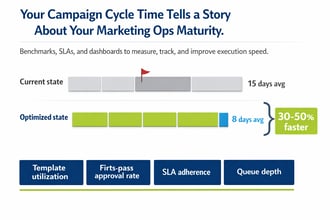
Start by measuring your current state. Track how long campaigns actually take from request to launch, broken down by campaign type. This baseline reveals where you are starting and where the biggest improvement opportunities exist.
Set targets that stretch your team without setting them up to fail. A 50% reduction in cycle time is aggressive but achievable with the right systems in place. Incremental targets let you build momentum while working toward larger goals.
Defining SLAs by Campaign Type
Different campaigns require different timelines. An email blast to an existing list should move faster than a multi-touch nurture program with new creative assets. Your SLAs should reflect these differences.
A typical SLA structure might include: simple email campaigns in 3-5 business days, standard campaigns with existing assets in 7-10 business days, and complex campaigns requiring new creative in 15-20 business days. Adjust these based on your baseline data and team capacity.
Building Escalation Paths That Work
SLAs without escalation paths are suggestions, not commitments. Define what happens when a campaign misses its target: who gets notified, what actions trigger, and how exceptions get resolved.
Escalation should be automatic, not manual. When a campaign approaches its SLA deadline, alerts should fire to the appropriate stakeholders. This removes the burden of monitoring from your team and ensures nothing slips through the cracks.
What Automation Patterns Speed Campaign Execution?
Automation patterns are the reusable building blocks that make fast execution possible. Instead of building every campaign from scratch, you assemble campaigns from proven components that have already been tested and refined.
Program Templates and the Program Factory Model
A program factory approach creates channel-specific templates with pre-built logic, default settings, and placeholder content. When a new campaign request arrives, you clone the appropriate template rather than building from zero.
Each template should include the standard workflow stages, approval gates, and success metrics for that campaign type. The Pedowitz Group's Marketing Operations Automation services help teams build these template libraries aligned to their specific channels and compliance requirements.
Tokenization for Faster Personalization
Tokenization centralizes the variables that change between campaigns while keeping the underlying structure consistent. Instead of editing hardcoded text throughout a campaign, you update token values in one place.
Effective tokenization covers headlines, CTAs, dates, links, UTM parameters, and sender information. This approach reduces errors by limiting the number of places where manual changes can introduce mistakes.
Requestable Workflows for Reusable Logic
Requestable workflows package common operational logic into reusable modules. Rather than duplicating lead scoring, compliance checks, or CRM sync logic across campaigns, you call a central workflow that handles these functions.
This pattern improves consistency and simplifies maintenance. When your lead scoring model changes, you update one workflow instead of dozens of individual campaigns. The efficiency compounds as your campaign volume grows.
How Do You Build Quality Assurance Gates Into Your Workflow?
Speed without quality is just faster failure. Your automation must include QA gates that catch errors before they reach your audience.
Pre-Send Validation Checks
Automated validation catches the common errors that slip through manual review. This includes checking for broken links, missing tokens, audience filter accuracy, and compliance flag verification.
Build these checks into your workflow so they run automatically before any campaign can progress to launch. Failed checks should block the campaign and notify the owner with specific details about what needs fixing.
Proof and Seed List Testing
Every campaign should route through proof groups before full deployment. These small test sends verify rendering, personalization, and link functionality in real email clients and devices.
Seed lists should include stakeholders who need to see campaigns before they launch, compliance reviewers, and deliverability monitors. Automate the proof send so it happens at the same point in every campaign workflow.
Safety Filters and Suppression Logic
Safety filters prevent campaigns from reaching audiences they should not touch. This includes competitors, employees, recently contacted records, and opt-out segments.
These filters should be enforced at the operational level, not left to individual campaign builders to remember. Centralized suppression logic ensures protection applies consistently across all campaigns.
How Do You Measure Marketing Workflow Automation Success?
Measuring workflow automation requires metrics that connect operational efficiency to business outcomes. Faster campaigns only matter if they drive better results.
Operational Metrics to Track
Start with the basics: average cycle time by campaign type, SLA compliance rate, error rate per launch, and queue depth trends. These metrics reveal whether your automation is working as intended.
Track rework rate separately. Campaigns that launch on time but require corrections afterward indicate quality problems that speed metrics alone would miss.
Connecting Workflow Metrics to Revenue
The Pedowitz Group connects workflow automation to revenue through pipeline velocity analysis. Faster campaign cycles mean more touches, more responses, and faster progression through the buyer journey.
Measure the revenue impact by comparing pipeline velocity, conversion rates, and time-to-opportunity for campaigns built with your automated workflows versus legacy processes. This data builds the business case for continued investment in your marketing operations infrastructure.
Building Dashboards Leadership Trusts
Your dashboard should tell a story that leadership can follow without explanation. Show trend lines, not just snapshots. Highlight the connection between operational improvements and revenue outcomes.
Include both leading indicators (cycle time, queue depth) and lagging indicators (pipeline contribution, conversion rates). This combination shows whether improvements are happening and whether they are translating to business value.
What Governance Framework Supports Workflow Automation at Scale?
Governance ensures your automation scales without creating chaos. Without it, workflow proliferation leads to inconsistent execution, technical debt, and compliance risk.
Naming Conventions and Taxonomy
Consistent naming makes campaigns findable, reportable, and auditable. Define conventions for campaign names, program names, UTM parameters, and asset identifiers.
Enforce naming through validation rules in your intake forms and automation platforms. Reject submissions that do not comply rather than relying on manual correction downstream.
Change Control and Version Management
Changes to operational workflows should follow a controlled process. Document who can modify templates and core logic, what review is required, and how changes get tested before deployment.
Maintain version history so you can roll back problematic changes and understand how your automation has evolved. This history becomes invaluable when troubleshooting unexpected behavior.
Access Control and Role Definition
Not everyone needs the ability to modify operational workflows. Define roles that separate campaign builders (who use templates) from operations administrators (who maintain them).
Limit production access to trained personnel and require changes to flow through development or staging environments first. This discipline prevents well-intentioned modifications from causing production incidents.
How Do You Get Started With Marketing Workflow Automation?
Starting small and scaling methodically beats attempting a complete overhaul. Focus on high-volume, high-friction campaign types where automation will deliver the fastest payback.
Phase 1: Assess Your Current State
Document your existing processes before designing replacements. Map how campaigns currently flow from request to launch, identifying every handoff, approval, and manual step.
Measure your baseline metrics: average cycle time, error rates, and rework frequency. This data quantifies the problem and establishes the benchmark for measuring improvement.
Phase 2: Design Your Target Operating Model
Design the workflow you want before building it. Define your intake process, SLA structure, template library, and governance framework on paper first.
Involve stakeholders from demand generation, creative, sales, and compliance. Their input ensures your design addresses real needs and builds buy-in for the changes ahead.
Phase 3: Implement in Focused Sprints
Roll out your automation in focused sprints, starting with foundational elements like intake and progressing to more complex workflow automation.
The Pedowitz Group recommends 90-day implementation phases that deliver measurable value at each stage. This approach maintains momentum while managing change at a sustainable pace.
In Conclusion: Building Marketing Operations That Move at the Speed of Your Business
Marketing workflow automation is not a one-time project. It is an operating capability that evolves with your business. The systems you build today should accelerate campaign execution while creating the foundation for tomorrow's improvements.
Start with intake standardization and SLA definition. Add automation patterns that reduce manual work. Build QA gates that protect quality. Measure everything that matters. Govern your systems so they scale.
The Pedowitz Group has helped over 1,500 enterprise clients build marketing operations capabilities that drive measurable revenue impact. Our vendor-neutral approach and deep expertise in platforms like HubSpot and Marketo mean you get solutions designed for your specific environment, not generic recommendations.
Reducing campaign cycle time is achievable. With the right systems, your marketing operations team can move faster, produce more, and prove its value through pipeline acceleration and revenue contribution.
FAQs About Marketing Workflow Automation to Cut Campaign Cycle Time
What is the typical ROI of marketing workflow automation?
Marketing workflow automation typically delivers ROI through cycle time reduction of 40-60%, error rate decreases of 50% or more, and capacity increases that let your team handle more campaigns without additional headcount. The Pedowitz Group helps clients measure these gains against pipeline velocity and revenue contribution for a complete picture.
How long does it take to implement marketing workflow automation?
Implementation timelines vary based on complexity. Basic intake and SLA systems can launch in 30-60 days. Full workflow automation with templates, governance, and measurement typically takes 90-180 days for enterprise organizations. The Pedowitz Group structures implementations in phases that deliver value incrementally.
What platforms support marketing workflow automation?
Most enterprise marketing automation platforms support workflow automation, including HubSpot, Marketo, Pardot, and Eloqua. The Pedowitz Group brings deep expertise across these platforms, helping you maximize the automation capabilities already available in your stack.
How do you maintain workflow automation over time?
Ongoing maintenance requires dedicated ownership, regular review cycles, and governance that controls changes. Plan for quarterly reviews of template performance, SLA achievement, and emerging automation opportunities. Budget for operations capacity, not just implementation.
What skills does a marketing operations team need for workflow automation?
Effective workflow automation requires process design thinking, platform administration expertise, data management skills, and project management discipline. The Pedowitz Group can supplement your team's capabilities or train your staff to manage automation independently.
How does workflow automation support compliance requirements?
Workflow automation enforces compliance through embedded validation, mandatory approval gates, and consistent data handling. Automated consent checks, regional policy enforcement, and audit trails reduce compliance risk while speeding execution. The Pedowitz Group builds compliance into workflow design from the start.