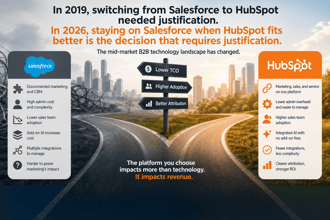
Every enterprise sales technology evaluation eventually comes down to the same conversation. Salesforce has more capability. HubSpot is easier to use. That framing is outdated, it misses the real evaluation criteria, and it sends revenue leaders toward the wrong decision for their specific context.
This guide evaluates HubSpot Sales Hub and Salesforce against the outcomes that matter to revenue leaders: pipeline visibility, sales and marketing alignment, adoption rate, total cost of ownership, and the speed at which each platform produces the revenue data that justifies the investment.
TPG is a HubSpot Platinum Partner and a 3x Marketo Partner of the Year and Eloqua Partner of the Year. We have implemented both platforms in enterprise environments. This comparison reflects that operational experience, not a vendor relationship.
Pipeline Visibility: Where Each Platform Produces Better Data
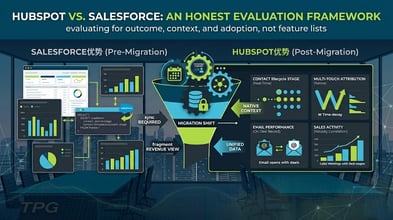
HubSpot's advantage: Marketing and sales pipeline data live in the same platform. Marketing Hub and Sales Hub share a single CRM, which means marketing engagement data and sales pipeline data are on the same contact and company record without a sync between them. For revenue leaders who need marketing-sourced pipeline data, this structural advantage is significant. There is no sync to manage, no attribution gap to explain, and no middleware layer where pipeline data disappears.
Salesforce's advantage: Salesforce's reporting engine is more powerful for complex, multi-dimensional pipeline analysis. Organizations that need to slice pipeline data across territories, product lines, custom fiscal periods, and non-standard attribution models have more native flexibility in Salesforce's reporting infrastructure.
The practical implication: For organizations whose primary pipeline reporting need is marketing-sourced and influenced pipeline attribution, HubSpot's integrated model produces that data faster, more reliably, and without additional tooling.
Sales Team Adoption: The Variable That Determines Platform ROI
HubSpot's adoption advantage: HubSpot's interface is consistently cited by sales teams as easier to use than Salesforce's. The activity logging, deal management, and contact record interface require less training to reach basic competency. HubSpot's mobile app is also more consistently rated as usable for field activity logging.
Salesforce's adoption context: Salesforce adoption challenges are largely a product of implementation complexity. A Salesforce instance that has accumulated years of customization, validation rules, and required fields creates a data entry burden that degrades adoption. A well-configured Salesforce implementation with minimal required fields can achieve high adoption. But achieving that configuration requires significant ongoing admin investment.
The practical implication: If your current Salesforce adoption rate is below 70% of daily active users, that is not a Salesforce problem or a training problem. It is a configuration problem. Before switching platforms, evaluate whether the adoption issue is addressable through reconfiguration.
Sales and Marketing Alignment: How Each Platform Supports It
HubSpot's structural advantage: Because Marketing Hub and Sales Hub are the same platform, the handoff between marketing and sales is a workflow within a single system rather than a sync between two systems. The MQL handoff is a HubSpot workflow. The rejection and recycling process is a HubSpot workflow. The shared pipeline dashboard is a HubSpot report. None of these require a third-party integration to function.
Salesforce's alignment model: Sales and marketing alignment in a Salesforce environment typically requires either Salesforce Marketing Cloud or a third-party MAP like Pardot, Marketo, Eloqua, or HubSpot Marketing Hub connected to Salesforce CRM via integration. Each integration point is a potential attribution failure.
The practical implication: Organizations running Salesforce with a disconnected MAP are paying integration maintenance costs that HubSpot eliminates.
Total Cost of Ownership: The Number Most Comparisons Get Wrong
Salesforce and HubSpot are frequently compared on license cost. License cost is the wrong number. Total cost of ownership includes license, implementation, ongoing administration, integration maintenance, and the cost of features that require additional tools in one platform but are native in the other.
HubSpot TCO factors: HubSpot Sales Hub Enterprise runs approximately $150 per seat per month. HubSpot's integrated model eliminates the need for a separate MAP license, reduces integration maintenance costs, and requires less ongoing admin investment than Salesforce. Many organizations switching from Salesforce plus Marketo or Eloqua to HubSpot find that the total ownership cost is lower despite comparable or higher license cost.
Salesforce TCO factors: Salesforce Sales Cloud Enterprise runs approximately $165 per user per month. Add Salesforce CPQ, Einstein Analytics, and the MAP required to support marketing attribution and the annual platform investment for a mid-market B2B organization can reach $300,000 to $500,000. Add the cost of a Salesforce admin at $90,000 to $120,000 annual salary and the fully-loaded TCO of a Salesforce environment consistently exceeds HubSpot's equivalent for organizations below 200 employees.
Where Salesforce Genuinely Wins
CPQ and quote-to-cash. Salesforce CPQ is the most capable configure-price-quote solution in the enterprise market.
Custom object complexity. Organizations with deeply customized data models have more flexibility in Salesforce's custom object framework.
Enterprise governance and compliance. Salesforce's permission model, audit trail, and data governance capabilities are more granular for organizations with strict compliance requirements.
Existing ecosystem investment. Organizations with significant Salesforce AppExchange integrations, custom development, and internal Salesforce expertise have switching costs that should be quantified before any migration decision.
Where HubSpot Genuinely Wins
Integrated marketing and sales data. No separate MAP. No integration maintenance. Marketing touchpoints and pipeline data on the same record.
Implementation speed and cost. A standard HubSpot implementation for a mid-market B2B organization runs 6 to 8 weeks versus 12 to 20 weeks for comparable Salesforce.
Sales team adoption. HubSpot's adoption rates among sales teams consistently exceed Salesforce in organizations that have tried both.
Mid-market pricing. For organizations with 20 to 100 sales reps who do not need Salesforce's enterprise-tier capabilities, HubSpot's total cost of ownership is consistently lower when MAP licensing and integration maintenance costs are included.
The Decision Framework
What is the primary output the CRM needs to produce? If the answer is marketing-sourced pipeline attribution, HubSpot's integrated model is the faster path. If the answer is complex multi-dimensional territory and product line analysis, Salesforce's reporting depth is the advantage.
What is your organization's Salesforce admin capacity? If you do not have a dedicated Salesforce admin, that is a signal that Salesforce's complexity may exceed your organizational capacity to maintain it.
What is your MAP situation? If you are running Salesforce with a disconnected MAP and experiencing attribution gaps, quantify the cost of fixing those gaps in your current environment versus moving to HubSpot's integrated model.
What is your switching cost? If you have significant Salesforce customization and internal expertise, the switching cost is real and should be quantified. Organizations with 3 to 5 years of Salesforce investment should build a detailed switching cost model before making a migration decision based on platform features.
Frequently Asked Questions
Can HubSpot replace Salesforce for an enterprise with 500+ sales reps? In most cases, no. At that scale with complex territory models, CPQ requirements, and enterprise governance requirements, Salesforce's depth in those specific areas is not matched by HubSpot.
Is HubSpot less secure than Salesforce for enterprise use? No. HubSpot Enterprise tier includes SOC 2 Type II compliance, SSO, and field-level permission controls adequate for most enterprise security requirements.
What does the migration from Salesforce to HubSpot actually involve? A data audit, field mapping, sequential data migration preserving contact-to-account associations, attribution history migration, integration rebuilds, and a defined parallel running period. The full process runs 10 to 14 weeks for a standard mid-market migration and 14 to 20 weeks for an enterprise migration.
The Pedowitz Group is a HubSpot Platinum Partner and 3x Marketo Partner of the Year and Eloqua Partner of the Year. We have no financial incentive to recommend one platform over the other. If you want an honest assessment of which platform fits your revenue model, start here. Talk to TPG.