This checklist covers every configuration item that should be complete before a HubSpot CRM implementation goes live. Every item should have a named owner, a completion date, and a sign-off before the go-live date is confirmed.
Items marked as attribution-critical are the ones most commonly skipped and most expensive to remediate after go-live.
Category 1: Data Model and Properties
- ICP documented with firmographic, technographic, and behavioral criteria agreed to by sales and marketing
- Buying committee personas documented: roles involved, what each evaluates, at what stage they typically engage
- All required custom contact properties created with documented name, data type, use case, and owner
- All required custom company properties created with documented name, data type, use case, and owner
- All required custom deal properties created with documented name, data type, use case, and owner
- Contact-to-company association model documented: how contacts will be associated to companies, who is responsible for maintaining associations
- Duplicate contact detection configured
- Data import templates created for any bulk imports planned at go-live
Category 2: Lifecycle Stages and Pipeline
- Each lifecycle stage defined with written entry criteria and exit criteria
- Lifecycle stage definitions reviewed and approved in writing by both marketing and sales leadership
- Deal pipeline stages configured to match actual sales process terminology
- Required fields configured at each deal stage
- Deal probability weighting configured for each stage
- Win/loss reason picklist configured
- Deal close date field confirmed as required at deal creation
Category 3: Lead Scoring
- Lead scoring model designed from current ICP criteria and buying signal data
- Demographic scoring dimension configured
- Behavioral scoring dimension configured
- Negative scoring configured: unsubscribes, bounces, competitor domain visits
- MQL threshold set at the score that corresponds to lifecycle stage entry criteria
- Lead scoring model documented
- Scoring model validated against a sample of recent closed-won contacts
Category 4: Lead Routing and Assignment (attribution-critical)
- Lead routing rules configured to match territory and assignment logic agreed with sales leadership
- Round-robin rotation configured for teams that share lead volume
- Routing rules tested against sample records before go-live
- Fallback assignment rule configured
- Routing notification emails configured
- Lead assignment report configured
Category 5: Marketing Hub to CRM Sync (attribution-critical)
- Marketing Hub to CRM integration enabled and authenticated
- Field mapping documented for every contact property that needs to sync
- Bi-directional sync direction confirmed for every field
- Sync tested with live test records
- Attribution fields confirmed syncing: original source, first conversion, and recent conversion fields verified in CRM contact records
- Sync error monitoring configured
Category 6: UTM Taxonomy and Tracking (attribution-critical)
- UTM taxonomy standard documented
- UTM taxonomy distributed to every person who creates marketing links
- UTM taxonomy enforcement process established: QA check on every campaign link before launch
- HubSpot tracking code installed on all marketing properties
- HubSpot tracking code verified firing correctly on all pages
- Cookie consent configuration reviewed for GDPR and CCPA compliance
- Cross-domain tracking configured if marketing properties span multiple domains
Category 7: Attribution and Reporting (attribution-critical)
- Multi-touch attribution model selected and documented
- Attribution model rationale documented
- Marketing-sourced pipeline dashboard built and validated against test data before live data loads
- Marketing-influenced pipeline dashboard built and validated
- Channel attribution report built
- Lead funnel report built
- Reporting permission structure configured
Category 8: SLA Workflows
- MQL handoff workflow built
- SQL acceptance workflow built
- Lead rejection workflow built
- Lead recycling workflow built
- SLA enforcement alert configured
- All SLA workflows tested with live test records before go-live
Category 9: Integrations
- Integration dependency map complete
- Each integration configured and tested in sandbox environment
- Each integration tested with live data before go-live
- Integration data flow documentation complete
- Integration error monitoring configured for each integration
Category 10: Sales Team Readiness
- Sales team training completed before go-live
- Training content is role-specific
- Sales team has logged into HubSpot and completed at least one end-to-end workflow test before go-live
- Sales leadership has reviewed and approved the pipeline dashboard they will use post-go-live
- HubSpot mobile app installed on sales team devices where mobile CRM use is expected
Category 11: Pre-Go-Live Validation
- Data association validation
- Workflow trigger validation
- Attribution field validation
- Pipeline dashboard validation
- Integration validation
- Routing validation
Category 12: Go-Live and Hypercare
- Go-live date confirmed with all stakeholders
- Parallel running period defined with end date and cutover criteria documented
- 30-day hypercare monitoring protocol assigned
- Escalation path documented
- Post-go-live attribution baseline measurement scheduled: Day 30 and Day 90 pipeline attribution reviews on calendar
Frequently Asked Questions
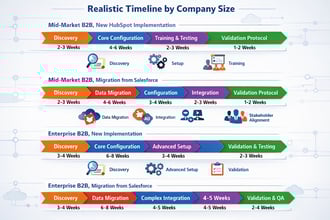
How long does it take to complete this checklist? Categories 1 through 6 run concurrently and take 3 to 4 weeks. Categories 7 through 9 run concurrently with Categories 4 through 6 and add 1 to 2 weeks. Categories 10 through 12 run in the final week before go-live. Total elapsed time for a standard implementation is 6 to 8 weeks.
Which items are most commonly incomplete at go-live? Category 6 (UTM taxonomy distribution) and Category 5 (Marketing Hub to CRM sync testing) are the most common incomplete items. UTM taxonomy documents are created but not distributed to agency partners and paid media vendors who also create marketing links.
What is the consequence of going live before Category 7 (attribution dashboards) is complete? Campaign data that runs through HubSpot before the attribution dashboards are built still generates attribution data, but the risk is that data quality problems in the first 30 to 60 days are not visible because no one is monitoring the attribution report. Build the dashboards before go-live so monitoring can begin from day one.
The Pedowitz Group is a HubSpot Platinum Partner and 3x Marketo Partner of the Year and Eloqua Partner of the Year. If you are approaching a go-live and want an independent validation against this checklist, we can complete it in a single review session. Talk to TPG.