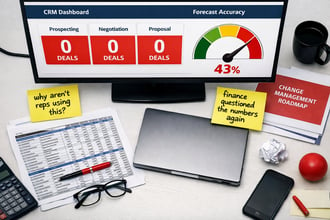
A HubSpot CRM that nobody uses is not a CRM. It is an expensive contact database. TPG has completed 150+ HubSpot CRM implementations in 19 years. The pattern we see most often: companies go live, get initial adoption, and watch usage drop to 35-40% within six months because the configuration doesn't match how the sales team actually works.
After a TPG engagement, average sales team CRM adoption improves from 35% to 82%. Average implementation timeline: 60 days.
By the Numbers
| Metric | Result |
|---|---|
| HubSpot CRM implementations completed | 150+ |
| Years of HubSpot expertise | 19 |
| Average adoption rate improvement | 35% to 82% |
| Average implementation timeline | 60 days |
The Problem
HubSpot Is Live But Sales Treats It Like a Contact Rolodex
The most common scenario we see: HubSpot CRM was launched 6-12 months ago, there are thousands of contacts in the system, and the sales team uses it to look up phone numbers. Nobody creates deals. Nobody logs activities. Nobody runs pipeline reviews from it. The CRM isn't wrong — the configuration is. A deal pipeline that doesn't reflect the actual sales process, with stage names that don't match the team's vocabulary, won't get used.
Custom Properties Built Without a Data Architecture
Someone added 47 custom properties over the past year. Half of them capture information that is never reviewed. A third overlap with default HubSpot fields or with each other. The remaining ones are used inconsistently because nobody documented what they were for or how to populate them. The result: your reporting pulls from fields that are incomplete, duplicated, or meaningless. You can't answer basic questions about your pipeline from the data you have.
Integrations Creating Duplicate and Conflicting Data
The HubSpot-to-Salesforce sync that was "set up in an afternoon" created 3,000 duplicate contact records. The Zoom integration writes meeting records as both a note and a meeting object. The data enrichment tool updates fields the sales team thought they controlled manually. Every integration decision made without architecture thinking creates cleanup debt that compounds monthly.
Nobody Can Explain What Happened to This Quarter's Pipeline
Your sales leader knows deals closed. They don't know why deals were lost, where deals stalled, which rep has the longest average sales cycle, or which lead source produces the highest close rates. That information exists in HubSpot — it just isn't surfaced because the pipeline stages, deal properties, and reporting weren't built to answer those questions.
Our Approach
Phase 01: CRM Audit and Architecture (Weeks 1-3)
We audit your current HubSpot configuration against your actual sales process. We document what is working, what is producing bad data, and what is creating friction for the sales team. We interview reps and managers. We review your deal pipeline stage exit criteria, your custom property architecture, your integrations, and your reporting.
The audit produces a prioritized configuration recommendations document and a 60-day implementation roadmap. You know what we're fixing and why before we touch anything.
Phase 02: Configuration and Integration (Weeks 4-10)
We rebuild the configuration to match the sales process rather than forcing the sales team to match the software. This includes: deal pipeline restructuring with clear stage definitions and exit criteria, custom property architecture cleanup (consolidation, documentation, removal of dead fields), integration architecture review and remediation, workflow automation for deal progression and task creation, and sequence configuration for sales outreach.
Every decision in this phase is documented. Future configuration changes have a reference point.
Phase 03: Training and Adoption (Weeks 10-14)
Configuration without adoption investment produces the same 35% usage rate that brought you here. We build a training program that covers the use cases your team has, not generic HubSpot feature tours. Sales rep training, sales manager training for pipeline review, and admin training for ongoing maintenance. We also build an adoption monitoring dashboard so you can see usage trends after go-live.
What's Included
- Full HubSpot CRM configuration audit and findings report
- Deal pipeline redesign aligned to actual sales process
- Custom property architecture rebuild with field-level documentation
- Integration architecture review and remediation (up to 3 integrations)
- Workflow automation build for deal progression, task creation, and notification
- Sales sequence configuration for top 3 outreach use cases
- Data cleanup process and deduplication run
- Sales rep training (up to 15 reps, role-based curriculum)
- Sales manager training for pipeline review and forecasting
- HubSpot admin training for ongoing configuration ownership
- Adoption monitoring dashboard with 30-day post-launch check-in
"We were 8 months post-launch and our HubSpot was a mess. TPG rebuilt our deal pipeline, fixed our integrations, and retrained the team in 60 days. We went from 30% adoption to over 80% within the first month after the relaunch." — Director of Sales Operations, Growth-Stage Healthcare Technology Company
Who This Service Is Built For
- Companies 6-18 months post-HubSpot implementation who are not getting the pipeline visibility or adoption they expected
- Sales leaders who have given up pulling reports from HubSpot because the data isn't reliable
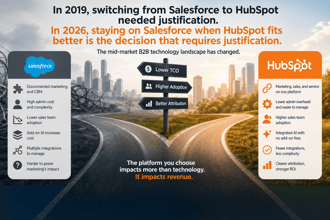
- Companies migrating from Salesforce to HubSpot who need a clean implementation rather than a lift-and-shift of their existing configuration
- Operations teams who inherited a HubSpot instance they didn't build and don't fully understand
- Companies adding Sales Hub Enterprise and needing the advanced features (forecasting, playbooks, custom views) properly configured
- Organizations where HubSpot and another CRM are running in parallel and the sync is producing duplicate data
Related Services
- Revenue Operations Consulting — Aligning marketing, sales, and CS around shared revenue data
- HubSpot Marketing Hub Consulting — Marketing Hub configuration and campaign infrastructure
- Demand Generation Consulting — Building programs that fill the pipeline you're managing
- RM6 Revenue Marketing Diagnostic — Full revenue marketing maturity assessment
Frequently Asked Questions
What does a HubSpot CRM consulting engagement cost? TPG's HubSpot CRM engagements range from $18,000 for a focused audit and configuration fix to $75,000+ for a full implementation including migration support, integration architecture, and adoption programming. Scope depends on the complexity of your current configuration, the number of integrations, and how much data cleanup is required. We audit before we quote.
Do you also handle HubSpot Marketing Hub? Yes. Many of our CRM engagements include Marketing Hub work as part of the RevOps architecture. We also run standalone Marketing Hub engagements for companies that have their CRM working well and need to improve the marketing automation layer.
We're migrating from Salesforce. Can you help? Yes. We've supported over 40 Salesforce-to-HubSpot migrations. The most common mistake in migrations is importing the Salesforce data model directly into HubSpot without redesigning it for HubSpot's native architecture. We assess your Salesforce configuration, design the right HubSpot data model, and execute the migration with data integrity intact.
How long does a typical HubSpot CRM engagement take? Our standard engagement runs 10-14 weeks from kickoff to adoption training completion. Simpler configurations (fewer integrations, smaller sales teams) complete in 60 days. Complex migrations with multiple integrations and large data volumes extend to 16-20 weeks.
What happens if we want ongoing HubSpot support after the project? We offer ongoing HubSpot support retainers for clients who need regular configuration optimization, reporting updates, and platform maintenance. Many clients move to a retainer after an initial implementation or optimization project.
The Pedowitz Group | pedowitzgroup.com | Revenue Marketing Experts Since 2007