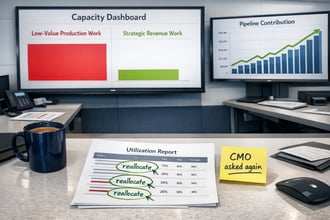
Slow campaign launches rarely trace back to a lack of ideas or talent. The real bottleneck hides in your intake process—the way requests enter your system, move through approvals, and land on someone's desk for execution. When intake breaks down, every campaign stalls. The Pedowitz Group helps enterprise marketing operations leaders cut cycle time by redesigning these critical workflows from the ground up.
This guide walks you through seven steps to audit, map, and rebuild your marketing intake, briefing, and approval workflows. By the end, you'll have a repeatable process that eliminates confusion, speeds up campaign execution, and frees your team to focus on work that drives revenue.
Quick Guide: How to Redesign Marketing Intake in 7 Easy Steps
- Audit Your Current Intake Process: Document every step in your existing workflow to identify hidden delays.
- Map Cycle Time Bottlenecks: Measure how long each stage takes and pinpoint where campaigns stall.
- Standardize Your Campaign Brief Template: Create one brief format that captures everything needed upfront.
- Build Tiered Approval Paths: Design approval routes based on campaign risk and complexity levels.
- Assign Clear Ownership at Each Stage: Define who owns each handoff so nothing falls through cracks.
- Automate Routing and Notifications: The Pedowitz Group recommends automating repetitive handoffs to reduce delays.
- Measure and Optimize Quarterly: Track cycle time metrics and refine your process every 90 days.
How to Rebuild Your Marketing Intake Workflow for Faster Execution
1. Audit Your Current Intake Process
Start by documenting exactly how campaign requests enter your marketing operations function today. Track every touchpoint: email threads, Slack messages, meetings, and formal request systems. Note who receives requests, how information gets captured, and where requests sit before someone acts on them.
This audit reveals the true state of your intake system. Most organizations discover that requests arrive through multiple channels with inconsistent information. According to research on marketing approval workflows, unclear ownership and vague briefs cause most delays when businesses scale.
Talk to everyone who touches the process. Campaign managers, designers, copywriters, and stakeholders each see different friction points. Their input uncovers gaps that metrics alone miss.
2. Map Cycle Time Bottlenecks
Once you understand your current process, measure it. Track the elapsed time from request submission to campaign launch for 10-20 recent campaigns. Break this down by stage: intake, briefing, creative development, review, approval, and deployment.
Look for stages where campaigns consistently stall. Common bottlenecks include waiting for stakeholder feedback, chasing missing assets, and unclear approval authority. The goal is to identify where your workflow loses the most time.
Create a simple visualization showing average time per stage. This baseline becomes your benchmark for measuring improvement. Focus your redesign efforts on the stages with the longest wait times—these represent your highest-impact opportunities.
3. Standardize Your Campaign Brief Template
A standardized brief eliminates the back-and-forth that slows down every campaign. Your brief template should capture all required information upfront so the execution team can start immediately.
Include these essential fields: campaign objective, target audience, key messages, required assets, channel specifications, compliance requirements, and deadline. Add conditional fields for specific campaign types—a webinar brief needs different details than an email nurture.
Freeze the brief at kickoff. According to workflow experts, treating new ideas after kickoff as separate requests prevents scope creep that derails timelines. This discipline keeps your intake process predictable.
4. Build Tiered Approval Paths
Not every campaign needs the same approval rigor. A social media post carries different risk than a product launch email to your entire database. Design approval paths that match the stakes.
Create three tiers based on campaign risk level. Low-risk campaigns (routine emails, social posts) might need only manager sign-off. Medium-risk campaigns (new offers, segment tests) add a marketing leadership review. High-risk campaigns (compliance-sensitive, executive communications) route through legal and brand teams.
Define clear criteria for each tier so requesters self-select the right path. This tiered approach speeds up routine work while maintaining governance for high-stakes campaigns.
5. Assign Clear Ownership at Each Stage
Every handoff in your workflow needs a single accountable owner. When ownership is unclear, requests stall in limbo while people assume someone else will act.
Document the RACI (Responsible, Accountable, Consulted, Informed) for each stage of your redesigned workflow. The accountable person owns moving work forward—they escalate delays, track progress, and ensure handoffs happen on schedule.
Publish this ownership model so everyone knows who to contact. The Pedowitz Group uses this approach to help clients reduce the "who's handling this?" confusion that adds days to every campaign cycle.
6. Automate Routing and Notifications
Once your workflow logic is solid, automate the repetitive parts. Automation handles routing, notifications, reminders, and status updates so your team focuses on actual campaign work instead of project management overhead.
Start with these high-value automations: route requests to the right queue based on campaign type, notify approvers when items need their attention, escalate stalled requests after defined SLA thresholds, and update requesters on status changes automatically.
According to recent workflow studies, structured automation can reduce campaign cycle time by up to 30%. Focus on eliminating manual handoffs before adding advanced features.
7. Measure and Optimize Quarterly
Your redesigned workflow needs ongoing maintenance. Set up tracking for key metrics: average cycle time by campaign type, time spent in each stage, SLA compliance rate, and request volume trends.
Review these metrics quarterly with your marketing operations team. Look for new bottlenecks that emerge as volume grows or processes change. Update your brief templates, approval paths, and automations based on what the data reveals.
Build a feedback loop with campaign requesters. Their experience surfaces friction that metrics miss. This ongoing optimization ensures your intake process scales with your organization.
What Are the Signs Your Marketing Intake Process Needs Redesign?
Campaign requests arrive through multiple channels with no central tracking system. Your team spends hours chasing missing information after requests are submitted. Approvals stall because no one knows whose sign-off is next.
Watch for these warning signs:
- Campaigns routinely miss launch dates due to approval delays
- Requesters complain they can't find status updates on their campaigns
- Your ops team feels constantly reactive instead of strategic
- Similar campaigns take wildly different amounts of time to execute
- New team members struggle to understand how to get campaigns done
If three or more of these apply, your intake process is likely costing you significant time and revenue opportunity.
How Does Marketing Workflow Automation Improve Campaign Speed?
Automation removes the manual coordination that creates delays between workflow stages. Instead of someone checking spreadsheets and sending follow-up emails, the system handles routing, notifications, and escalations automatically.
The biggest time savings come from three areas. First, instant routing ensures requests reach the right person immediately instead of sitting in a shared inbox. Second, automated reminders keep approvers on track without manual follow-up. Third, status visibility reduces the "checking in" conversations that interrupt everyone's work.
Automation also improves consistency. Every campaign follows the same process regardless of who submits it. This standardization makes cycle time predictable and easier to optimize.
How The Pedowitz Group Helps You Accelerate Campaign Execution
The Pedowitz Group specializes in marketing operations optimization for enterprise and mid-market B2B organizations. Our Marketing Operations Consulting team has redesigned intake and approval workflows for over 1,500 corporate clients across technology, financial services, manufacturing, and healthcare industries.
We bring a vendor-neutral approach to workflow design, focusing on your specific bottlenecks rather than pushing particular tools. Our methodology combines process mapping, stakeholder alignment, and technology configuration into a cohesive implementation plan.
The Pedowitz Group delivers measurable results. Clients have achieved a 65% reduction in marketing overhead through automation and significant improvements in campaign cycle time. Our team handles everything from audit through implementation, with ongoing optimization support to ensure your workflows scale.
Contact our marketing operations team to discuss how we can help you ship campaigns faster.
FAQs About How to Redesign Marketing Intake to Ship Campaigns Faster
How long does it take to redesign a marketing intake workflow?
A full workflow redesign typically takes 4-8 weeks depending on complexity. The audit and mapping phases require 1-2 weeks each. Implementation and testing add another 2-4 weeks. The Pedowitz Group has streamlined this process for clients who need faster results.
What tools do I need to automate marketing intake?
Most organizations can automate intake using their existing marketing automation platform or project management system. HubSpot, Marketo, Asana, and Monday.com all support workflow automation. The Pedowitz Group helps clients configure these tools for optimal intake routing.
How do I get stakeholder buy-in for workflow changes?
Start with data. Show stakeholders the current cycle time and where delays occur. Calculate the revenue impact of faster campaign launches. Frame the redesign as solving their pain points—less confusion, clearer expectations, and faster results.
Should I redesign the entire workflow at once or in phases?
Phased implementation works best for most organizations. Start with the biggest bottleneck identified in your audit. Prove results there, then expand to other stages. The Pedowitz Group recommends 90-day implementation sprints with measurement checkpoints.
How do I maintain workflow quality as campaign volume grows?
Build scalability into your design from the start. Tiered approval paths handle volume spikes by routing routine work through faster paths. Automation eliminates the manual coordination that breaks down under pressure. Quarterly reviews catch emerging bottlenecks before they become critical.
What metrics should I track after redesigning intake?
Focus on four key metrics: average cycle time from request to launch, SLA compliance rate for each stage, requester satisfaction scores, and request volume trends. The Pedowitz Group builds dashboards that track these metrics automatically for ongoing optimization.