The most common question before a HubSpot CRM implementation is "how long will this take?" The most common answer from vendors is a timeline designed to win the deal, not reflect the actual work required.
The Honest Answer: It Depends on Four Variables
Data complexity. The volume of records, the quality of that data, and the number of custom objects or fields that need to map to HubSpot are the primary drivers of migration timeline.
Integration requirements. A HubSpot implementation that only connects Marketing Hub to CRM implements faster than one that also needs to integrate a data enrichment platform, a sales engagement tool, a CPQ system, and a business intelligence platform.
Organizational alignment speed. The speed at which your internal stakeholders can agree on lifecycle stage definitions, lead scoring criteria, and SLA terms is frequently the largest variable in implementation timeline.
Scope of the revenue-ready requirement. An implementation scoped to populate HubSpot with your existing data takes less time than one scoped to produce a marketing-sourced pipeline dashboard the CMO can present to the CFO.
Timeline by Company Size and Scenario
Mid-Market B2B, New HubSpot Implementation
Realistic timeline: 5 to 7 weeks.
Week 1 to 2: Discovery, revenue model mapping, data model design, lifecycle stage alignment with sales. Week 2 to 4: Core configuration: properties, pipeline stages, lead scoring, routing. Week 3 to 5: Marketing Hub sync, UTM taxonomy, attribution dashboards, SLA workflows. Week 5 to 6: Integration configuration and testing. Week 6 to 7: Validation protocol, sales training, go-live. Week 7 to 9: 30-day hypercare monitoring.
Mid-Market B2B, Migration from Salesforce
Realistic timeline: 9 to 11 weeks.
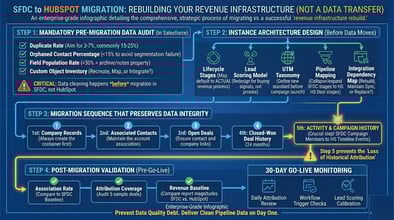
Weeks 1 to 2: Salesforce data audit, migration scope definition. Weeks 2 to 4: HubSpot instance architecture, concurrent with data preparation in Salesforce. Weeks 4 to 6: Data migration in sequence. Weeks 5 to 8: Integration configuration, workflow build, attribution dashboard build. Weeks 8 to 10: Validation, parallel running period, sales training. Week 10 to 11: Cutover and hypercare start.
Enterprise B2B, New Implementation
Realistic timeline: 10 to 14 weeks.
Weeks 1 to 3: Discovery across multiple stakeholder groups, revenue model mapping, enterprise data model design, lifecycle stage alignment across multiple sales segments. Weeks 3 to 6: Core configuration: enterprise-tier HubSpot setup, complex routing logic, multi-team pipeline configuration, custom objects if required. Weeks 5 to 9: Marketing Hub integration, multi-Hub configuration, integration builds. Weeks 8 to 12: Validation protocol across all configuration components, sales team training by role and region. Weeks 12 to 14: Staged go-live by team or region, hypercare monitoring.
Enterprise B2B, Migration from Salesforce
Realistic timeline: 14 to 20 weeks.
The migration adds the data audit, custom object architecture decisions, complex field mapping, attribution history migration, and an extended parallel running period to the enterprise implementation timeline.
Where Most Implementations Lose Time
Alignment delays on lifecycle stages and MQL criteria. The single most common cause of timeline slippage. When this alignment takes 4 to 6 weeks instead of 1 to 2, the entire timeline shifts right. Escalate alignment conversations to CMO and VP of Sales level immediately if they are not reaching resolution at the manager level.
Integration surprises. Integrations scoped based on a verbal description rather than a documented data flow consistently surface unexpected complexity during build.
Data quality remediation. Data audits that reveal higher-than-expected duplicate rates or contact-to-account association problems add remediation time to the pre-migration phase.
Approval cycles for configuration decisions. Build 2 to 3 business days of approval buffer into every phase of an enterprise implementation.
What Compresses the Timeline
Pre-implementation alignment work. Teams that arrive at kickoff with written, agreed-upon lifecycle stage definitions and MQL criteria compress the implementation timeline by 1 to 2 weeks.
Clean data. A clean database with high contact-to-account association rates and low duplicate rates compresses the data audit and migration phases by 1 to 2 weeks.
Named decision authority. Name a single person with authority to approve implementation configuration decisions before the kickoff.
What Does Not Compress the Timeline
Skipping the data audit. It defers the data quality work to the post-go-live period where it takes longer, costs more, and affects live programs.
Skipping sales alignment. Configuring lifecycle stages and lead routing without sales alignment produces a CRM that sales does not use.
Frequently Asked Questions
Can a HubSpot CRM implementation be done in 30 days? For a small mid-market company with a simple sales process, one or two integrations, and a clean database under 10,000 records, a 30-day implementation is possible if alignment is pre-established. For any enterprise scenario or any migration from a complex CRM, 30 days is not a realistic timeline for a revenue-ready implementation.
Why do HubSpot implementation timelines from vendors vary so widely? Because different vendors are scoping different outcomes. A vendor scoping "get you live on HubSpot" can quote 3 to 4 weeks. A vendor scoping "get you to a marketing-sourced pipeline report your CFO will trust" will quote 8 to 12 weeks.
What should we do if our implementation is running behind schedule? Identify whether the delay is in a technical phase or an alignment phase. Technical delays can often be compressed with additional resourcing. Alignment delays cannot. If the delay is in lifecycle stage or SLA alignment, escalate to CMO and VP of Sales level immediately.
The Pedowitz Group is a HubSpot Platinum Partner and 3x Marketo Partner of the Year and Eloqua Partner of the Year. If you are planning an implementation and want a realistic timeline based on your specific scope, a 60-minute scoping session will give you a timeline you can actually hold to. Talk to TPG.