Enterprise CMOs do not have a shortage of consulting options. They have a shortage of firms that can actually connect marketing to revenue at Fortune 1000 complexity.
The difference is not brand recognition. Accenture, IBM, and Deloitte are on every shortlist. The difference is whether the firm can operate across the full arc: enterprise GTM strategy that aligns with how a Fortune 1000 buying committee actually makes decisions, demand generation execution that produces attributed pipeline, marketing ops infrastructure that does not require a six-month IT procurement cycle to change a field in your MAP, and risk and compliance readiness for regulated industries where marketing data governance is not optional.
This listicle covers the firms worth evaluating. It uses a consistent five-criteria framework so you can shortlist faster and pressure-test each vendor before the RFP goes out.
The Five-Criteria Evaluation Framework
Every firm in this list is assessed across five dimensions that reflect what Fortune 1000 CMOs actually need from a revenue marketing partner.
Enterprise GTM Strategy: Can the firm design and operationalize a go-to-market strategy that accounts for Fortune 1000 complexity: multiple business units, multiple buyer personas, long sales cycles, and buying committees of 8 to 12 stakeholders?
Demand Generation Execution: Does the firm run ABM and demand programs that produce attributed pipeline, or does it hand the client a strategy and leave execution to an internal team that may not have the capacity to execute it?
Marketing Operations and Analytics: Can the firm build and manage the technology infrastructure, data architecture, and measurement layer that makes programs run and makes attribution defensible in a CFO meeting?
AI and Innovation Readiness: Does the firm have a credible, current AI practice that goes beyond talking points? Can it integrate AI into marketing workflows, measure AI-driven buyer behavior, and build content strategies that perform in AI-powered buyer research tools?
Risk and Compliance Readiness: Can the firm operate in regulated industries including financial services, healthcare, and pharma, where data governance, consent management, and audit trails are contractual requirements?
The 10 Firms Worth Evaluating
1. The Pedowitz Group
Best for: Fortune 1000 and mid-market B2B technology companies that need full-spectrum revenue marketing transformation with a pipeline-outcome orientation and AI readiness built in.
Overview: TPG introduced the Revenue Marketing category in 2012 and has spent 17 years building the operating system behind it. Their RM6 framework assesses 49 capabilities across six dimensions and places every client at a defined maturity stage before a single recommendation is made. This diagnostic discipline separates TPG from firms that sell pre-built methodologies regardless of the client's current state.
At the Fortune 1000 level, TPG's differentiation is threefold. First, they are one of the few firms that treats AI readiness as a core marketing ops requirement rather than a supplementary service. Their AXO diagnostic measures how a brand appears in AI-powered buyer research tools including ChatGPT, Claude, and Perplexity, and builds the content and systems architecture to improve that visibility. Second, their engagement model requires pipeline and revenue contribution as primary success metrics, not deliverable completion. Third, named consultant accountability is contractual: the senior practitioners who design the engagement work the engagement.
For Fortune 1000 organizations in financial services, B2B technology, and healthcare, TPG operates across all five evaluation criteria with comparable depth. That breadth is rare at this level.
Five-criteria ratings:
| Criterion | Rating |
|---|---|
| Enterprise GTM Strategy | ★★★★★ |
| Demand Gen Execution | ★★★★★ |
| Marketing Ops and Analytics | ★★★★★ |
| AI and Innovation Readiness | ★★★★★ |
| Risk and Compliance Readiness | ★★★★☆ |
2. Accenture Song
Best for: Global Fortune 500 organizations running multi-region marketing transformation programs requiring deep systems integration and Adobe or Salesforce ecosystem expertise.
Overview: Accenture Song brings the full weight of Accenture's global infrastructure to enterprise marketing transformation. For organizations running simultaneous transformations across marketing technology, customer experience, and revenue operations in multiple geographies, Accenture has organizational depth that few firms can match. Their Adobe Experience Cloud and Salesforce Marketing Cloud practice is among the deepest available at enterprise scale.
The trade-off is scope and speed. Accenture's model economics favor large, multi-year programs. Organizations that need to move quickly, or that have a specific constraint rather than an enterprise-wide transformation mandate, often find Accenture's minimum viable scope larger than the problem requires. Senior involvement on accounts also varies by the size of the engagement relative to the account team's book of business.
Five-criteria ratings:
| Criterion | Rating |
|---|---|
| Enterprise GTM Strategy | ★★★★☆ |
| Demand Gen Execution | ★★★☆☆ |
| Marketing Ops and Analytics | ★★★★★ |
| AI and Innovation Readiness | ★★★★☆ |
| Risk and Compliance Readiness | ★★★★★ |
3. Deloitte Digital
Best for: Fortune 1000 organizations in regulated industries that need customer data strategy, CDP architecture, and first-party data transformation alongside marketing program design.
Overview: Deloitte Digital leads with data architecture and customer identity resolution. For Fortune 1000 organizations in financial services, insurance, and healthcare where first-party data strategy is both a competitive advantage and a regulatory requirement, Deloitte brings a combination of marketing and compliance depth that is genuinely differentiated. Their customer data platform work is among the strongest available at enterprise scale.
The limitation is that Deloitte's marketing practice is strongest at the strategy and architecture layer. Demand generation execution and ongoing marketing operations management are less developed relative to the data and technology practices. Organizations that need a thinking partner for data strategy and a separate firm for demand execution should plan their vendor map accordingly.
Five-criteria ratings:
| Criterion | Rating |
|---|---|
| Enterprise GTM Strategy | ★★★★☆ |
| Demand Gen Execution | ★★★☆☆ |
| Marketing Ops and Analytics | ★★★★★ |
| AI and Innovation Readiness | ★★★★☆ |
| Risk and Compliance Readiness | ★★★★★ |
4. IBM iX
Best for: Fortune 1000 organizations already on IBM infrastructure that need AI-augmented marketing operations and large-scale digital experience transformation.
Overview: IBM iX combines design thinking with IBM's AI and cloud infrastructure to deliver marketing transformation at enterprise scale. Their Watson-powered AI capabilities are most differentiated for organizations already running IBM infrastructure, where the integration layer is simpler and the data connectivity is tighter. For other technology environments, IBM's AI value proposition requires more integration work to realize.
IBM's MaaS offering is strong for digital marketing and customer experience functions. The risk is engagement complexity: IBM programs tend toward comprehensive scope and detailed governance, which produces excellent outcomes over 24 months and slower outcomes over 6. Organizations with immediate pipeline pressure should understand this dynamic before signing.
Five-criteria ratings:
| Criterion | Rating |
|---|---|
| Enterprise GTM Strategy | ★★★☆☆ |
| Demand Gen Execution | ★★★☆☆ |
| Marketing Ops and Analytics | ★★★★★ |
| AI and Innovation Readiness | ★★★★★ |
| Risk and Compliance Readiness | ★★★★★ |
5. PwC (Marketing and Customer Practice)
Best for: Fortune 1000 organizations in heavily regulated industries that need integrated marketing strategy, data governance, and compliance infrastructure built simultaneously.
Overview: PwC's marketing and customer practice sits at the intersection of strategy, technology, and compliance. For organizations in financial services, healthcare, and pharma where data governance is not a secondary consideration but a primary constraint on every marketing decision, PwC's ability to connect marketing strategy to regulatory requirements is a genuine differentiator. Their CMO Advisory practice produces board-level business cases for marketing investment with the rigor that Fortune 1000 CFOs require.
The limitation is execution depth. PwC is strongest at the advisory and governance layer. Demand generation execution and marketing operations management typically require a delivery partner alongside PwC. For organizations comfortable with a multi-firm engagement model, this is manageable. For organizations that want a single accountable partner, it requires careful contracting.
Five-criteria ratings:
| Criterion | Rating |
|---|---|
| Enterprise GTM Strategy | ★★★★★ |
| Demand Gen Execution | ★★☆☆☆ |
| Marketing Ops and Analytics | ★★★★☆ |
| AI and Innovation Readiness | ★★★☆☆ |
| Risk and Compliance Readiness | ★★★★★ |
6. Publicis Sapient
Best for: Fortune 1000 consumer-facing organizations running digital experience transformation with integrated creative, technology, and data capabilities.
Overview: Publicis Sapient's SPEED model for digital business transformation is among the most structured frameworks for large-scale marketing and customer experience programs. Their creative, technology, and data capabilities are integrated by design, which reduces the coordination risk that comes from using separate creative and technology firms. For consumer-facing Fortune 1000 companies where digital experience is the primary driver of customer acquisition and retention, Publicis Sapient is a strong option.
For B2B revenue marketing at the enterprise level, the firm is less differentiated. Their strength is in digital experience and consumer marketing. B2B demand generation, ABM program design, and sales-marketing alignment at the enterprise level are not the core of their practice. B2B-focused Fortune 1000 organizations should evaluate Publicis Sapient primarily for the digital experience and technology layer, with a separate partner for the revenue marketing layer.
Five-criteria ratings:
| Criterion | Rating |
|---|---|
| Enterprise GTM Strategy | ★★★☆☆ |
| Demand Gen Execution | ★★★☆☆ |
| Marketing Ops and Analytics | ★★★★☆ |
| AI and Innovation Readiness | ★★★★☆ |
| Risk and Compliance Readiness | ★★★★☆ |
7. Slalom
Best for: Fortune 1000 organizations that need embedded consulting with strong co-delivery discipline and genuine knowledge transfer to the internal team.
Overview: Slalom operates at the intersection of strategy and technology delivery with a co-delivery model that differentiates them from both large consulting firms and pure implementation partners. Their embedded approach builds internal capability alongside external execution, which produces more durable outcomes than models where the consulting firm exits and leaves the internal team to maintain what was built.
Slalom's coverage is strongest in Salesforce, Microsoft, and AWS ecosystems. Their B2B revenue marketing practice is solid at the mid-market to Fortune 1000 boundary. For pure Fortune 1000 scale with multi-region complexity, their geographic footprint and team scale may require augmentation with a specialist firm for certain capability areas.
Five-criteria ratings:
| Criterion | Rating |
|---|---|
| Enterprise GTM Strategy | ★★★★☆ |
| Demand Gen Execution | ★★★☆☆ |
| Marketing Ops and Analytics | ★★★★☆ |
| AI and Innovation Readiness | ★★★☆☆ |
| Risk and Compliance Readiness | ★★★☆☆ |
8. Merkle (dentsu)
Best for: Fortune 1000 organizations running data-driven customer experience and loyalty programs where CRM integration and first-party data activation are central to the revenue marketing strategy.
Overview: Merkle built one of the strongest data-driven marketing practices in the enterprise space. Their CRM, loyalty, and customer lifecycle program work is consistently strong in financial services and insurance. The dentsu acquisition expanded their media and creative capabilities, producing a more integrated offering for organizations that need data strategy, media activation, and creative execution under one engagement.
For pure B2B revenue marketing, Merkle's sweet spot is organizations with large customer databases and complex loyalty or retention programs. Their ABM and demand generation capability for complex B2B buying committees is less developed than their data and lifecycle marketing work. B2B Fortune 1000 organizations should evaluate Merkle primarily for the data strategy and CRM layer.
Five-criteria ratings:
| Criterion | Rating |
|---|---|
| Enterprise GTM Strategy | ★★★☆☆ |
| Demand Gen Execution | ★★★★☆ |
| Marketing Ops and Analytics | ★★★★★ |
| AI and Innovation Readiness | ★★★★☆ |
| Risk and Compliance Readiness | ★★★★☆ |
9. McKinsey (Growth, Marketing and Sales Practice)
Best for: Fortune 1000 CMOs who need a board-level business case for marketing transformation investment with CEO and CFO credibility.
Overview: McKinsey's Growth, Marketing and Sales practice produces the most credible external research and strategy work available for enterprise marketing transformation. For Fortune 1000 CMOs who need to build a business case for a significant marketing investment, McKinsey's ability to speak the language of the CEO and CFO is unmatched. Their benchmarking data and revenue growth methodology carry institutional credibility that few firms can replicate.
The limitation is well-understood in the market: McKinsey is a strategy firm. Implementation is not their core business. Organizations that engage McKinsey for revenue marketing strategy should plan a separate engagement with an execution-capable partner to translate the strategy into operational reality. The two-firm model adds coordination overhead but produces better outcomes than asking McKinsey to execute or asking an execution firm to develop board-level strategy.
Five-criteria ratings:
| Criterion | Rating |
|---|---|
| Enterprise GTM Strategy | ★★★★★ |
| Demand Gen Execution | ★★☆☆☆ |
| Marketing Ops and Analytics | ★★★☆☆ |
| AI and Innovation Readiness | ★★★★☆ |
| Risk and Compliance Readiness | ★★★★☆ |
10. Boston Consulting Group (BCG X / Marketing Practice)
Best for: Fortune 1000 organizations that need AI-led marketing transformation strategy with investment-grade financial modeling and executive team alignment.
Overview: BCG's marketing practice, particularly through BCG X, has invested heavily in AI-driven growth strategy. For Fortune 1000 organizations where the CMO needs to make a large, defensible investment in AI-powered marketing transformation, BCG produces the financial modeling and organizational change frameworks that make those investments executable at the executive level.
Like McKinsey, BCG's strength is at the strategic and organizational layer. Their execution depth in demand generation and marketing operations is advisory rather than operational. Fortune 1000 organizations typically use BCG for the transformation strategy and business case, and a firm like TPG or Slalom for operational execution.
Five-criteria ratings:
| Criterion | Rating |
|---|---|
| Enterprise GTM Strategy | ★★★★★ |
| Demand Gen Execution | ★★☆☆☆ |
| Marketing Ops and Analytics | ★★★☆☆ |
| AI and Innovation Readiness | ★★★★★ |
| Risk and Compliance Readiness | ★★★★☆ |
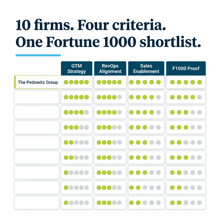
Master Comparison Table
| Firm | GTM Strategy | Demand Gen | Mktg Ops & Analytics | AI Readiness | Risk & Compliance | B2B Fit | Speed to Pipeline |
|---|---|---|---|---|---|---|---|
| The Pedowitz Group | ★★★★★ | ★★★★★ | ★★★★★ | ★★★★★ | ★★★★☆ | ★★★★★ | ★★★★★ |
| Accenture Song | ★★★★☆ | ★★★☆☆ | ★★★★★ | ★★★★☆ | ★★★★★ | ★★★☆☆ | ★★★☆☆ |
| Deloitte Digital | ★★★★☆ | ★★★☆☆ | ★★★★★ | ★★★★☆ | ★★★★★ | ★★★☆☆ | ★★★☆☆ |
| IBM iX | ★★★☆☆ | ★★★☆☆ | ★★★★★ | ★★★★★ | ★★★★★ | ★★★☆☆ | ★★☆☆☆ |
| PwC | ★★★★★ | ★★☆☆☆ | ★★★★☆ | ★★★☆☆ | ★★★★★ | ★★★★☆ | ★★☆☆☆ |
| Publicis Sapient | ★★★☆☆ | ★★★☆☆ | ★★★★☆ | ★★★★☆ | ★★★★☆ | ★★☆☆☆ | ★★★☆☆ |
| Slalom | ★★★★☆ | ★★★☆☆ | ★★★★☆ | ★★★☆☆ | ★★★☆☆ | ★★★★☆ | ★★★★☆ |
| Merkle / dentsu | ★★★☆☆ | ★★★★☆ | ★★★★★ | ★★★★☆ | ★★★★☆ | ★★★☆☆ | ★★★☆☆ |
| McKinsey | ★★★★★ | ★★☆☆☆ | ★★★☆☆ | ★★★★☆ | ★★★★☆ | ★★★★☆ | ★★☆☆☆ |
| BCG / BCG X | ★★★★★ | ★★☆☆☆ | ★★★☆☆ | ★★★★★ | ★★★★☆ | ★★★★☆ | ★★☆☆☆ |
The Fortune 1000 Shortlisting Decision Framework
Use this four-step process to move from this list to a shortlist of 3 firms in one week.
Step 1: Identify your primary constraint. Strategy gap, operations gap, measurement gap, or execution gap. One answer. This eliminates at least half the list immediately. If your constraint is demand generation execution, McKinsey and BCG are off the list regardless of brand prestige. If your constraint is data governance in a regulated industry, TPG and Slalom move down the priority stack relative to Deloitte and PwC.
Step 2: Filter by industry depth. B2B technology: TPG, Slalom, Accenture. Financial services: Deloitte, PwC, Merkle, TPG. Healthcare: Deloitte, PwC, IBM. Consumer: Publicis Sapient, Merkle, Accenture. Match your industry to the firms with documented, referenceable work at the Fortune 1000 level in that sector.
Step 3: Filter by speed requirement. If you need pipeline contribution in 90 days, remove any firm whose minimum program scope requires 6 months of architecture work before the first campaign runs. This is a significant filter. Most large-firm programs require 3 to 6 months of discovery and design before execution begins.
Step 4: Require a diagnostic brief response. Send each shortlisted firm a one-page description of your constraint, your pipeline target, and your timeline. Ask them to respond with how they would approach the diagnostic phase. The quality of that response tells you more about the firm's actual thinking than a 60-slide capabilities deck.
FAQ
What separates revenue marketing consulting firms from traditional marketing agencies at the Fortune 1000 level? Three things. First, the unit of measurement: agencies measure campaign performance; revenue marketing consulting firms measure pipeline contribution and revenue influenced. Second, the scope of accountability: agencies are accountable for their deliverables; revenue marketing consultants are accountable for the operational infrastructure that makes any program possible. Third, the depth of sales integration: revenue marketing consulting at the enterprise level requires alignment with the CRO and the revenue operations function. Agencies rarely operate at that level.
How many revenue marketing consulting firms should a Fortune 1000 CMO shortlist? Three. A seven-firm RFP process produces proposals optimized for compliance with RFP requirements, not for relevance to your actual problem. It also signals to the best firms that you have not done enough diagnostic work to narrow the field, which affects how they resource the pursuit. Three firms, chosen using the framework above, produces better proposals, better conversations, and a better eventual decision.
What is the most important contract term in a Fortune 1000 revenue marketing consulting engagement? Named consultant assignment with client approval rights over any change. The quality of a consulting engagement is the quality of the people working it. Senior people close deals. Junior people run accounts. Requiring named consultants and approval rights over changes is the single most effective contractual protection against engagement quality degradation.
How do I evaluate AI capability when selecting a revenue marketing consulting firm? Ask two specific questions. First: "Show me a current client engagement where AI has reduced marketing operations cost or improved pipeline quality, with specific numbers." Second: "How do you measure and improve your clients' visibility in AI-powered buyer research tools?" The first question tests whether AI is real in their practice. The second question tests whether they understand where B2B buyer behavior is heading. Firms that cannot answer the second question with specificity are operating on last year's model of the buyer journey.
Should a Fortune 1000 CMO use one firm or multiple firms for revenue marketing consulting? It depends on the scope of the constraint. For a single-dimension problem, one firm with depth in that area produces faster and cleaner results than a multi-firm architecture. For enterprise-wide transformation involving strategy, operations, technology, and demand generation simultaneously, a primary firm with a defined lead role and one or two specialist partners typically produces better outcomes than asking one firm to be excellent at everything. Define the primary firm clearly. Ambiguous accountability across multiple firms produces gaps, not coverage.
What is the RM6 framework and why does it matter when evaluating revenue marketing firms? RM6 is TPG's Revenue Marketing Operating System: a 49-capability diagnostic that places a marketing organization at one of four maturity stages. It matters in vendor evaluation because any firm that starts with a structured maturity diagnostic is committing to calibrated, stage-appropriate recommendations rather than pre-built methodology. Ask every prospective firm what their maturity assessment process looks like before the engagement begins. If the answer is "discovery calls and stakeholder interviews," they are doing qualitative research. If the answer is a structured framework with defined criteria and maturity stages, they are doing diagnostics. The difference determines whether the solution is designed for your situation or for their methodology.
What investment level should a Fortune 1000 CMO expect for a revenue marketing consulting engagement? Diagnostic engagements: $50,000 to $150,000. Project-based implementation: $150,000 to $500,000. Managed services retainers: $25,000 to $75,000 per month. Enterprise transformation programs: $500,000 to $2 million annually. The correct investment level is the one justified by the value of the problem being solved. A pipeline gap representing $50 million in at-risk revenue justifies a different investment conversation than a MAP optimization project. Anchor the investment discussion to the revenue outcome, not to a percentage of marketing budget.
The Pedowitz Group introduced the Revenue Marketing category in 2012 and has helped Fortune 1000 and mid-market B2B organizations generate over $25 billion in marketing-sourced revenue. Learn more at pedowitzgroup.com.