Marketing operations teams are doing some of the most consequential work in B2B revenue organizations right now. They build the infrastructure that makes attribution possible, connect the systems that track pipeline, and run the reporting that either defends marketing's budget or gets it cut. But most MOps teams are still measured on platform uptime, email deliverability, and campaign launch speed. Those are execution metrics. They are not revenue metrics.
This listicle is built for enterprise and mid-market B2B marketing operations leaders who need to prove impact in a revenue conversation, not just a marketing review. Each metric below is defined, calculated, and connected to a specific scaling decision it should be driving.
A note before the list: attribution is not a technology problem. It is a data architecture and alignment problem. The best attribution model in the world produces garbage if the UTM taxonomy is inconsistent, the CRM sync is partial, or sales is not logging activity against the right accounts. Fix the foundation before optimizing the metrics.
1. Marketing-Sourced Pipeline
What it is: The total value of open and closed pipeline where marketing was the first touch on the account or contact that initiated the opportunity.
How to calculate it: Pull all open and closed-won opportunities from CRM. Filter for opportunities where the first touch on the primary contact or account was a marketing channel: organic search, paid, content, email, event. Sum the opportunity value. Divide by total pipeline to get the percentage.
Why it matters for scaling: This is the metric your CFO will ask about. If marketing-sourced pipeline is below 20% in a B2B technology company, either the attribution model is broken or marketing is not generating demand. Scaling any program without a reliable baseline for this number is spending blind.
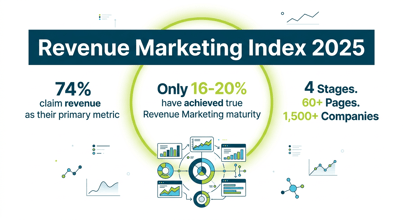
Benchmark: Stage 4 revenue marketing organizations source 40 to 60% of total pipeline from marketing. Most mid-market B2B companies are running at 15 to 30%. The gap between where you are and where the benchmark sits is the business case for your next budget conversation.
2. Marketing-Influenced Pipeline
What it is: The total value of pipeline where marketing touched the account or contact at any point during the buying cycle, not just at first touch.
How to calculate it: Pull all open and closed-won opportunities. For each opportunity, identify whether any contact on the account had a marketing touchpoint: email open, content download, event attendance, paid ad click, webinar registration. If yes, the opportunity is marketing-influenced. Sum the value.
Why it matters for scaling: Sourced pipeline undercounts marketing's contribution in long buying cycles. A Fortune 1000 deal that takes 14 months to close will often have a first touch from a sales rep or a referral. But marketing touched the buying committee 40 times during the evaluation. Influenced pipeline captures that contribution. If influenced pipeline is high and sourced pipeline is low, marketing is accelerating deals it did not originate. That is still pipeline value worth documenting.
Scaling decision it drives: Budget allocation between demand creation programs (sourced) and nurture and engagement programs (influenced). Both require investment. This metric tells you which is underperforming.
3. Cost Per Opportunity (CPO)
What it is: The total marketing spend required to generate one sales-qualified opportunity.
How to calculate it: Take total marketing program spend for a defined period. Divide by the number of net new sales-qualified opportunities created in that same period. Do this by channel and by program, not just in aggregate.
Why it matters for scaling: CPO is the scaling efficiency metric. If your CPO from paid LinkedIn is $4,200 and your CPO from organic content is $800, you have a scaling decision in front of you. Agencies and channel vendors will always argue for more spend in their channel. CPO gives you the data to push back or confirm.
Common mistake: MOps teams calculate CPO on MQLs, not opportunities. An MQL that never becomes an opportunity has a CPO of infinity. Calculate CPO on SQLs only. If your CRM does not have a reliable SQL stage, fix that before optimizing CPO.
4. Lead Velocity Rate (LVR)
What it is: The month-over-month percentage growth in qualified leads or qualified accounts entering the pipeline.
How to calculate it: Take the number of qualified leads or accounts this month. Subtract last month's number. Divide by last month's number. Multiply by 100. That is your LVR percentage.
Why it matters for scaling: Revenue lags pipeline. Pipeline lags qualified demand. Lead velocity rate is a leading indicator that tells you whether pipeline will grow or contract before it shows up in the revenue number. A negative LVR in March means a pipeline gap in June. MOps teams that track LVR can surface that signal early enough to adjust programs. Teams that track only closed revenue are always looking backward.
Scaling decision it drives: Program investment timing. If LVR has been negative for two consecutive months, that is not the moment to cut demand generation budget. That is the moment to diagnose which programs are losing efficiency and shift investment before the pipeline gap becomes a revenue gap.
5. MQL-to-SQL Conversion Rate
What it is: The percentage of marketing-qualified leads that sales accepts as sales-qualified.
How to calculate it: Take the number of MQLs passed to sales in a defined period. Divide by the number of those MQLs that sales accepted and converted to SQLs. Multiply by 100.
Why it matters for scaling: A low MQL-to-SQL conversion rate is not always a lead quality problem. It is often a definition problem, a process problem, or an alignment problem. If sales is rejecting 70% of what marketing sends, either the MQL criteria are wrong, the SLA is broken, or sales and marketing are not operating from the same ICP. MOps owns the infrastructure that enforces this handoff. Tracking conversion rate here surfaces the failure point before it becomes a sourcing argument between the CMO and the CRO.
Benchmark: In high-performing B2B revenue organizations, MQL-to-SQL conversion runs between 13 and 25%. Below 10% signals a definition or alignment problem. Above 30% often signals that the MQL bar is too high and marketing is withholding qualified demand.
6. Pipeline Velocity
What it is: How fast opportunities move through the pipeline, expressed as revenue per day.
How to calculate it: Multiply the number of opportunities by the average deal value by the win rate. Divide by the average sales cycle length in days. The result is the dollar value of pipeline moving toward revenue on any given day.
Why it matters for scaling: Pipeline velocity is the metric that connects marketing operations work to revenue timing. MOps programs that improve lead quality, nurture sequences, and content at the evaluation stage all affect velocity. If velocity slows, the cause is usually one of four variables: fewer opportunities, smaller deal sizes, lower win rates, or longer cycles. Each one points to a different MOps intervention.
Scaling decision it drives: Nurture program investment. If average sales cycle length is increasing, it often means evaluation-stage content is thin and buyers are stalling. That is a content and nurture program investment decision, not a sourcing problem.
7. Marketing's Contribution to Revenue by Segment
What it is: Marketing-sourced and influenced closed-won revenue broken out by ICP segment: company size, industry, geography, or product line.
How to calculate it: Pull all closed-won opportunities for a defined period. Tag each one by segment. Filter for opportunities with a marketing first touch or a marketing touchpoint during the buying cycle. Sum closed-won revenue by segment. Calculate as a percentage of total closed-won revenue in each segment.
Why it matters for scaling: Aggregate attribution numbers hide segment-level failures. A 35% marketing-sourced pipeline number looks healthy until you break it by segment and find that 90% of it is coming from one vertical while three others show near-zero marketing contribution. Enterprise MOps teams that do not track attribution by segment are optimizing programs for the wrong buyers.
Scaling decision it drives: Segment-specific program investment. If marketing contribution is strong in mid-market technology but weak in enterprise financial services, that gap should drive both a content investment decision and a channel decision. You cannot scale evenly across segments if performance is uneven.
8. Campaign Execution Speed vs. Pipeline Contribution
What it is: A paired metric that tracks how long it takes to launch a campaign and what pipeline that campaign generates.
How to calculate it: For each campaign type, track two numbers. First, the average days from brief approval to campaign launch. Second, the pipeline sourced or influenced per dollar of program spend within 90 days of launch. Plot them together.
Why it matters for scaling: Campaign execution speed is a common MOps metric that gets tracked in isolation. It is meaningless without the pipeline contribution side. A campaign that launches in 3 days and generates no pipeline is a fast failure. A campaign that takes 14 days and generates $400,000 in influenced pipeline justified the build time. Pairing these metrics gives MOps leadership a way to defend build investment and identify where speed gains would actually produce revenue impact.
Enterprise-specific note: At Fortune 1000 scale, campaign execution bottlenecks are usually in legal and compliance review, not in MOps build time. Track where the time goes before optimizing the wrong stage.
9. Technology Stack ROI
What it is: The pipeline contribution per dollar invested in marketing technology, tracked by platform.
How to calculate it: For each major platform in the stack (MAP, ABM platform, intent data, analytics), identify the total annual cost including license, implementation, and internal management time. Then identify the pipeline that platform directly enabled: opportunities created from campaigns run in the MAP, accounts activated through the ABM platform, intent signals that triggered outreach leading to opportunities. Divide pipeline contribution by platform cost.
Why it matters for scaling: Marketing technology budgets compound. Every year, platforms accumulate. Most enterprise MOps teams have platforms they pay for but cannot clearly connect to pipeline. Technology stack ROI forces that connection. It is also the metric that justifies new platform investment: you cannot make the case for a $200,000 intent data investment without showing what the current stack is producing relative to its cost.
Common gap: Most MOps teams can tell you what the stack costs. Very few can tell you what each platform contributes to pipeline. Building this metric requires tagging opportunity sources back to the platform that enabled them. It is worth the build time.
10. Marketing Operations Capacity vs. Revenue Output
What it is: The revenue output per full-time equivalent in the MOps function, tracked over time.
How to calculate it: Take total marketing-sourced and influenced closed-won revenue for a period. Divide by the number of full-time equivalents in the MOps function, including contractors and agencies in the calculation. Track this ratio quarter over quarter.
Why it matters for scaling: This is the metric that makes the case for MOps headcount investment and for automation investment. If revenue output per FTE is flat or declining as the business grows, it means the function is not scaling efficiently. If it is increasing, the current team is absorbing more work at higher output. Both signals drive different decisions: one toward headcount or tooling investment, the other toward determining where the ceiling is before quality breaks.
Scaling decision it drives: This is the metric that directly answers the question enterprise MOps leaders face most often: "Can we scale demand generation programs without adding headcount?" If output per FTE has been growing for three consecutive quarters, the answer is yes, but you are approaching the ceiling. If it has been flat, the answer is that current capacity is already at scale and additional program volume will degrade quality or execution speed.
Frequently Asked Questions
What is the most important revenue attribution metric for marketing operations? Marketing-sourced pipeline is the foundation. It is the metric that connects MOps work to the revenue number your CFO cares about. Every other metric in this list either explains why sourced pipeline is what it is or points to where it will go next quarter. Build this one first. Add the others as the data infrastructure matures.
How do you build a reliable attribution model without perfect CRM data? Start with what you have, document the limitations, and be transparent about them. A 70% complete attribution model with documented gaps is more credible than a 100% complete model that excludes half the touchpoints. The goal in the first 90 days is consistency: consistent UTM tagging, consistent stage definitions, consistent contact-to-account association. Once those are reliable, attribution accuracy improves without changing the model.
What is a realistic timeline to build revenue attribution from scratch? 90 days to a working first-touch model. 6 months to a reliable multi-touch model. 12 months to a model that holds up in a CFO conversation. The bottleneck is almost always data quality and sales adoption, not technology. You can configure a multi-touch attribution model in HubSpot or Salesforce in two weeks. Getting sales to log activity consistently enough to make it accurate takes much longer.
How does marketing operations prove impact when sales cycles are 12 or more months? Use leading indicators: lead velocity rate, account engagement score, MQL-to-SQL conversion, and pipeline velocity. These metrics move in the current quarter and predict closed revenue 6 to 12 months out. MOps teams that report only on closed revenue will always be defending results that are a year old. Teams that report on leading indicators can have a forward-looking revenue conversation.
What is the difference between marketing-sourced and marketing-influenced pipeline? Sourced means marketing was the first touch that created the opportunity. Influenced means marketing touched the account or buying committee at any point during the buying cycle. Both matter. Sourced pipeline proves demand creation. Influenced pipeline proves nurture and engagement value. Enterprise ABM programs will always have lower sourced and higher influenced numbers because the first touch on a named account is often a sales development rep, not a marketing channel.
How should creative services in marketing operations be measured? Creative services should be measured by the campaign performance it enables, not by output volume. The right metrics are campaign launch rate by creative type, A/B test win rate on creative variables, and the pipeline contribution of campaigns where creative was a tested variable. Volume metrics like "assets produced per month" measure activity. Pipeline contribution metrics measure impact. Build the connection between creative output and campaign performance data in your MAP and you will have a defensible creative ROI story.
The Pedowitz Group has helped more than 1,500 B2B organizations build the marketing operations infrastructure that makes attribution possible and pipeline accountability real. If you want to know where your current MOps function stands against a revenue marketing standard, the RM6 diagnostic is the right starting point. Talk to TPG.